Nikhil Prasad Fact checked by:Thailand Medical News Team Sep 23, 2026 31 minutes ago
Epstein-Barr virus (EBV), best known for causing infectious mononucleosis, may have a much broader role in human disease. A new scientific review details evidence connecting the widespread virus with multiple sclerosis (MS), autoimmune disorders, dangerous inflammatory conditions, lymphoproliferative diseases, and several cancers.
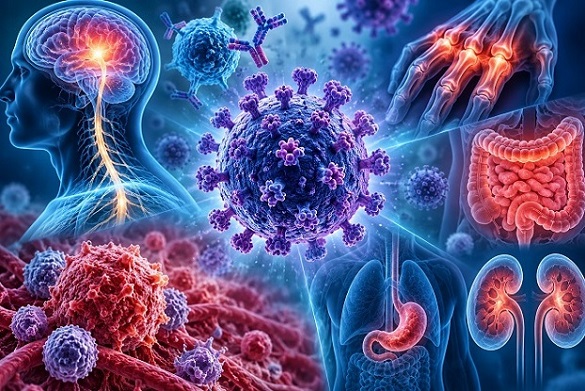 A major review links Epstein-Barr virus with MS, autoimmune disorders, cancers, severe inflammatory disease,
and other long-term health conditions.
Researchers are from the Faculty of Medicine, UCLouvain; and the Department of Internal Medicine and Infectious Diseases, Cliniques Universitaires Saint-Luc, UCLouvain.
Why EBV Can Have Lifelong Effects
Around 95% of people worldwide have antibodies indicating previous EBV infection. After initial infection, the virus can establish lifelong latency inside memory B cells, periodically reactivating and using different viral proteins to manipulate cell survival and evade immune surveillance.
This
Thailand Medical News report highlights particularly compelling evidence surrounding MS. A longitudinal investigation involving more than 10 million U.S. military personnel found a 32-fold increase in MS risk following EBV infection. Researchers believe molecular mimicry could help explain the connection: antibodies against the viral protein EBNA1 can cross-react with GlialCAM, a protein found in the central nervous system.
Autoimmune Diseases Also Linked to EBV
EBV has additionally been associated with rheumatoid arthritis, systemic lupus erythematosus, inflammatory bowel disease, IgA nephropathy, type 1 diabetes, juvenile idiopathic arthritis, and celiac disease.
Proposed mechanisms include molecular mimicry, bystander immune-cell activation, epitope spreading, and EBNA2-related changes in the activity of genes associated with immune susceptibility. However, evidence for these conditions is less conclusive than for MS.
Cancer and Life-Threatening Inflammation
EBV can contribute to lymphoproliferative disorders when immune surveillance becomes impaired, particularly during immunosuppression. The virus is also strongly associated with nasopharyngeal carcinoma and a distinct subtype of gastric cancer. Approximately 119,750 nasopharyngeal carcinoma cases occur globally each year, while EBV-associated disease accounts for an estimated 7%–10% of gastric adenocarcinomas.
Another serious complication is EBV-associated hemophagocytic lymphohistiocytosis (HLH), a potentially fatal hyperinflammatory syndrome involving uncontrolled T-cell and natural killer-cell activity.
The review also examines chronic active EBV disease, a rare but potentially fatal disorder affecting T or natural killer cells, and emerging evidence linking EBV reactivation with long COVID. The researchers stress that the long COVID connection remains preliminary and causality has not been established.
New Treatments and Vaccines Could Change the Picture
Researchers are
exploring EBNA1 as a therapeutic target, while EBV vaccines are under clinical development. However, no vaccine candidate has yet demonstrated protective efficacy.
Conclusions
The evidence increasingly portrays EBV as more than the cause of mononucleosis. Its strongest disease connections include MS and established EBV-associated malignancies, while evidence for several autoimmune conditions and long COVID remains less definitive. Better understanding how this lifelong virus alters immune and cellular functions could ultimately support vaccines and targeted therapies capable of preventing or reducing multiple EBV-associated diseases.
The study findings were published in the peer reviewed journal: Viruses.
https://www.mdpi.com/1999-4915/18/9/1048
Read Also:
https://www.thailandmedical.news/articles/long-covid




 Share
Share
 Tweet
Tweet
 Share
Share