Nikhil Prasad Fact checked by:Thailand Medical News Team Apr 29, 2026 5 months, 4 days, 21 hours, 9 minutes ago
Medical News: A natural compound found in black seed (Nigella sativa) oil is drawing attention after new research revealed its remarkable ability to protect brain cells following a severe type of stroke known as intracerebral hemorrhage. The phytochemical compound, called thymoquinone, appears to significantly reduce brain damage while helping nerve cells survive and recover.
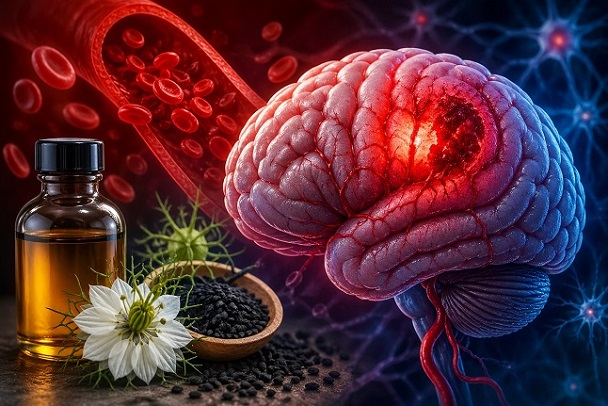 Natural compound thymoquinone helps protect brain cells and reduce damage after hemorrhagic stroke
A Dangerous Type of Stroke
Natural compound thymoquinone helps protect brain cells and reduce damage after hemorrhagic stroke
A Dangerous Type of Stroke
Intracerebral hemorrhage occurs when a blood vessel bursts inside the brain, causing bleeding that damages surrounding tissue. Unlike more common strokes caused by blocked blood flow, this type leads to rapid and often severe brain injury. Much of the damage does not happen immediately but develops over time due to oxidative stress, inflammation, and progressive loss of brain cells.
What Researchers Investigated
Scientists from Universitas Airlangga, Universitas Airlangga Hospital, Universitas Ciputra, and the Faculty of Pharmacy at Universitas Airlangga in Indonesia conducted a controlled laboratory study using rats to better understand how thymoquinone affects brain injury after hemorrhage.
The researchers divided the animals into three groups: one untreated and two treated with different doses of thymoquinone. The compound was given shortly after the brain bleed occurred to target early-stage damage.
Major Improvements Seen
The results were striking. Rats treated with thymoquinone showed a clear reduction in markers of brain damage. One key indicator, membrane blebbing, which signals injury to brain cell structures, dropped significantly in treated groups. At the same time, levels of malondialdehyde, a harmful byproduct of oxidative stress, were sharply reduced.
Equally important, the brain’s natural defense systems became stronger. The treated animals showed higher levels of protective enzymes like superoxide dismutase and increased activity of NRF2, a critical protein that helps switch on antioxidant defenses. These changes suggest that the compound does not just reduce damage but actively boosts the brain’s ability to defend itself.
Stronger Protection at Higher Dose
The study found that higher doses of thymoquinone produced the most powerful effects. Rats receiving the larger dose had better-preserved brain tissue, healthier neuron structures, and significantly more surviving brain cells compared to untreated animals. This dose-dependent response highlights the compound’s potential strength as a therapeutic agent.
What This Means for Brain Recovery
This
Medical News report highlights that one of the most promising findings was the increase in surviving neurons around the damaged area. This suggests that thymoquinone may not only prevent further injury but also support recovery processes in the brain.
Microscopic analysis confirmed these findings. Untreated brains showed shrunken, damaged neurons and disorganized tissue, while treated brains displayed more intact cells with clearer structures and improved organization.
Why This Matters
The ability to both reduce oxidative stress and enhance natural antioxidant systems is crucial in treating brain injuries. After a hemorrhage, toxic molecules rapidly accumulate and damage cells. By neutralizing these molecules and strengthening cellular defenses, thymoquinone appears to interrupt the cycle of damage.
Limitations and Next Steps
Despite the encouraging findings, the study was conducted in animals and over a short period. Long-term effects, optimal dosing, and real-world applications in humans still need to be explored. Researchers also note that functional recovery, such as improvements in movement or cognition, was not assessed in this study.
Conclusion
This research provides strong evidence that thymoquinone could become a promising natural therapy for reducing brain damage after hemorrhagic stroke. Its ability to lower harmful oxidative stress, activate protective pathways, and preserve brain cells positions it as a potential breakthrough in stroke treatment. However, further studies in humans are essential before it can be considered for clinical use. The findings highlight an exciting direction for future therapies that combine natural compounds with modern medical approaches to improve outcomes in one of the most devastating forms of stroke.
The study findings were published in the peer reviewed journal: Biomedicines.
https://www.mdpi.com/2227-9059/14/5/1009
For the latest on herbs and phytochemicals, keep on logging to Thailand
Medical News.
Read Also:
https://www.thailandmedical.news/articles/herbs-and-phytochemicals




 Share
Share
 Tweet
Tweet
 Share
Share

































