Nikhil Prasad Fact checked by:Thailand Medical News Team Jan 11, 2026 8 months, 3 weeks, 3 days, 6 hours, 54 minutes ago
Medical News: A New Look at Why Long COVID Persists
A growing group of researchers from McMillan Research Ltd-UK, the University of Leeds-UK, and Michigan State University-USA has assembled a highly readable overview of why so many people continue to suffer months or even years after a SARS-CoV-2 infection. Instead of viewing Long COVID as random or mysterious, the team argues that the answers lie within the very cells that are meant to defend the body. Their work suggests that over time, immune cells known as macrophages may slowly shift from protectors into the main engine of extended symptoms. This
Medical News report shows how this shift may explain why fatigue, pain, cognitive issues, heart rate changes, breathing difficulty, and digestive problems continue even after the virus is no longer active.
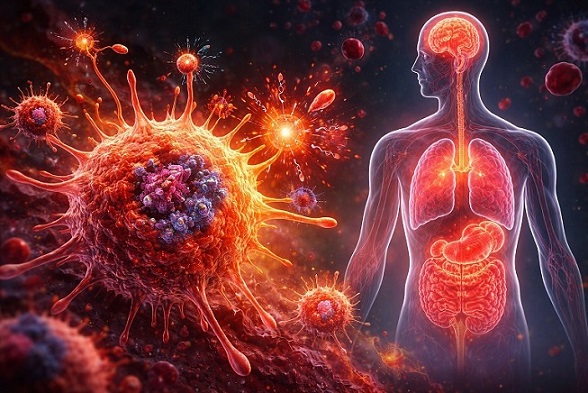 Macrophage Chaos Drives Lingering Long COVID Symptoms
How Macrophages Become Stuck in Overdrive
Macrophage Chaos Drives Lingering Long COVID Symptoms
How Macrophages Become Stuck in Overdrive
Macrophages normally clear invaders, chew up debris and signal the body to repair injured tissues. However, the new paper explains that the spike protein from SARS-CoV-2 can linger inside specific monocyte derived macrophages long after a person tests negative. That lingering material can “train” macrophages to stay switched on. Scientists call this epigenetic reprogramming, meaning the cell becomes locked into an inflammatory rhythm that does not turn off. Once trapped, macrophages continue releasing potent inflammatory signals such as IL-6, IL-1β and TNF-α that set off chain reactions throughout the body. Adding fuel to the fire, mucosal immune cells called MAIT cells can detect inflammation and send even more activating signals, particularly from the gut.
Why Symptoms Appear All Over the Body
The review makes clear that the widespread symptoms seen in Long COVID relate to where these activated macrophages travel. Once primed, they move into tissues that naturally harbour immune cells. In the brainstem, their activity can interfere with autonomic control, disrupting heart rate, breathing stability, stress responses and sleep architecture. In the gut, they can disturb digestion, irritate intestinal nerves, affect nutrient processing and contribute to bloating, diarrhoea or constipation. Within blood vessels, macrophages may promote microclot formation, damage delicate endothelial layers and reduce oxygen delivery through tissues, explaining chest tightness, breathlessness and exercise intolerance. At mucosal regions that communicate with the vagus nerve, they may trigger dizziness, palpitations and temperature swings. The authors note that several other immune partners—including mast cells, CD8 T cells and regulatory T cells—may amplify dysfunction once macrophages go off course.
What the Findings Suggest
In conclusion, the authors argue that Long COVID is best understood as a persistent immune disorder, driven by macrophages stuck in a long running inflammatory state. They describe a feedback loop in which spike protein remnants, mucosal immune activity and epigenetic imprinting reinforce one another, even when no active virus is prese
nt. According to the article, the most promising treatment strategies ahead will focus not only on hunting the virus but calming immune circuits, clearing immune debris, repairing the gut barrier and restoring natural immune resolution. With this framework, Long COVID moves from a confused puzzle to a clearer target—a disorder centered on the body’s own immune machinery, misdirected but potentially correctable with the right tools and deeper study.
The study findings were published in the peer reviewed International Journal of Molecular Sciences.
https://www.thailandmedical.news/
For the latest on Long COVID, keep on logging to Thailand
Medical News.
Read Also:
https://www.thailandmedical.news/articles/long-covid
https://www.thailandmedical.news/articles/coronavirus




 Share
Share
 Tweet
Tweet
 Share
Share

































