Nikhil Prasad Fact checked by:Thailand Medical News Team Apr 30, 2026 5 months, 3 days, 23 hours, 31 minutes ago
Medical News: A new scientific model explains why even mild activity can trigger prolonged fatigue and cognitive symptoms
A new scientific review is shedding light on one of the most puzzling symptoms seen in Long COVID and chronic fatigue syndrome—why even light activity can leave some individuals feeling severely unwell for days. Researchers have now identified a complex biological chain reaction linking energy production, immune activation, and brain function, offering a clearer explanation for post-exertional malaise (PEM).
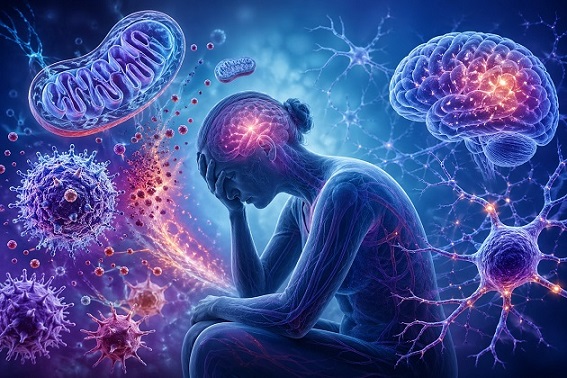 New research explains how disrupted energy production, immune activation, and brain inflammation drive
prolonged fatigue after exertion
What Is Post Exertional Malaise
Post-exertional malaise is far more than simple tiredness. It is a delayed worsening of symptoms such as fatigue, brain fog, muscle weakness, and pain after even minor physical or mental exertion. In many cases, symptoms do not appear immediately but develop hours or even days later, making it particularly difficult to manage.
The study highlights that PEM is highly prevalent among individuals with Long COVID. A large-scale analysis referenced in the research found that approximately 36.9 percent of affected individuals experience this condition within a year of infection.
The Cellular Energy Breakdown
At the center of PEM lies a dysfunction in mitochondria, the structures within cells responsible for generating energy in the form of ATP. Under normal circumstances, physical activity strengthens these cellular powerhouses. However, in individuals with PEM, this adaptive response fails.
Instead of improving efficiency, exertion leads to mitochondrial stress, reduced energy production, and increased generation of harmful molecules known as reactive oxygen species. This imbalance results in an energy deficit, leaving cells unable to meet even basic functional demands.
Immune System Amplification
The research further explains that mitochondrial damage releases molecular signals that activate the immune system. This triggers the release of inflammatory substances such as IL-1β, IL-6, and TNF-α.
In individuals with PEM, the immune system may already be sensitized due to prior infection or persistent viral remnants. Physical or mental exertion then acts as a second trigger, amplifying the inflammatory response beyond normal levels.
This
Medical News report underscores that this “two-hit” mechanism—initial biological vulnerability followed by exertion—may explain the sudden and disproportionate worsening of symptoms experienced by patients.
Neurological Impact and Brain Dysfunction
The study also reveals that inflammation originating in the body can extend to the brain through both circulatory and neural pathways. Once in the central nervous system, this inflammation activates im
mune cells within the brain and disrupts normal neuronal function.
This process affects key brain regions involved in cognition and perception, contributing to symptoms such as impaired memory, reduced concentration, and mental fatigue. The research also points to a phenomenon known as interoceptive dysregulation, where the brain misinterprets internal bodily signals, amplifying sensations of exhaustion and discomfort.
A Self-Perpetuating Biological Cycle
One of the most significant findings is the identification of a self-sustaining cycle. Mitochondrial dysfunction leads to inflammation, inflammation further damages energy production, and both processes impair brain function. This interconnected loop prevents normal recovery and contributes to the prolonged nature of symptoms.
Unlike healthy individuals, where the body restores balance after exertion, individuals with PEM experience a breakdown in these recovery mechanisms, allowing symptoms to persist or intensify.
Clinical Significance
These findings emphasize that PEM is not caused by a single dysfunction but by a multi-system failure involving metabolic, immune, and neurological processes. This integrated understanding provides a more comprehensive explanation for the severity and persistence of symptoms.
Conclusion
The study offers a significant advancement in understanding post-exertional malaise by framing it as a multi-system disorder driven by interconnected dysfunction in energy metabolism, immune regulation, and brain activity. The evidence shows that mitochondrial impairment initiates a cascade of inflammation and neurological disruption, which then reinforces itself through a continuous feedback loop. This not only explains the delayed onset and prolonged recovery seen in patients but also highlights the need for treatment strategies that address all three systems simultaneously. By targeting these interconnected pathways, future therapies may be better equipped to interrupt the cycle and provide meaningful relief for individuals suffering from Long COVID and related chronic conditions.
The study findings were published in the peer reviewed journal: Frontiers in Immunology.
https://www.frontiersin.org/journals/immunology/articles/10.3389/fimmu.2026.1774310/full
For the latest on Long COVID, keep on logging to Thailand
Medical News.
Read Also:
https://www.thailandmedical.news/articles/long-covid




 Share
Share
 Tweet
Tweet
 Share
Share

































