Nikhil Prasad Fact checked by:Thailand Medical News Team Jun 04, 2026 1 month, 2 weeks, 5 days, 15 hours, 33 minutes ago
Medical News: Lyme disease is widely known as a tick-borne infection that can cause fever, fatigue, skin rashes, and joint pain. However, a new scientific review is warning that the disease can also silently attack the heart, sometimes causing life-threatening complications that may be mistaken for other cardiac conditions.
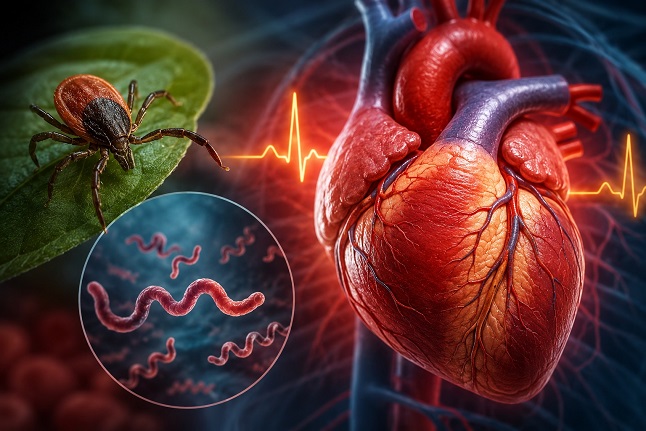 New review reveals that Lyme disease can silently attack the heart, causing dangerous rhythm disorders, inflammation,
and potentially life-threatening complications
Researchers from the Division of Infectious Diseases and Epidemiology at Dr. Manuel Gea Gonzalez General Hospital in Mexico City, the Division of Basic Research at the National Cancer Institute in Mexico City, and the Emergency Division of Dr. Manuel Gea Gonzalez General Hospital conducted an extensive review of published medical literature examining cardiovascular complications linked to Lyme disease.
Lyme Disease Can Affect More Than Just Joints and Skin
Lyme disease is caused by the bacterium Borrelia burgdorferi, which is transmitted through the bite of infected ticks. While many people associate Lyme disease with the characteristic bullseye rash known as erythema migrans, the infection can spread throughout the body if left untreated.
The review found that although heart involvement occurs in only about 1.5 to 10 percent of untreated patients, the consequences can be severe. In some cases, patients experienced sudden fainting spells, dangerously slow heart rates, cardiac arrest, or complete disruption of the heart's electrical system.
Heart Block Emerges as the Most Common Threat
The researchers analyzed 30 studies published between 2000 and 2025. The most frequently reported cardiovascular complication was atrioventricular (AV) block, a condition in which electrical signals traveling through the heart become delayed or completely interrupted.
These electrical disturbances ranged from mild first-degree AV block to complete heart block, where communication between the upper and lower chambers of the heart stops altogether. Many patients developed symptoms suddenly, including dizziness, fainting, chest discomfort, severe fatigue, and shortness of breath.
In several documented cases, temporary pacemakers had to be implanted to keep patients alive until antibiotic treatment eliminated the infection. Fortunately, permanent pacemakers were rarely required because the heart's electrical system often recovered once the underlying infection was treated.
Lyme Disease Can Trigger Multiple Heart Disorders
Beyond heart block, the review uncovered a surprisingly broad range of cardiac complications.
Patients developed dangerous heart rhythm abnormalities, including atrial fibrillation, ventricular tachycardia, and ventricular fibrillation. Some suffered myocarditis, an inflammation of the heart muscle that can weaken the heart's pumping ability and mimic a heart attack.
Others experienced pericarditis, an inflammation of the protective sac surrounding the heart. Symptoms often included chest pain and electrocardiogram changes that closely resembl
ed those seen during a heart attack, making diagnosis particularly challenging.
This
Medical News report highlights that Lyme disease can affect every layer of the heart, including the endocardium, myocardium, and pericardium, creating a wide spectrum of complications that may easily be overlooked by clinicians unfamiliar with the infection.
Rare Cases Show Damage to Heart Valves and Major Blood Vessels
Among the most unusual findings were cases involving heart valve damage and inflammation of major blood vessels.
Researchers documented instances of Lyme-associated endocarditis, where heart valves became severely damaged and required surgical repair or replacement. In some patients, advanced molecular testing detected Borrelia burgdorferi DNA directly within removed valve tissue.
The review also identified reports of aortitis, a dangerous inflammation of the aorta, the body's largest artery. If left untreated, aortitis can weaken the vessel wall and potentially lead to aneurysms, dissections, or fatal rupture.
Additionally, rare cases of Lyme-related vasculitis were reported. This condition causes inflammation of blood vessels and can lead to strokes even in individuals with no traditional cardiovascular risk factors.
Early Diagnosis Makes a Critical Difference
One of the most encouraging findings was that most patients recovered fully when diagnosed and treated promptly.
Doctors typically relied on a combination of patient history, possible tick exposure, blood tests, electrocardiograms, cardiac imaging, and continuous heart monitoring. The Suspicious Index in Lyme Carditis (SILC) scoring system has also emerged as a useful tool to help identify patients at risk.
Treatment most commonly involved intravenous ceftriaxone followed by oral doxycycline. In severe cases involving heart block or unstable heart rhythms, temporary pacing and intensive monitoring were necessary.
Across the majority of reported cases, symptoms resolved and heart function returned to normal after appropriate treatment.
Conclusions
The review demonstrates that Lyme disease is far more than a simple tick-borne illness causing rash and joint pain. Although cardiac complications remain relatively uncommon, they can be sudden, severe, and potentially fatal if missed. The findings show that heart block remains the hallmark cardiac manifestation, but Lyme disease can also cause myocarditis, pericarditis, dangerous arrhythmias, valve damage, inflammation of major blood vessels, and even stroke-related complications. Importantly, most of these conditions appear to be reversible when recognized early and treated aggressively with appropriate antibiotics. The researchers stress that greater awareness among healthcare professionals is essential so that Lyme disease is considered in patients presenting with unexplained cardiac symptoms, particularly in areas where tick exposure is common. Earlier recognition could prevent unnecessary procedures, reduce complications, and significantly improve patient outcomes.
The study findings were published in the peer reviewed journal: Infectious Disease Reports.
https://www.mdpi.com/2036-7449/18/3/40
For the latest on Lyme Disease, keep on logging to Thailand
Medical News.
Read Also:
https://www.thailandmedical.news/news/lyme-bacteria-found-to-use-multiple-tricks-to-outsmart-human-immunity
https://www.thailandmedical.news/news/lyme-disease-canadian-medical-association-warns-of-new-clinical-symptoms
https://www.thailandmedical.news/news/lyme-disease-researchers-from-university-of-massachusetts-developing--annual--antibody-dose-that-could-help-prevent-infection
https://www.thailandmedical.news/news/polish-study-shows-that-individuals-with-a-history-of-lyme-disease-have-a-higher-risk-of-disease-severity-upon-infection-with-sars-cov-2




 Share
Share
 Tweet
Tweet
 Share
Share