Nikhil Prasad Fact checked by:Thailand Medical News Team Jan 08, 2026 8 months, 3 weeks, 5 days, 16 hours, 37 minutes ago
Medical News: COVID-19 infection may have set off a shocking chain reaction
A remarkable case from Brazil has raised medical eyebrows after doctors documented what appears to be the evolution of prostate cancer following repeated bouts of COVID-19-related prostatitis in a previously healthy 55-year-old man.
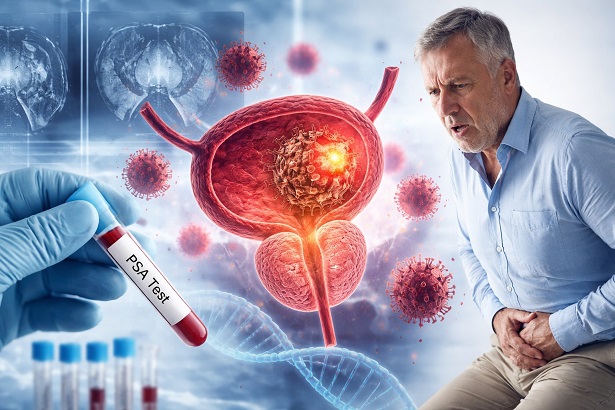 Doctors document a rare case where COVID—19 driven prostate inflammation appears to evolve into prostate
cancer over two years
Researchers from the Urology Service of Pedro Ernesto University Hospital (HUPE) and the Department of Surgical Specialties at the State University of Rio de Janeiro (UERJ) reported the first known case linking SARS-CoV-2 inflammation in the prostate with the later emergence of prostate cancer.
This
Medical News report highlights the possibility that COVID-19 may do far more than cause temporary symptoms for some men.
How the mystery began
The patient had no family history of prostate cancer and screening DNA tests uncovered no inherited cancer-linked mutations. His prostate specific antigen or PSA level was safely low in 2021.
The story changed dramatically in 2022 when he caught COVID-19 for a second time. During the illness he developed prostatitis – painful inflammation of the prostate – with burning, weak urine flow and sudden jumps in PSA levels.
MRI scans taken that year and shown in page-one images of the report displayed cloudy changes across the prostate marked PI-RADS 4, meaning suspicious but not yet clearly cancer. Symptoms eased with antibiotics, though lingering urinary problems required medication.
A worrying evolution captured on scans
By early 2024 the disease pattern transformed. A follow-up MRI (shown in page-three images) revealed a long PI-RADS 5 lesion, the highest danger category, stretching from the apex to the base of the prostate. A smaller abnormal area had also appeared on the left side, suggesting multifocal disease.
Biopsy confirmed the frightening shift: acinar adenocarcinoma, a common but serious prostate cancer, with Gleason scores of 6 and 7 in 16 of 26 samples. PET-PSMA scans showed it was still limited to the prostate, improving treatment odds.
Major genetic clues found in the tumor
Laboratory tests from the removed prostate revealed:
-TMPRSS2::ERG gene fusion, a hallmark cancer-driving mutation
-PTEN loss, a known accelerator of tumor spread
-Chronic inflammatory cells sitting beside the cancer in tissue slides
The presence of inflammation suggested COVID-19-triggered prostatitis may have set the biological stage.
Androgen deprivation followed by a modern hormonal drug shrank the tumor before surgery. Post-operation results showed only a tiny cancer remnant with clear surgical margins.
Why the findings matter
trong>
Prostate cancer has long been linked to chronic inflammation, but this is the first time experts have captured a three-year timeline showing COVID-19 leading to prostatitis, lingering irritation and eventual cancer in a genetically non-predisposed patient.
Although the scientists caution that coincidence cannot be ruled out, the clear progression seen through PSA tests, MRI scans, biopsies, PET imaging and surgery suggests a biological connection that must be studied further.
The researchers conclude that COVID-19 may in select cases trigger prostate cell changes that later evolve into cancer, particularly when the TMPRSS2 gene – which the coronavirus uses to enter cells – is involved. Their message is clear: men with persistent urinary symptoms after COVID-19 should see a doctor and request prostate screening.
The study findings were published in the peer reviewed journal: Frontiers in Oncology.
https://www.frontiersin.org/journals/oncology/articles/10.3389/fonc.2025.1679663/full
For the latest COVID-19 News, keep on logging to Thailand Medical News.
https://www.thailandmedical.news/articles/coronavirus
https://www.thailandmedical.news/articles/long-covid




 Share
Share
 Tweet
Tweet
 Share
Share

































