Nikhil Prasad Fact checked by:Thailand Medical News Team Jun 09, 2026 3 months, 3 weeks, 4 days, 6 hours, 34 minutes ago
Medical News: Scientists Discover How Glial Cell Vesicles Can Both Harm and Heal the Brain
Neurodegenerative diseases such as Alzheimer’s disease, Parkinson’s disease, and amyotrophic lateral sclerosis (ALS) continue to challenge researchers worldwide. A new review has shed light on an unexpected player in these devastating conditions—tiny biological particles known as extracellular vesicles (EVs). These microscopic sacs, released by support cells in the brain called glial cells, appear to have a surprising double role. Depending on their contents, they can either worsen disease by spreading harmful proteins or help protect and repair damaged brain cells.
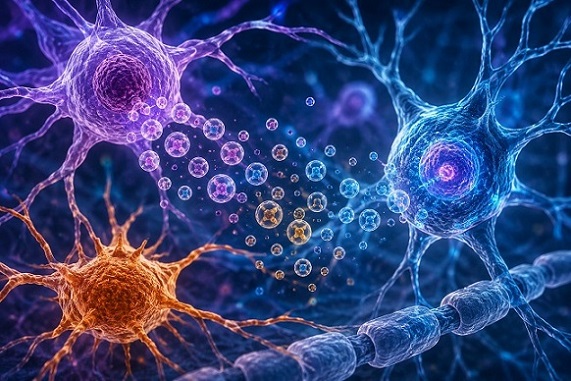 Tiny extracellular vesicles released by brain support cells may either spread neurodegenerative
disease or help protect and repair damaged neurons
The study was conducted by researchers from the Department of Pathology and Experimental Therapeutics, Bellvitge University Hospital IDIBELL in Barcelona, Spain; the Institute of Biomedicine of the University of Barcelona (IBUB), Spain; and RISE-Health, Faculty of Health Sciences, University of Beira Interior, Covilhã, Portugal.
Tiny Packages with Powerful Effects
Extracellular vesicles are extremely small membrane-covered particles released by almost every cell in the body. They act as biological delivery vehicles, carrying proteins, genetic material, fats, and other molecules from one cell to another. In the brain, glial cells—including astrocytes, microglia, and oligodendrocytes—use these vesicles to communicate with neurons and help maintain healthy brain function.
For years, scientists believed these vesicles were little more than cellular waste containers. However, growing evidence now shows that they are critical messengers capable of influencing how cells behave, survive, and respond to injury.
The new review highlights how these vesicles can either support healthy brain activity or contribute to the progression of neurological disease, depending on the molecular cargo they carry.
When Brain Messengers Turn Dangerous
One of the most important findings is that EVs can help spread disease-related proteins throughout the brain. In Alzheimer's disease, vesicles released by activated glial cells can transport toxic forms of amyloid-beta and tau proteins. These proteins are known to form plaques and tangles that damage brain cells and contribute to memory loss.
Similarly, in Parkinson’s disease, glial-cell-derived vesicles can carry alpha-synuclein, the protein responsible for forming Lewy bodies in affected brains. Researchers found that these vesicles may transfer harmful proteins from one cell to another, helping disease spread through neural networks.
In ALS, vesicles released by diseased astrocytes have been shown to carry abnormal microRNAs and inflammatory molecules that directly damage motor neurons. Some studies reported that these altered vesicles significantly reduced neuron survival and disrupted nerve cell connections.
The review suggests that when the brain’s
natural waste-disposal systems begin to fail, cells increasingly use EVs as an alternative route to expel unwanted materials. Unfortunately, this process may inadvertently accelerate disease progression by releasing toxic proteins into the surrounding environment.
The Protective Side of Glial Vesicles
Despite these concerning findings, the review also reveals a much more encouraging side of EV biology.
Healthy glial cells release vesicles packed with protective molecules that support neuronal survival, reduce inflammation, and promote repair. Astrocyte-derived vesicles contain growth factors, antioxidant enzymes, and beneficial microRNAs that help neurons maintain energy production and resist stress.
Microglial vesicles can also play protective roles under certain conditions, helping remove harmful substances and regulate immune responses in the brain. Oligodendrocyte-derived vesicles support the maintenance of myelin, the protective coating surrounding nerve fibers, and provide metabolic support that keeps neurons functioning properly.
Importantly, several experimental studies demonstrated that vesicles derived from healthy stem-cell-generated glial cells reduced inflammation, improved neuronal survival, and lessened disease-related damage in animal models.
This
Medical News report highlights that the same type of vesicle can either damage or protect the brain depending on the health and activation state of the cell that produces it.
Stem Cell Technology Opens New Doors
A major focus of the review is the use of induced pluripotent stem cells (iPSCs). These are adult cells reprogrammed back into a stem-cell-like state and then converted into specific brain cell types.
Researchers can now create patient-specific astrocytes, microglia, and oligodendrocytes in the laboratory. This allows scientists to study how EVs behave in individuals carrying genetic mutations linked to Alzheimer’s, Parkinson’s, or ALS.
The technology is helping researchers identify disease-specific EV signatures and uncover new biomarkers that could be detected in blood samples long before symptoms appear.
Future Potential for Diagnosis and Treatment
One particularly exciting discovery is that some brain-derived EVs can cross the blood-brain barrier and enter the bloodstream. This means that valuable information about brain health could potentially be obtained through simple blood tests.
Researchers are also exploring engineered EVs as future therapies. Because these natural particles can deliver biological cargo directly to specific cells, they may one day be used to transport drugs, protective proteins, or gene therapies into the brain with remarkable precision.
Conclusion
The emerging science of glial extracellular vesicles is transforming our understanding of neurodegenerative diseases. These tiny particles are no longer viewed as cellular debris but as powerful biological messengers capable of influencing the course of disease. The review demonstrates that EVs possess a remarkable dual nature: they can spread toxic proteins and inflammation that worsen conditions such as Alzheimer’s disease, Parkinson’s disease, and ALS, yet they can also deliver protective signals that support neuronal survival and tissue repair. The development of advanced iPSC-based models and brain organoids is giving scientists unprecedented opportunities to study these mechanisms in human-relevant systems. As research progresses, EVs may become valuable tools for early diagnosis, disease monitoring, and the development of highly targeted therapies capable of slowing or even preventing neurodegeneration.
The study findings were published in the peer reviewed International Journal of Molecular Sciences.
https://www.mdpi.com/1422-0067/27/12/5182
For the latest research on Alzheimer and Parkinsons, keep on logging to Thailand
Medical News.
Read Also:
https://www.thailandmedical.news/articles/alzheimer,-dementia-




 Share
Share
 Tweet
Tweet
 Share
Share

































