Nikhil Prasad Fact checked by:Thailand Medical News Team Jul 05, 2026 2 months, 4 weeks, 1 day, 21 hours, 25 minutes ago
Medical News: Researchers Uncover How SARS-CoV-2 Could Worsen Parkinson's Disease
Scientists have uncovered fresh evidence suggesting that a protein from the virus responsible for COVID-19 may accelerate the progression of Parkinson's disease by binding more strongly to harmful protein clumps as the disease advances. The findings provide new clues into why some people with Parkinson's experienced faster neurological decline after COVID-19 infection and may also open the door to future treatments aimed at blocking these interactions.
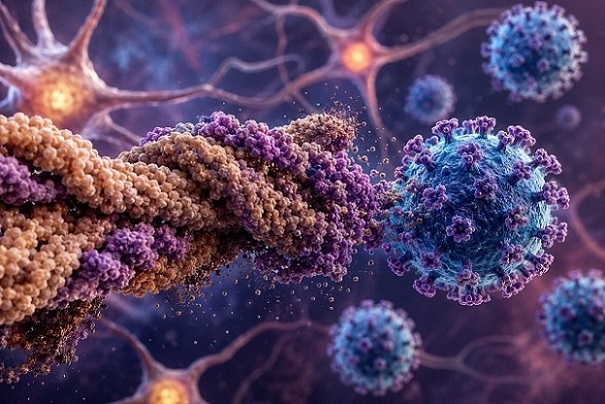 Researchers found that a SARS-CoV-2 protein may bind more strongly to Parkinson's-related protein clumps as
the disease advances, potentially accelerating harmful brain changes
The research was conducted by scientists from the Department of Computer Science and Engineering at APJ Abdul Kalam Technological University, Thiruvananthapuram, the Department of Biotechnology at Koneru Lakshmaiah Education Foundation (KLEF) Deemed to be University, Vaddeswaram, and the Department of Computer Science and Engineering at Rajagiri School of Engineering & Technology, Kochi, India.
Tracking Harmful Protein Changes
Parkinson's disease develops when a brain protein called alpha-synuclein folds incorrectly and forms sticky fibers known as fibrils. These abnormal structures gradually spread through the brain, damaging nerve cells involved in movement, balance, and other vital functions.
Using advanced computer modeling, artificial intelligence, and three-dimensional structural analysis, the researchers examined alpha-synuclein fibrils representing early, middle, and late stages of Parkinson's disease. They investigated how these changing fibrils interact with the SARS-CoV-2 nucleocapsid (N) protein, which earlier laboratory studies had already suggested could promote alpha-synuclein aggregation.
Binding Strength Increased as Parkinson's Progressed
The analysis revealed that the viral protein attached only weakly to fibrils representing the earliest stages of Parkinson's disease. However, as the fibrils matured and became more structurally organized, their ability to bind the viral protein increased dramatically.
Late-stage fibrils displayed exceptionally strong predicted binding, with the researchers identifying much larger contact surfaces and more stable molecular interactions than those seen in early disease. The study suggests that as Parkinson's progresses, the abnormal protein fibers develop increasingly favorable docking sites for the viral protein.
This
Medical News report highlights an important implication of these findings: if SARS-CoV-2 infection occurs in people already developing Parkinson's disease, the viral protein could potentially stabilize or accelerate the formation of the most harmful alpha-synuclein structures.
Hidden Structural Changes Revealed
The researchers employed a mathematical techni
que called persistent homology to examine how the architecture of alpha-synuclein fibrils changes during disease progression. Rather than simply measuring protein size, this method identifies stable loops, folds, and structural patterns that emerge as fibrils mature.
Their analysis showed a gradual increase in structural complexity and rigidity from preclinical to late-stage Parkinson's disease. At the same time, important binding "hotspots" became more defined within the non-amyloid component region, protofilament interfaces, and hydrophobic grooves of the fibrils.
Remarkably, the team's computational system correctly identified between 74% and 92% of these critical interaction sites when compared with established protein modeling software, demonstrating strong agreement between independent analytical methods.
Why the Findings Matter
The study provides a possible molecular explanation for clinical observations made during the COVID-19 pandemic, when many Parkinson's patients experienced worsening motor symptoms following SARS-CoV-2 infection.
Although the research was entirely computational and does not prove that COVID-19 directly causes Parkinson's disease or speeds its progression in every patient, it offers a biologically plausible mechanism that deserves further laboratory and clinical investigation.
The findings also suggest that future therapies might target these newly identified binding regions to prevent viral proteins from enhancing alpha-synuclein aggregation or to interfere with the maturation of toxic fibrils before irreversible brain damage occurs.
Conclusion
This study offers compelling new evidence that the structural evolution of alpha-synuclein fibrils during Parkinson's disease may make them increasingly vulnerable to interaction with the SARS-CoV-2 nucleocapsid protein. While experimental validation is still required, the work provides an important framework for understanding how viral infections may influence neurodegenerative diseases. It also identifies several conserved molecular targets that could guide future drug development aimed at slowing Parkinson's progression and reducing long-term neurological complications associated with COVID-19.
The study findings were published in the peer reviewed Journal of Alzheimer's Disease Reports.
https://journals.sagepub.com/doi/full/10.1177/25424823261464972
For the latest COVID-19 news, keep on logging to Thailand
Medical News.
Read Also:
https://www.thailandmedical.news/articles/coronavirus
https://www.thailandmedical.news/articles/long-covid
https://www.thailandmedical.news/articles/alzheimer,-dementia-




 Share
Share
 Tweet
Tweet
 Share
Share

































