Nikhil Prasad Fact checked by:Thailand Medical News Team Feb 13, 2026 7 months, 2 weeks, 5 days, 2 hours, 46 minutes ago
Medical News: A common vegetable long used in Asian kitchens and traditional healing systems may hold surprising power against some of the world’s most dangerous viruses. Scientists from the Department of Medical and Surgical Sciences (DIMEC), Alma Mater Studiorum, University of Bologna, Italy, have published a detailed scientific review examining the antiviral properties of Momordica charantia, better known as bitter melon. Their findings suggest that compounds inside this plant can interfere with viruses in multiple ways, from blocking replication to stopping viral proteins from being produced.
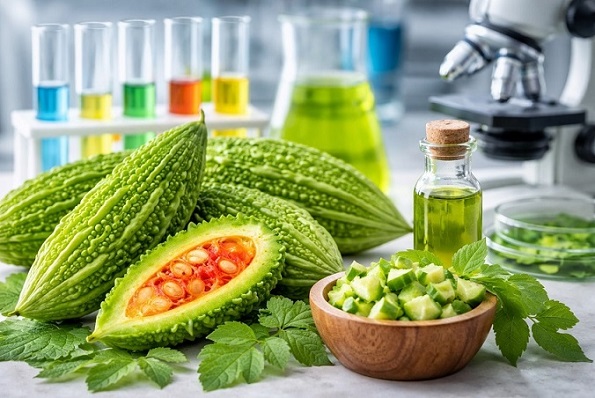 Italian scientists reveal how bitter melon proteins can block viruses including HIV hepatitis B dengue and
SARS-CoV-2 in laboratory studies
Ancient Remedy Meets Modern Virology
Bitter melon has been used for centuries in India, China, Thailand, Africa and the Caribbean to treat fever, infections and inflammatory conditions. Although ancient healers did not know about viruses, many of the illnesses they treated, such as measles-like rashes and flu-like fevers, are now known to be viral in origin. The Italian research team analyzed decades of laboratory studies to understand whether these traditional uses had scientific backing.
According to this
Medical News report, the plant contains several groups of bioactive compounds or phytochemicals, but the most powerful antiviral agents appear to be special proteins called ribosome-inactivating proteins, or RIPs. These proteins can shut down the machinery inside infected cells that viruses rely on to multiply.
How Bitter Melon Blocks Viruses
Among the most studied compounds is MAP30, a protein isolated from bitter melon seeds and fruit. Laboratory experiments show that MAP30 can suppress HIV-1 by blocking reverse transcriptase activity and preventing the virus from integrating its genetic material into human DNA. It also reduced hepatitis B virus DNA levels in infected liver cells, cutting viral replication significantly without causing major cell damage at tested doses.
Another group of proteins, called alpha- and beta-momorcharin, demonstrated the ability to inhibit HIV integrase, an enzyme essential for viral spread. In herpes simplex virus experiments, MAP30 showed stronger antiviral effects than the commonly used drug acyclovir in certain laboratory settings, even working against drug-resistant strains.
The review also highlighted promising results against dengue virus. A modified fusion protein containing MAP30 protected infected mice, with survival rates reaching 100 percent at specific doses. More recently, both MAP30 and another protein known as MCI were shown to inhibit SARS-CoV-2 replication in human lung cells at very low concentrations, with minimal toxicity.
Beyond Proteins - a Broader Arsenal
Bitter melon also contains triterpenoids, flavonoids and polysaccharides. Some of these compounds demonstrated moderate anti-HIV activity in cell studies, while computer modeling suggests others may bind to key enz
ymes of influenza viruses and coronaviruses. However, researchers caution that computer simulations must be confirmed through real-world biological testing.
Polysaccharides extracted from the fruit have shown immune-enhancing properties in animal studies. In immunosuppressed mice, high doses restored immune markers close to normal levels, suggesting that bitter melon could strengthen the body’s natural defenses during infection.
Limitations and the Road Ahead
Despite the impressive laboratory evidence, the researchers emphasized that most data come from in vitro or animal experiments. Human clinical trials are still lacking, and RIP proteins have a narrow safety margin, meaning dosage control would be critical. More pharmacological studies are needed to confirm safety, absorption and long-term effects.
In conclusion, bitter melon stands out as a scientifically promising but still underdeveloped antiviral resource. Its unique proteins directly disrupt viral replication, while other plant compounds may enhance immune responses. Although not yet ready to replace standard antiviral drugs, it represents a valuable source for future drug discovery and nutraceutical development, especially as new viral threats continue to emerge worldwide.
The study findings were published in the peer reviewed journal: Biomedicines.
https://www.mdpi.com/2227-9059/14/2/412
For the latest on herbs and phytochemicals, keep on logging to Thailand
Medical News.
Read Also:
https://www.thailandmedical.news/articles/herbs-and-phytochemicals




 Share
Share
 Tweet
Tweet
 Share
Share

































