Italian Researchers Find That Certain Nutraceuticals Slow Parkinson Brain Damage
Nikhil Prasad Fact checked by:Thailand Medical News Team Jan 31, 2026 8 months, 3 days, 21 hours, 33 minutes ago
Medical News: Parkinson’s disease is a complex brain disorder that slowly damages nerve cells responsible for movement, balance, and even thinking. While current treatments mostly manage symptoms, scientists are increasingly searching for ways to slow or stop the disease itself. A new scientific review has now brought renewed attention to an unexpected area of hope: naturally occurring food compounds known as nutraceuticals.
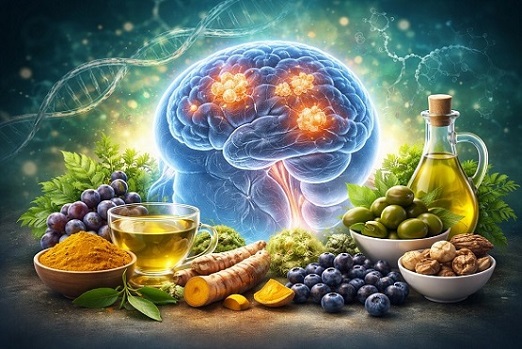 Natural dietary compounds may help block toxic protein clumps linked to Parkinson’s disease.
Understanding the Root of the Damage
Natural dietary compounds may help block toxic protein clumps linked to Parkinson’s disease.
Understanding the Root of the Damage
At the center of Parkinson’s disease is a protein called alpha-synuclein. In healthy brains, this protein helps nerve cells communicate. In Parkinson’s, however, alpha synuclein loses its normal shape and clumps together. These clumps disrupt brain cells, damage mitochondria, trigger inflammation, and eventually lead to nerve cell death. Scientists now believe that the most toxic forms are not the large clumps seen under microscopes, but smaller unstable clusters that form earlier in the disease process.
How Nutraceuticals Interfere with Harmful Protein Clumps
According to this
Medical News report, researchers found that several nutraceuticals can directly interfere with how alpha-synuclein folds and clumps.
Compounds such as curcumin from turmeric, epigallocatechin gallate from green tea, resveratrol from grapes, and oleuropein from olives were shown to block the formation of toxic protein clusters or even break apart existing ones.
Instead of allowing alpha-synuclein to form harmful shapes, these natural molecules guide it into less dangerous forms. Some act like chemical chaperones, stabilizing the protein, while others remodel existing clumps into inactive structures that are less damaging to brain cells.
Supporting the Brain Beyond Protein Control
The review also highlights that nutraceuticals do more than just act on alpha-synuclein directly. Many of these compounds strengthen the brain’s own defense systems. They reduce oxidative stress, calm chronic inflammation, protect energy-producing mitochondria, and improve the brain’s ability to clear damaged proteins through natural recycling pathways.
Certain compounds such as ginsenosides from ginseng and caffeine were found to work indirectly by improving cellular balance and reducing inflammation, even if they do not strongly bind to alpha synuclein itself.
Challenges in Turning Food Compounds into Treatments
Despite promising laboratory results, the researchers caution that most nutraceuticals face major challenges in real-world use. Many are poorly absorbed, quickly broken down in the body, or struggle to cross the blood–brain barrier. To overcome this, scientists are experimenting with advanced delivery systems such as nanoparticles and stem cell–derived exosomes to safely transport these compounds into th
e brain.
Institutions Behind the Research
The researchers involved in this comprehensive review are from the Department of Translational Biomedicine and Neuroscience “DiBraiN” at the University of Bari Aldo Moro in Bari, Italy.
Conclusion
The findings strongly suggest that nutraceuticals could one day play a meaningful role in slowing Parkinson’s disease progression. By targeting the earliest and most toxic protein changes while also protecting brain cells, these natural compounds offer a multi-layered strategy that conventional drugs often lack. However, large human trials and improved delivery technologies are essential before these promising molecules can move from the laboratory to everyday clinical use.
The study findings were published in the peer reviewed International Journal of Molecular Sciences
https://www.mdpi.com/1422-0067/27/3/1324
For the latest on Parkinson’s Disease, keep on logging to Thailand
Medical News.
Read Also:
https://www.thailandmedical.news/articles/herbs-and-phytochemicals
https://www.thailandmedical.news/articles/alzheimer,-dementia-




 Share
Share
 Tweet
Tweet
 Share
Share

































