Nikhil Prasad Fact checked by:Thailand Medical News Team Jan 28, 2026 8 months, 1 week, 1 day, 14 hours, 7 minutes ago
Medical News: Researchers from Cardiff University School of Medicine in the United Kingdom, the University of Cambridge in the United Kingdom, Mansoura University in Egypt, University Hospital Llandough in the United Kingdom, and Omeros Corporation in the United States have uncovered new biological evidence that helps explain why many people continue to suffer debilitating symptoms long after recovering from acute COVID-19 infection.
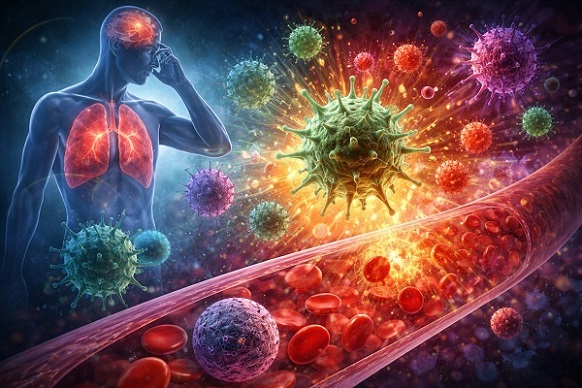 Persistent immune pathway activation may explain long COVID symptoms and point to new treatments
A Closer Look at Long COVID
Persistent immune pathway activation may explain long COVID symptoms and point to new treatments
A Closer Look at Long COVID
Long COVID is a condition affecting millions worldwide, marked by symptoms such as extreme fatigue, breathlessness, brain fog, chest pain, and muscle weakness that persist for months or even years. While doctors have long suspected chronic inflammation to be a driving factor, the exact biological mechanisms have remained unclear. This
Medical News report highlights a major breakthrough in understanding that process.
The Role of The Complement System
The complement system is a part of the immune system that helps the body fight infections. It works through several interconnected pathways that activate inflammation to destroy viruses and damaged cells. However, when this system remains overactive, it can cause ongoing inflammation and tissue damage.
In this study, scientists focused on the lectin pathway, one of the earliest triggers of the complement system. Using blood samples from 159 people with long COVID and 76 fully recovered individuals, the researchers measured specific immune markers that indicate whether this pathway remains switched on long after infection.
Key Findings from The Study
The researchers found significantly higher levels of a marker called MASP-2 C1 inhibitor complexes in people with long COVID. This marker signals persistent activation of the lectin pathway, even more than two years after the original infection in many cases. Importantly, this pathway activates other inflammatory routes downstream, amplifying immune damage throughout the body.
By combining four immune markers MASP-2 C1 inhibitor, iC3b, terminal complement complex, and properdin, the team achieved strong accuracy in distinguishing long COVID patients from healthy individuals. Classical immune pathways, once thought to be responsible, showed weak predictive value. These findings clearly point to the lectin pathway as the main driver of long-term immune disruption.
Why This Matters for Patients
Persistent activation of the lectin pathway may help explain blood clotting problems, damaged blood vessels, and ongoing fatigue seen in long COVID sufferers. MASP-2 is also known to interact with clotting factors, suggesting a direct link between immune overactivation and circulation issues commonly reported by patients.
New Hope for Targeted Treatments
One of the most important implications of this research is that the lectin pathway can
be targeted with existing experimental drugs. Blocking this pathway could potentially reduce inflammation, improve blood flow, and break the cycle of immune overactivation that keeps patients unwell for months or years.
Conclusion
This study provides compelling evidence that long COVID is driven by a specific and measurable immune malfunction rather than vague or unexplained symptoms. By identifying the lectin complement pathway as a central culprit, researchers have opened the door to more accurate diagnostics and targeted therapies. These findings bring renewed hope that long COVID may soon be treatable through precision immune modulation rather than symptom management alone.
The study findings were published in the peer reviewed journal: Immunology.
https://onlinelibrary.wiley.com/doi/10.1111/imm.70110
For the latest on Long COVID, keep on logging to Thailand
Medical News.
Read Also:
https://www.thailandmedical.news/articles/coronavirus
https://www.thailandmedical.news/articles/long-covid




 Share
Share
 Tweet
Tweet
 Share
Share