Nikhil Prasad Fact checked by:Thailand Medical News Team Feb 02, 2026 8 months, 2 days, 1 hour, 18 minutes ago
Medical News: Chronic inflammation has long been linked to disease, but new research is now revealing just how deeply immune inflammation and oxidative stress are intertwined in driving some of the world’s most serious health conditions. This
Medical News report highlights a new scientific editorial that brings together evidence showing how these biological processes act as common engines behind cancer, neurodegenerative disorders, heart disease, bone damage, and gastrointestinal illnesses.
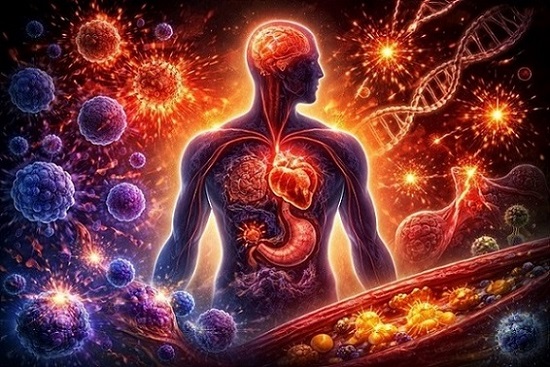 Chronic inflammation and oxidative stress act together as hidden engines behind cancer, brain disorders,
heart disease, and more.
When Protection Turns Harmful
Inflammation is the body’s natural defense system. It helps fight infections, repair damaged tissue, and restore balance. Under normal circumstances, this process is tightly controlled. However, when inflammation becomes prolonged or poorly regulated, it can cause more harm than good. Researchers explain that chronic inflammation damages tissues, disrupts immune balance, and accelerates disease progression rather than stopping it.
Oxidative Stress Adds Fuel to The Fire
The study emphasizes that inflammation rarely acts alone. It is closely linked to oxidative stress, a condition caused by an excess of unstable molecules known as free radicals. These molecules damage cells, DNA, and mitochondria. Once oxidative stress begins, it further fuels inflammation, creating a vicious cycle that is difficult to stop. This harmful feedback loop has now been identified across many unrelated diseases, suggesting a shared biological foundation.
Cancer And Infection Driven Inflammation
One highlighted study examined patients with Helicobacter pylori–associated gastric cancer. Researchers found that as cancer advanced, patients showed stage specific changes in inflammatory cytokines, oxidative damage markers, and antioxidant defenses. These shifts suggest that inflammation and oxidative stress do not just exist alongside cancer but actively evolve as the disease worsens, influencing tumor growth and patient outcomes.
New Clues in Neurodegenerative Diseases
Another key study focused on Parkinson’s disease. Using an animal model, scientists investigated a chemokine receptor known as CCR1. Blocking this receptor significantly reduced brain inflammation, nerve cell loss, and movement problems. The findings also showed lower immune cell infiltration and calmer inflammatory signaling in the brain. This positions CCR1 as a potential biomarker and therapeutic target for slowing neurodegeneration.
Inflammation Beyond the Brain and Cancer
Review articles in the issue expand the discussion to cardiovascular and bone diseases. One review explains how chronic inflammation drives atherosclerosis from its earliest stages, leading to plaque formation, blood vessel damage, and increased risk of heart attacks and strokes. The researchers also note strong links between carotid ar
tery disease and cognitive decline, reinforcing inflammation as a whole-body problem rather than a localized one.
Another review explores how non coding RNAs regulate inflammatory pathways in osteonecrosis of the jaw. These molecules influence bone cell survival, tissue breakdown, and healing. Beyond explaining disease mechanisms, the authors highlight their potential as future diagnostic markers and treatment targets.
The Gut Microbiome Enters the Picture
The issue also presents a clinical trial protocol investigating Fusobacterium nucleatum, a gut bacterium linked to bowel disease and colorectal cancer. The planned study will examine how this microbe activates inflammatory and oxidative stress pathways, affects treatment response, and alters disease severity. Advanced imaging and molecular analysis may help doctors better classify patients and monitor disease progression without invasive procedures.
Conclusions
Together, these findings strongly support the idea that immune inflammation and oxidative stress are not isolated problems but shared biological drivers across many diseases. By identifying common pathways, biomarkers, and molecular targets, researchers are opening the door to treatments that could work across multiple conditions rather than one disease at a time. Importantly, future therapies may focus on restoring balance rather than simply suppressing symptoms. This integrated approach could significantly improve patient outcomes, reduce disease progression, and enhance quality of life across a wide range of chronic illnesses.
The researchers involved are from the Department of Chemical, Biological, Pharmaceutical and Environmental Sciences at the University of Messina in Italy, and the Departmental Faculty of Medicine at UniCamillus Saint Camillus International University of Health Sciences in Rome, Italy.
The study findings were published in the peer reviewed International Journal of Molecular Sciences.
https://www.mdpi.com/1422-0067/27/3/1467
For the latest on Immune Inflammation and Oxidative Stress, keep on logging to
Thailand Medical News.
Read Also:
https://www.thailandmedical.news/articles/coronavirus
https://www.thailandmedical.news/articles/long-covid
https://www.thailandmedical.news/articles/cancer




 Share
Share
 Tweet
Tweet
 Share
Share

































