Nikhil Prasad Fact checked by:Thailand Medical News Team Dec 11, 2025 9 months, 3 weeks, 2 days, 22 hours, 23 minutes ago
Medical News: Viruses Turn Host Defense Mechanism into a Tool for Infection
A new study led by researchers from Yangzhou University in China and the Université de Sherbrooke in Canada has uncovered how viruses cleverly hijack a vital cellular process known as the unfolded protein response (UPR) to help themselves survive and replicate inside host cells. Originally designed to protect cells under stress, this pathway is now revealed to be a double-edged sword—something viruses can turn in their favor.
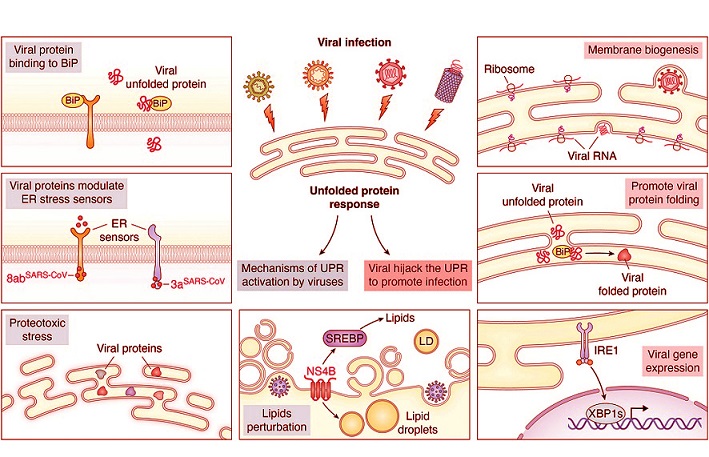 Viruses use a two-step approach to activate and exploit the unfolded protein response (UPR). First, they trigger UPR through both general stress—caused by high viral protein production and disrupted lipid metabolism—and direct actions, such as viral proteins binding to UPR sensors or sequestering BiP (e.g., HCV E1/E2, SARS-CoV). Once UPR is active, viruses hijack its pathways to aid replication. They use the IRE1-XBP1s axis to expand ER membranes for replication and co-opt host chaperones for proper folding of viral proteins. Some even use UPR transcription factors like XBP1s to boost viral gene expression.
The UPR is activated when the cell’s protein-folding machinery, located in the endoplasmic reticulum (ER), becomes overwhelmed. This can happen due to environmental stress or the buildup of misfolded proteins. The study explains how viruses intentionally push the ER into stress mode, either by overloading it with viral proteins or directly tampering with the sensors that monitor protein folding. According to this
Medical News report, the virus can then take control of the UPR to support its own survival and replication.
How the UPR Normally Works
The UPR has three main branches: IRE1, PERK, and ATF6 (or bZIP17/28 in plants). When activated, these branches temporarily halt protein production, increase production of helper molecules (chaperones), and expand the ER to deal with stress. If stress continues too long, however, the UPR can trigger cell death to prevent further damage. This safety mechanism is meant to protect the organism, but viruses have developed ways to stop the process before it gets that far.
Viruses Turn Cell Stress into a Survival Strategy
The researchers showed that viruses like dengue, Zika, hepatitis C, SARS-CoV, and even plant viruses like turnip mosaic virus, all use the UPR to their advantage. They boost the ER’s capacity to fold proteins, remodel the ER membrane to build replication compartments, and suppress parts of the UPR that would otherwise lead to cell death.
For instance, dengue virus activates the IRE1 branch to expand the ER and allow more room for replication. It also reverses PERK pathway stress signals to restore protein production, ensuring continued viral protein synthesis. Meanwhile, hepatitis C virus cleverly bypasses translation blockades by using an internal mechanism that allows it to continue making proteins regardless of UPR status.
In plant viruses, similar tricks are used. Proteins like 6K2 from turnip mosaic virus reprogram the ER’s shape to make viral f
actories, while sugarcane streak mosaic virus blocks the processing of stress signals to delay the cell’s self-destruct mechanism.
Blocking Cell Death While Maximizing Virus Output
To keep the host cell alive long enough to produce viral copies, viruses also hijack parts of the UPR involved in protein cleanup and waste removal. By manipulating pathways like ERAD (which normally clears out misfolded proteins) and autophagy (which recycles damaged parts of the cell), viruses eliminate antiviral factors while preserving their own structures.
Some viruses go even further to prevent the host cell from dying. They suppress the final stage of the UPR that causes programmed cell death (apoptosis), ensuring the virus can keep replicating in the same cell for longer. This delicate balancing act ensures a steady production of viral particles while avoiding an early shutdown by the cell’s natural defenses.
A New Frontier in Antiviral Research
Understanding how viruses fine-tune and exploit the UPR opens new doors for antiviral therapies. The researchers emphasize that targeting this interaction point—without harming the cell’s own vital functions—could help fight both human and plant viruses. The team calls for more research to explore how viruses manipulate lipid metabolism through the UPR, which could reveal even more vulnerabilities.
These insights not only reveal the clever strategies used by viruses but also highlight how much more we need to learn about the molecular battles happening inside infected cells.
The study was conducted by scientists from the College of Plant Protection and Joint International Research Laboratory at Yangzhou University in China, and Centre SÈVE, Département De Biologie at the Université de Sherbrooke, Canada.
The study findings were published in the peer reviewed Journal of Biological Chemistry.
https://www.sciencedirect.com/science/article/pii/S0021925825028923
For the latest on Viruses, keep on logging to Thailand
Medical News.
Read Also:
https://www.thailandmedical.news/articles/coronavirus




 Share
Share
 Tweet
Tweet
 Share
Share