Nikhil Prasad Fact checked by:Thailand Medical News Team Feb 15, 2026 7 months, 2 weeks, 2 days, 17 hours, 17 minutes ago
Medical News: A new study is shedding light on how tiny energy producing structures inside our cells may influence the growth and aggressiveness of breast cancer. Researchers have discovered that changes in a key mitochondrial enzyme complex, known as succinate dehydrogenase or SDH, could play an important role in how different types of breast cancer behave.
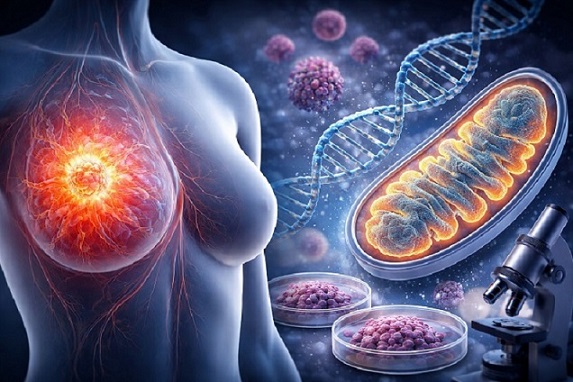 Subtle changes in mitochondrial energy genes may influence breast cancer progression and survival
outcomes across different subtypes.
The research was conducted by scientists from the University of Chittagong and the Department of Pharmacology and Therapeutics, McGill University, Canada.
Understanding The Cell’s Power Engine
Mitochondria are often described as the “power plants” of the cell because they generate energy. One of their important components is the SDH complex, made up of four subunits called SDHA, SDHB, SDHC and SDHD. These help control how cells use oxygen and nutrients to produce energy.
When this system is disrupted, cells can accumulate a substance called succinate. This buildup can trigger abnormal signaling, mimic low oxygen conditions, and push cells toward cancer-like behavior. Although SDH has long been considered a tumor suppressor in some cancers, its role in breast cancer has remained unclear, especially in South Asian populations.
What The Researchers Found
The team analyzed tumor samples from 25 breast cancer patients treated at Chittagong Medical College Hospital. The cancers were categorized into Luminal A, Luminal B, Her2 positive and triple negative breast cancer subtypes. Their findings were also compared with data from The Cancer Genome Atlas, which mainly includes Western populations.
They discovered that all four SDH subunits were generally increased in tumor tissues compared to nearby normal tissues in the Bangladeshi patients. However, patterns varied by subtype. SDHA and SDHB were often elevated in Luminal and Her2 positive cancers. SDHC showed consistent overexpression across most subtypes. SDHD behaved differently, increasing in some subtypes but decreasing in others.
When compared with international data, one striking difference emerged. In global datasets, SDHD was often reduced in breast cancer, while in the Bangladeshi group it was frequently increased. This
Medical News report highlights how population specific biological differences may shape cancer behavior.
Links To Survival and Disease Stage
Further analysis showed that high levels of SDHA, SDHB and SDHD were associated with poorer overall survival. Interestingly, low levels of SDHC were also linked to worse outcomes. This suggests that both overactivity and underactivity of certain mitochondrial genes can negatively affect patients.
The researchers also found that SDH gene mutations were rare in breast cancer. Instead, changes in gene copy number and epigenetic alterations, which affect how genes are switched on or off, appeared to drive the abnormal expression
. They observed increased levels of METTL3, an enzyme involved in RNA modification, suggesting a possible epigenetic mechanism behind SDH dysregulation.
Why This Matters
Breast cancer is not a single disease but a collection of subtypes with different behaviors and treatment responses. The study shows that mitochondrial metabolism may vary across subtypes and populations, potentially influencing how aggressive the cancer becomes.
In conclusion, the findings suggest that SDH subunits are not acting in a simple on or off manner. Instead, each subunit may contribute independently to breast cancer progression. Both increased and decreased expression patterns were linked to survival outcomes, underlining the complexity of mitochondrial involvement. These results open the door to future research exploring whether targeting mitochondrial metabolism could improve treatment strategies, especially in underrepresented populations.
The study findings were published in the peer reviewed International Journal of Molecular Sciences.
https://www.mdpi.com/1422-0067/27/4/1722
For the latest on breast cancer, keep on logging to Thailand
Medical News.
Read Also:
https://www.thailandmedical.news/articles/cancer




 Share
Share
 Tweet
Tweet
 Share
Share

































