Nikhil Prasad Fact checked by:Thailand Medical News Team Aug 23, 2026 49 minutes ago
Chikungunya is best known as a mosquito-borne infection that can cause fever and severe joint pain, but a new scientific review warns that outbreaks could also create challenges for blood supplies. The virus has now been reported in more than 110 countries across Africa, Asia, the Americas, and Europe.
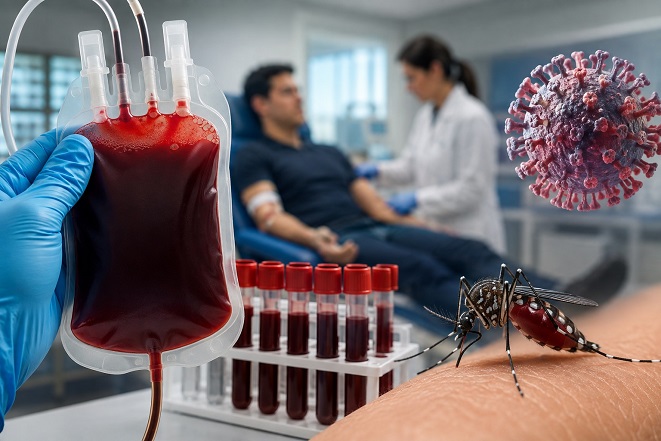 Chikungunya outbreaks may create new blood-safety challenges because apparently healthy donors can sometimes carry the
virus
The review examined what is currently known about chikungunya virus (CHIKV), including its spread, symptoms, diagnosis, vaccines, and potential risks to people receiving donated blood.
Apparently Healthy Donors May Carry the Virus
One important concern is that infected people do not always realize they have chikungunya. Although many develop sudden fever and intense joint pain, some remain asymptomatic or have symptoms mild enough to overlook.
This matters because a person could potentially donate blood while the virus is circulating in the bloodstream. Previous studies summarized in the review estimated CHIKV RNA positivity at around 0.5% among blood donors overall, rising to approximately 0.6% in endemic or outbreak settings. Individual studies reported rates around 1.9% in Puerto Rico and 1% in Thailand and French Polynesia.
During epidemic peak months in Puerto Rico, one investigation found viral RNA in 1.34% of donors, with some apparently healthy donors carrying extremely high viral concentrations.
Virus Can Survive Blood Processing
Another key finding is that normal blood processing and storage should not automatically be expected to destroy CHIKV. Laboratory research has recovered infectious virus from red blood cells, platelets, and plasma after conditions similar to those used during routine transfusion practice. However, demonstrating that virus remains infectious experimentally does not prove that recipients will become infected.
Importantly, confirmed clinical cases of chikungunya transmitted through transfusion remain extremely limited. The review concludes that the current overall transfusion risk appears very low, but absence of documented cases does not mean transmission is impossible.
Blood Screening Could Strengthen Protection
As this
Thailand Medical News report highlights, several safeguards can reduce potential risks during outbreaks. Nucleic acid amplification testing, or NAAT, can directly detect viral genetic material in donated blood, including during the period before antibodies become detectable.
Pathogen-reduction technologies provide another defense. Laboratory studies found particularly large reductions in infectious CHIKV when certain light-activated treatments were applied to platelets and plasma. These technologies, however, are not universally available and cannot currently be applied equally to every blood component.
Institutions Behind the Review
The institutions involved were North-Western Tuscany Blood Bank at Pisa University Hospital; the
Laboratory of Virology and Laboratories of Biosecurity at the National Institute for Infectious Diseases “Lazzaro Spallanzani”–IRCCS in Rome; and the Division of Hematology and Transfusion Medicine at “Carlo Poma” Hospital in Mantua, Italy.
Conclusions
The evidence indicates that chikungunya currently poses a very low transfusion risk, but expanding mosquito populations, international travel, and future outbreaks could change that picture. Blood services therefore need flexible surveillance, donor screening, viral testing, and pathogen-reduction strategies that can be rapidly strengthened when local transmission increases.
The study findings were published in the peer reviewed journal: Viruses.
https://www.mdpi.com/1999-4915/18/8/924
Read Also:
https://www.thailandmedical.news/news/chikungunya-virus-triggers-two-very-different-brain-cell-responses
https://www.thailandmedical.news/news/chikungunya-virus-triggers-chronic-arthritis
https://www.thailandmedical.news/news/chikungunya-infection-can-cause-rare-immune-blood-disorder




 Share
Share
 Tweet
Tweet
 Share
Share