Nikhil Prasad Fact checked by:Thailand Medical News Team Jun 04, 2026 4 months, 1 day, 15 hours, 11 minutes ago
Medical News: A phytochemical compound extracted from the burdock plant is generating excitement among cancer researchers after a new study found that it can slow the growth of several major breast cancer subtypes while also reducing tumor size in animal models. The compound, known as arctigenin, appears to attack breast cancer through multiple biological pathways at the same time, a feature that could make it especially valuable in tackling one of the most complex and diverse forms of cancer.
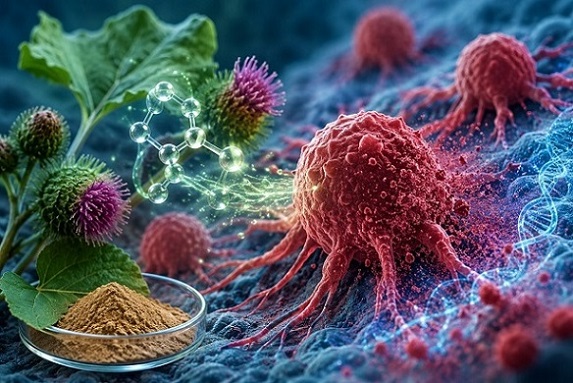 The phytochemical arctigenin significantly slowed breast cancer growth & reduced tumor size in preclinical studies
Researchers from the Division of Cancer Research and Training and the Institute for Advanced Biomedical Research at Charles R. Drew University of Medicine and Science in Los Angeles, California, conducted the study to investigate whether arctigenin could work against different forms of breast cancer and to better understand how it produces its anti-cancer effects.
A Natural Compound with Broad Anti-Cancer Potential
Arctigenin is a plant-derived compound found primarily in Arctium lappa, commonly known as burdock. The herb has been used in traditional Chinese medicine for centuries, mainly for inflammatory conditions. Previous laboratory studies had already suggested that the phytochemical arctigenin may possess anti-cancer properties, but its effectiveness across multiple breast cancer subtypes had not been thoroughly explored.
Breast cancer is not a single disease. It consists of several subtypes, including hormone receptor-positive cancers, HER2-positive cancers, and triple-negative breast cancer. Triple-negative breast cancer is considered particularly dangerous because it lacks the common molecular targets used by many modern therapies and is often associated with poorer outcomes.
To test arctigenin, the research team examined its effects on three different breast cancer cell lines representing these major disease categories.
Cancer Cell Growth Dramatically Reduced
The study found that arctigenin significantly reduced the growth of all three breast cancer subtypes in laboratory experiments. Importantly, the compound worked in a dose-dependent manner, meaning its cancer-fighting activity became stronger as the dose increased.
Researchers observed that arctigenin was able to alter numerous genes involved in cancer growth and survival. Rather than targeting a single pathway, the compound influenced a broad network of biological processes associated with tumor development.
Among the affected pathways were those involved in cell division, programmed cell death, cancer cell movement, and drug resistance. This broad-spectrum activity may be one of the reasons the compound showed effectiveness across very different breast cancer types.
Forcing Cancer Cells to Stop Dividing
One of the most important discoveries was arctigenin’s ability to disrupt the cancer cell cycle.
Healthy cells pass through a series of carefully con
trolled stages before dividing. Cancer cells often bypass these controls and multiply uncontrollably. The researchers found that arctigenin effectively halted this process.
In hormone receptor-positive breast cancer cells, the compound trapped cells in the G2/M phase, preventing them from completing division. In triple-negative breast cancer cells, it stopped progression at the G0/G1 phase, another critical checkpoint that controls cellular growth.
By blocking these stages, arctigenin effectively prevented cancer cells from reproducing.
This
Medical News report notes that the phytochemical did not use a single mechanism but instead appeared to adapt its activity depending on the molecular characteristics of the cancer subtype being targeted.
Triggering Cancer Cell Suicide
The research team also discovered that arctigenin activated apoptosis, often described as programmed cell death.
Cancer cells typically develop ways to avoid apoptosis, allowing them to survive far longer than they should. Treatment with arctigenin reversed this advantage.
The study showed significant increases in both early-stage and late-stage apoptosis in breast cancer cells. At the same time, the proportion of living cancer cells dropped sharply. Key cancer-related genes associated with survival were suppressed, while genes linked to cell death became more active.
This suggests that arctigenin not only stops cancer cells from multiplying but also actively encourages their destruction.
Blocking Cancer Cell Movement
Another important finding involved cancer cell migration. Metastasis, the process through which cancer spreads to distant organs, remains one of the leading causes of cancer-related deaths. Laboratory wound-healing experiments demonstrated that arctigenin significantly impaired the ability of breast cancer cells to move and close artificial wounds.
The findings indicate that the compound may possess anti-metastatic properties, potentially helping to limit the spread of disease.
Strong Results in Animal Studies
The laboratory findings were reinforced by animal experiments involving mice implanted with human breast cancer tumors.
Mice receiving daily oral arctigenin treatment experienced substantial reductions in tumor growth. By the end of the study, tumor weights were reduced by approximately 40 percent in hormone receptor-positive tumors and by roughly 60 percent in triple-negative tumors.
Researchers also found dramatic reductions in Ki67, a well-known marker of tumor cell proliferation. Lower Ki67 levels generally indicate slower tumor growth and improved treatment response.
Perhaps equally important, the treated animals showed no obvious signs of toxicity. Body weight remained stable, food and water consumption were unaffected, and examinations of liver tissue revealed no evidence of damage, inflammation, or metastasis.
Conclusion
The findings suggest that arctigenin could emerge as a promising future therapy for breast cancer. Its ability to simultaneously suppress tumor growth, stop cell division, trigger cancer cell death, reduce cell migration, and shrink tumors in animal models makes it particularly intriguing. The compound also demonstrated activity against multiple breast cancer subtypes, including the difficult-to-treat triple-negative form. Although much more research is needed before human clinical trials can determine whether these benefits translate to patients, the study provides compelling evidence that arctigenin deserves further investigation as a potential natural multi-target cancer therapy. Its favorable safety profile and broad biological activity make it one of the more interesting plant-derived compounds currently under preclinical evaluation.
The study findings were published in the peer reviewed International Journal of Molecular Sciences.
https://www.mdpi.com/1422-0067/27/11/5055
For the latest on breast cancer, keep on logging to Thailand
Medical News.
Read Also:
https://www.thailandmedical.news/articles/cancer
https://www.thailandmedical.news/articles/herbs-and-phytochemicals




 Share
Share
 Tweet
Tweet
 Share
Share