Preliminary Findings Indicate That a New Sublineage of the Bundyibugyo Strain is Behind the Ebola Virus Outbreak in DRC
Nikhil Prasad Fact checked by:Thailand Medical News Team May 16, 2026 3 months, 2 weeks, 3 days, 6 hours, 14 minutes ago
Medical News: Health authorities and infectious disease experts are raising alarms after preliminary genomic investigations indicated that a new sublineage of the Bundibugyo ebolavirus may be driving the rapidly escalating Ebola outbreak currently devastating parts of the Democratic Republic of the Congo (DRC). The outbreak, which initially appeared localized near the eastern border regions, has now expanded aggressively across several provinces and is already spilling into neighboring Uganda and South Sudan, while unconfirmed surveillance signals suggest possible infections in Rwanda.
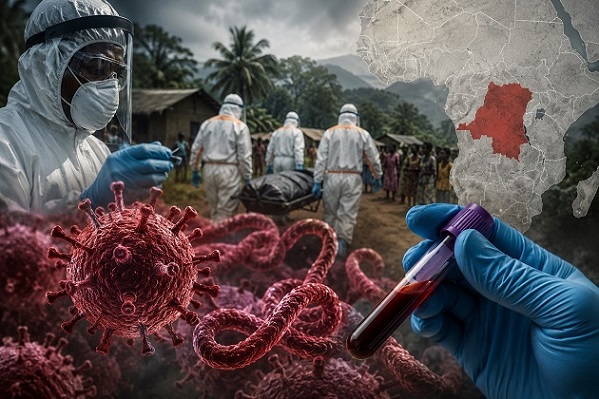 Scientists fear a newly evolved Bundibugyo Ebola sublineage may be accelerating a deadly cross-border outbreak
in Central Africa.
As of the late evening of May 15, 2026, at least 80 deaths have officially been recorded, though epidemiologists fear the real number could already be significantly higher due to underreporting, delayed testing, and overwhelmed regional healthcare systems. Field investigators are warning that several thousand individuals may already have been exposed or infected, with hospitals in Ituri and surrounding areas reporting rapidly rising admissions involving severe hemorrhagic symptoms, neurological complications, and respiratory distress.
Scientists Identify Possible New Bundibugyo Sublineage
Early sequencing data obtained from blood samples collected in outbreak clusters reportedly revealed mutations that differ from previously catalogued Bundibugyo ebolavirus isolates. Researchers involved in emergency genomic surveillance efforts believe the circulating pathogen may represent a newly evolved sublineage of the Bundibugyo strain, though full peer-reviewed confirmation is still pending. Details are expected to be released by late Monday by the African CDC.
The Bundibugyo ebolavirus was first identified in Uganda in 2007 and historically has been associated with smaller outbreaks than the infamous Zaire ebolavirus strain. However, investigators now fear that genetic changes may be influencing transmission efficiency, tissue tropism, and disease severity.
Scientists noted that some infected individuals are deteriorating unusually quickly despite Bundibugyo strains traditionally being linked to slower disease progression. Several clinicians in affected regions also described higher frequencies of severe bleeding manifestations and multi-organ complications than previously observed during earlier Bundibugyo outbreaks.
Understanding the Different Ebola Virus Species
There are six known species, commonly referred to as strains or types, of the Ebola virus. These viruses are named after the regions where they were first identified. Of these six, four are known to cause Ebola virus disease in humans.
The human-pathogenic strains include Ebola virus or Zaire ebolavirus, Sudan virus or Sudan ebolavirus, Bundibugyo virus or Bundibugyo ebolavirus, and Taï Forest virus or Taï Forest ebolavirus.
The Zaire strain remains the most deadly and notorious form, responsible for the catastrophic 2014 to 2016 West African epidemic that killed more than 11,000 people. Sudan virus continues to t
rigger periodic outbreaks in Uganda and Sudan, while the Taï Forest strain remains exceedingly rare.
The two non-human strains are Reston ebolavirus and Bombali ebolavirus. Reston virus has been detected in monkeys and pigs but is not known to cause illness in humans, while Bombali virus has primarily been identified in bats and has not yet been linked to human disease.
Key Differences Between the Zaire and Bundibugyo Strains
Although both the Zaire and Bundibugyo strains cause severe viral hemorrhagic fever, they differ substantially in virulence, genetics, and available medical countermeasures.
The Zaire strain is considered the deadliest, with untreated case fatality rates ranging between 50 percent and 90 percent. It is associated with explosive inflammatory responses commonly known as cytokine storms, leading to rapid systemic deterioration.
By comparison, Bundibugyo ebolavirus has traditionally demonstrated lower mortality rates of approximately 30 percent to 37 percent. Disease progression is generally slower, though the current outbreak may be challenging that historical understanding.
Genetically, the two strains differ by roughly 30 percent to 40 percent across their genomes. These differences significantly affect viral proteins involved in cell entry and immune evasion, particularly the glycoprotein and VP35 proteins.
This
Medical News report highlights growing concern among virologists because existing Ebola vaccines and monoclonal antibody therapies were primarily designed against the Zaire strain. FDA-approved products such as Ervebo, Inmazeb, and Ebanga are specifically targeted toward Zaire ebolavirus and are not proven to provide reliable protection against Bundibugyo infections.
Currently, no approved vaccines or dedicated antibody treatments exist for Bundibugyo ebolavirus. Most patient management relies heavily on aggressive supportive care including fluid replacement, electrolyte stabilization, oxygen therapy, blood product support, and intensive monitoring.
Outbreak Expanding Across Borders
Regional surveillance teams are now struggling to contain expanding chains of transmission along highly mobile border communities connecting the DRC, Uganda, and South Sudan. Healthcare workers are particularly concerned about the role of informal trade routes, refugee movements, and crowded transport hubs in accelerating spread.
Ugandan authorities have reportedly intensified border screening measures and activated emergency isolation units near western districts bordering the DRC. South Sudanese health officials are also conducting emergency tracing operations following suspected cross-border infections linked to traders and displaced individuals.
Meanwhile, Rwanda has begun heightened airport and land-border surveillance after reports emerged involving suspected symptomatic travelers. International health organizations fear that undetected cases may already be circulating silently beyond currently recognized hotspots.
Several aid organizations operating in the region warned that limited laboratory capacity, shortages of personal protective equipment, and deep mistrust of authorities among local populations could severely hamper containment efforts.
Researchers Concerned About Evolutionary Adaptation
One of the biggest fears surrounding the current outbreak involves the possibility that the newly identified sublineage may possess biological advantages over earlier Bundibugyo variants. Scientists are carefully studying whether observed mutations could improve viral replication efficiency or alter how the virus interacts with human immune systems.
Some preliminary field observations suggest a wider spectrum of symptoms compared to earlier Bundibugyo outbreaks, including more frequent neurological manifestations, prolonged fevers, gastrointestinal collapse, and extensive vascular injury.
Researchers are also evaluating whether the virus may be adapting toward more efficient human-to-human transmission, though definitive evidence has not yet emerged.
Public health experts warn that if the outbreak continues growing unchecked in densely populated or conflict-affected regions, the humanitarian and economic consequences could become devastating across central and eastern Africa.
The rapidly worsening Ebola situation in the DRC serves as another reminder that emerging viral pathogens continue evolving in unpredictable ways, especially in regions where healthcare infrastructure remains fragile and surveillance systems are underfunded. The apparent emergence of a new Bundibugyo sublineage is deeply concerning because medical countermeasures remain limited, while cross-border transmission risks are escalating daily. Unless aggressive containment measures, expanded genomic surveillance, international support, and emergency treatment capacity are mobilized immediately, health experts fear the outbreak could evolve into one of the most dangerous Ebola crises seen in recent years.
References:
https://www.reuters.com/business/healthcare-pharmaceuticals/africa-cdc-says-ebola-outbreak-confirmed-congos-ituri-province-2026-05-15/
https://www.cdc.gov/ebola/about/index.html
https://my.clevelandclinic.org/health/diseases/15606-ebola-virus-disease
https://www.bcm.edu/departments/molecular-virology-and-microbiology/emerging-infections-and-biodefense/specific-agents/ebola-virus
https://www.bmj.com/content/349/bmj.g7348
https://journals.asm.org/doi/10.1128/jvi.00643-21
https://journals.plos.org/plospathogens/article?id=10.1371/journal.ppat.1000212
https://www.sciencedirect.com/topics/immunology-and-microbiology/zaire-ebolavirus
Please note that this is a developing story and we will be providing more details and official links once the detailed genomic sequenced is analyzed and posted online.
For the latest on the Ebola outbreak in DRC, keep on logging to Thailand
Medical News.
Read Also:
https://www.thailandmedical.news/news/new-ebola-outbreak-infects-246-and-kills-65-in-drc-with-new-virus-strain-possibly-involved
https://www.thailandmedical.news/news/ebola-outbreak-in-drc-has-spread-to-uganda-and-possibly-to-south-sudan-and-rwanda




 Share
Share
 Tweet
Tweet
 Share
Share

































