COVID-19 Can Trigger Rhabdomyolysis or Dangerous Muscle Breakdown Along with Kidney Damage
Nikhil Prasad Fact checked by:Thailand Medical News Team Jul 19, 2026 2 months, 2 weeks, 1 day, 18 hours, 35 minutes ago
Medical News: For most people, COVID-19 is associated with fever, cough, or fatigue. However, doctors are warning that in rare cases, the virus may attack the muscles so severely that it causes a life-threatening condition known as rhabdomyolysis, where damaged muscle tissue rapidly breaks down and releases harmful substances into the bloodstream, potentially leading to acute kidney failure.
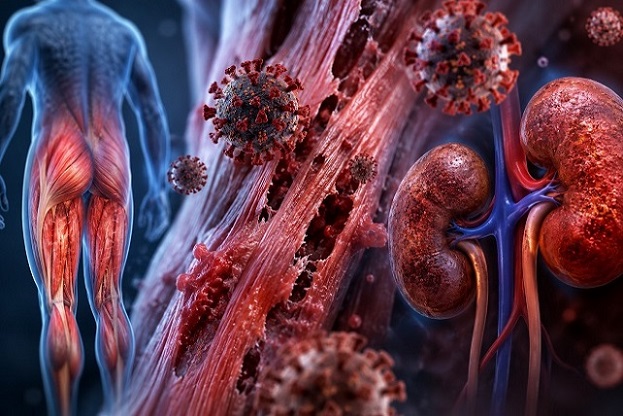 Doctors report that COVID-19 can rarely cause severe muscle breakdown leading to acute kidney injury, but early
diagnosis and treatment can result in recovery
Researchers from the Department of Kidney and Transplant Services at Princess Alexandra Hospital, Brisbane, the Infection Management Service at Princess Alexandra Hospital, Brisbane, Griffith University, Gold Coast, and the Faculty of Medicine, The University of Queensland, Brisbane, Australia, have documented a striking case highlighting this serious but often overlooked complication of COVID-19.
A Rare but Serious Case
The researchers described the case of a 63-year-old kidney transplant recipient who developed four weeks of fever, severe muscle pain, weakness, a dry cough, and dark brown urine after contracting COVID-19. Although his breathing remained stable and he did not require oxygen, laboratory tests revealed an alarming level of muscle destruction.
His creatine kinase, an enzyme released when muscles are damaged, reached more than 102,000 units/L, hundreds of times above the normal range. At the same time, his kidney function deteriorated rapidly, indicating severe acute kidney injury.
Doctors initially considered whether cholesterol-lowering medication might have caused the problem, but further testing suggested the viral infection itself was the primary trigger.
Muscle Biopsy Revealed Extensive Damage
MRI scans showed widespread swelling throughout the muscles of both thighs and the pelvic region, confirming severe muscle inflammation. A muscle biopsy provided even stronger evidence, revealing widespread muscle fiber death with very little inflammation, a pattern consistent with immune-mediated necrotizing myositis.
Interestingly, blood tests failed to detect the autoantibodies normally associated with autoimmune muscle diseases. This finding suggests that COVID-19 can produce severe muscle injury even without triggering the classic autoimmune pathways seen in other inflammatory muscle disorders.
Why COVID-19 May Damage Muscles
Scientists believe several mechanisms may explain how SARS-CoV-2 damages muscle tissue.
One possibility is that the virus directly infects skeletal muscle through ACE2 receptors found on muscle cells, causing cell injury and death. Another theory is that the body's immune response activates inflammatory pathways that unintentionally attack healthy muscle tissue.
The researchers also noted that underlying health conditions such as diabetes, hypertension, kidney disease, heart disease, and immune suppression may increase ACE2 expression in muscles, potentially making these patients more vulnera
ble to severe muscle complications following COVID-19 infection.
This
Medical News report highlights that the exact biological mechanisms remain poorly understood and require much more investigation before scientists can fully explain why only a small number of patients develop this devastating complication.
Intensive Treatment Prevented Permanent Kidney Failure
Treatment focused on rapidly limiting further muscle damage while protecting the kidneys.
Doctors immediately stopped the patient's statin medication, administered large amounts of intravenous fluids to flush muscle breakdown products from the body, treated the COVID-19 infection with a three-day course of remdesivir, and performed one session of haemodialysis after kidney function worsened significantly.
Fortunately, the patient's muscle enzyme levels steadily declined over the following days, kidney function gradually recovered, and he was discharged after one week without requiring additional immunosuppressive therapy.
Important Warning Signs
The researchers emphasize that severe muscle pain, profound weakness, dark or cola-colored urine, and rapidly worsening kidney function should never be dismissed in people with COVID-19, especially those who have underlying medical conditions or weakened immune systems.
Simple blood tests measuring creatine kinase may allow doctors to identify rhabdomyolysis early before permanent kidney damage develops. Prompt recognition and aggressive supportive treatment can dramatically improve recovery.
Conclusion
Although rhabdomyolysis remains an uncommon complication of COVID-19, this case demonstrates that the virus can sometimes trigger catastrophic muscle destruction even in patients without severe respiratory disease. Clinicians should remain alert when patients report severe muscle pain or dark urine, particularly those with kidney disease, transplant history, or multiple chronic illnesses. Earlier diagnosis, rapid treatment, and continued research into the underlying biological mechanisms could help prevent irreversible kidney damage and improve survival in these rare but potentially life-threatening cases.
The study findings were published in the peer reviewed Medical Journal of Australia.
https://onlinelibrary.wiley.com/doi/10.5694/mja2.70247
For the latest on COVID-19, keep on logging to Thailand
Medical News.
Read Also:
https://www.thailandmedical.news/articles/coronavirus
https://www.thailandmedical.news/articles/long-covid




 Share
Share
 Tweet
Tweet
 Share
Share

































