Nikhil Prasad Fact checked by:Thailand Medical News Team Aug 19, 2026 54 minutes ago
COVID-19 is mounting another late-summer comeback across the United States, with federal modeling indicating that infections are now increasing or likely increasing in every state. While severe disease indicators remain comparatively low, wastewater surveillance and other monitoring systems suggest SARS-CoV-2 transmission is accelerating as Americans travel, return to schools and spend more time gathering indoors.
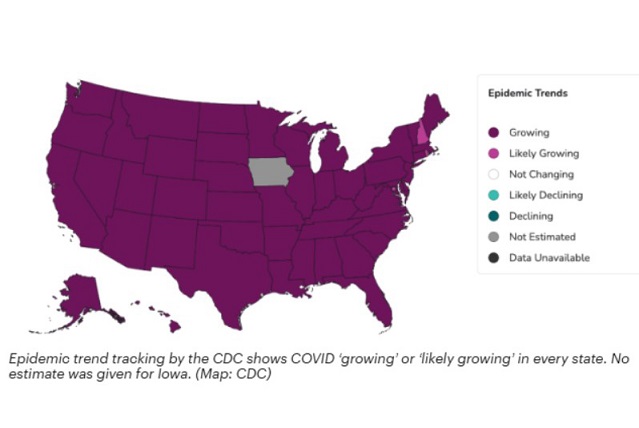 COVID-19 infections are rising across all 50 US states as wastewater surveillance signals an expanding late-summer wave
According to the US Centers for Disease Control and Prevention, COVID-19 infections were growing or likely growing in all 50 states by mid-August 2026, with no state showing a clearly declining trajectory.
Wastewater Signals Reveal a Broad National Increase
Wastewater surveillance has become particularly important because conventional testing captures only a fraction of infections. SARS-CoV-2 shed by infected individuals can be detected in sewage, including from people who have mild symptoms, have not tested, or do not realize they are infected.
.jpg)
CDC wastewater assessments nevertheless indicate that overall national activity remains very low. Hawaii and Mississippi have been classified as having moderate wastewater viral activity, although available wastewater information from Mississippi is limited.
Alabama, Alaska, California, Florida, Georgia, Nevada, Oregon, Texas and Washington have recorded low wastewater activity, while other states have generally remained in the very-low category. Geographically, the West and South are currently showing stronger activity than much of the country.
However, another surveillance system paints a more concerning picture. WastewaterSCAN, an infectious-disease monitoring program associated with Stanford University researchers, has characterized nationwide SARS-CoV-2 wastewater concentrations as high and reported a significant upward trend.
Amanda Bidwell, WastewaterSCAN scientific program manager, said concentrations had been steadily increasing since late June. SARS-CoV-2 concentrations during August were reportedly 106 percent higher than during July 2026.
This Thailand
Medical News report highlights why different surveillance systems should be interpreted according to their methodologies and sampling networks rather than viewed as necessarily contradictory.
Summer Wave Appears Milder Than Last Year
Despite widespread growth in transmission, current evidence does not indicate a return to the severe pandemic-era burden. CDC data characterize COVID-19-related emergency department visits as very low.
Testing also suggests considerably less activity than during the comparable period of 2025. Nearly 4 percent of reported COVID-19 tests were recently positive, compared with more th
an 9 percent during approximately the same period last year.
Experts therefore describe the developing wave as real but, so far, substantially smaller than the summer surge experienced in 2025.
The timing itself is unsurprising. SARS-CoV-2 has increasingly demonstrated a pattern of producing both summer and winter waves in the United States. Late-summer travel, gatherings and the reopening of schools can create additional opportunities for transmission.
Some forecasts suggest transmission could peak around early September, although the eventual size, duration and geographic distribution of the wave remain uncertain.
XFG Variants Are Leading Current Transmission
The increase is being driven by several Omicron descendants rather than an entirely new evolutionary branch.
XFG.1.1 has emerged as the leading strain, accounting for an estimated 22 to 40 percent of US infections during the latest reporting period. XFG is a recombinant SARS-CoV-2 lineage and remains genetically related to Omicron descendants circulating previously.
Another lineage, BA.3.2, sometimes called Cicada, accounts for roughly 15 percent of infections. Although BA.3.2 attracted attention because of its numerous mutations and international spread, it has not yet displaced XFG-related viruses in the United States.
The absence of a radically different variant may partly explain why the current rise has not produced a dramatic increase in severe outcomes. Nevertheless, existing variants can still cause serious illness, particularly among vulnerable individuals. Also, there is also the issue of Long COVID which at this stage is showing some unusual and worrisome trends which we will not comment much in this article but rather wait till an official statement is issued by relevant agencies or researchers with proper supporting data.
Symptoms Remain Familiar
Symptoms associated with the currently circulating variants remain broadly similar to those produced by earlier Omicron descendants. They can include cough, sore throat, nasal congestion, fatigue, fever, chills, headache, shortness of breath, nausea, vomiting and diarrhea.
Because COVID-19 symptoms overlap substantially with influenza, RSV and other respiratory infections, symptoms alone cannot reliably identify the virus. Testing can therefore remain useful, particularly for people at increased risk of complications who may qualify for antiviral treatment.
Older adults, infants, immunocompromised individuals and people with underlying medical conditions remain among those at greater risk of severe disease. Early antiviral treatment can reduce the likelihood of complications in eligible patients.
Interestingly, wastewater monitoring currently shows influenza and RSV circulating at lower levels than SARS-CoV-2, making COVID-19 the more prominent of the three major respiratory viruses being tracked through these systems.
What Americans Should Do If They Become Sick
Current CDC guidance emphasizes symptoms rather than a fixed COVID-specific isolation period. People who become sick with a respiratory infection should remain home and away from others until their symptoms are improving overall and they have been free of fever without fever-reducing medication for at least 24 hours.
Additional precautions can be particularly valuable around elderly or immunocompromised individuals. These include improving ventilation, creating physical distance and wearing a properly fitted high-filtration respirator such as an N95 or KN95.
What The Latest Data Really Mean
The emerging picture is therefore one of widespread but currently comparatively low-severity transmission. COVID-19 is increasing across virtually the entire country, wastewater concentrations are climbing sharply in several regions, and XFG-related variants are maintaining substantial circulation. Yet emergency department activity and test positivity remain considerably below levels recorded during stronger previous waves. The critical question is whether reopening schools, continuing summer travel and changing seasonal behavior will provide enough additional transmission opportunities to transform this modest rise into a larger September wave. Continued wastewater, hospitalization and variant surveillance will be essential for determining whether the present increase remains manageable or accelerates significantly.
References:
https://www.cdc.gov/cfa-modeling-and-forecasting/rt-estimates/index.html?tab=0
https://www.cdc.gov/wastewater/respiratory-viruses/national.html
https://data.wastewaterscan.org/
https://pmc19.com/
Read Also:
https://www.thailandmedical.news/articles/coronavirus




 Share
Share
 Tweet
Tweet
 Share
Share