Nikhil Prasad Fact checked by:Thailand Medical News Team Jul 06, 2026 1 month, 3 weeks, 6 days, 3 hours, 3 minutes ago
Medical News: Scientists Propose a New Way to Detect Aging Changes in Just One Month
A bold new scientific proposal could transform the way researchers evaluate anti-aging treatments by introducing a highly precise approach known as precision Gerontometry. Instead of waiting years to determine whether a treatment slows aging, scientists believe it may soon be possible to detect meaningful changes in biological aging within just one month.
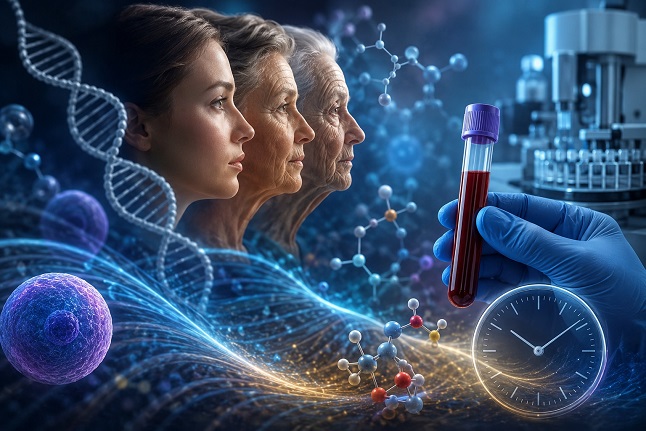 Scientists have proposed a precision Gerontometry system that could detect changes in biological aging within about
one month, potentially accelerating the search for effective anti-aging therapies
The work was developed by researchers Petr G. Lokhov and Elena E. Balashova from the Institute of Biomedical Chemistry, Moscow, Russia, who argue that the biggest obstacle in anti-aging medicine is not the lack of potential therapies but the inability to accurately measure whether they actually work.
Why Measuring Aging Has Been So Difficult
Aging is the biggest risk factor for many serious illnesses, including heart disease, stroke, cancer, Alzheimer's disease, Parkinson's disease, type 2 diabetes, and osteoporosis. Although scientists have identified numerous compounds that may slow aging, proving their effectiveness has remained extremely challenging.
Current biological aging tests, often called biological clocks, estimate a person's biological age using DNA, proteins, genes, or metabolites. However, these methods typically have error margins measured in several years, making them unsuitable for detecting small improvements during short clinical studies.
The researchers argue that this limitation has slowed the development of genuine anti-aging therapies while allowing many unproven products and treatments to make questionable longevity claims.
A Different Way to Measure Aging
Rather than trying to calculate a person's exact biological age, the proposed Gerontometry system focuses on measuring how biological age changes over time in the same individual.
The method relies on metabolomics, which studies thousands of tiny molecules called metabolites circulating in the blood. These molecules reflect countless biological processes taking place throughout the body.
Instead of examining only a handful of markers, the scientists propose analyzing thousands of metabolic signals simultaneously using high-resolution mass spectrometry. By averaging information from a very large number of metabolites, random fluctuations are greatly reduced, producing a much more stable measurement.
According to the authors, this approach could measure biological age changes with an accuracy of approximately one month—far beyond the capabilities of existing biological clocks.
How Precision Gerontometry Works
The researchers explain that aging affects virtually every organ, tissue and metabolic pathway in the body. Because of this, blood contains an enormous amount of information about the body's overall aging process.
<
;br />
Their proposed system first establishes each volunteer's normal aging rate by collecting blood samples over several months while maintaining a stable diet and lifestyle. After this baseline is established, an anti-aging intervention—such as a drug, dietary program, supplement or exercise plan—is introduced.
Scientists then continue collecting monthly blood samples and compare the person's metabolic profile with their original baseline. Even small changes in the rate of biological aging may become detectable without waiting many years for disease or death to occur.
In the middle of this
Medical News report, it becomes clear that the proposed framework is designed not only for laboratory research but also to make future clinical trials faster, cheaper and far more reliable.
Potential Uses Go Far Beyond Anti-Aging Drugs
The authors believe precision Gerontometry could reshape numerous areas of medicine and public health. Besides testing new longevity drugs, it may help evaluate existing medications for hidden aging effects, determine whether dietary supplements genuinely slow aging, identify the healthiest eating patterns, measure the impact of exercise and sleep, assess environmental pollution, and even study how stress or socioeconomic conditions influence biological aging.
The researchers also suggest the technology could support highly personalized health programs by allowing doctors to monitor how each person's body responds to lifestyle changes over time.
Conclusion
Although precision Gerontometry remains a proposed scientific framework rather than a routine clinical test, it presents an ambitious solution to one of aging research's greatest challenges. By focusing on measuring changes in biological age instead of estimating absolute age, and by analyzing thousands of blood metabolites simultaneously, the approach could dramatically improve the speed and accuracy of anti-aging research. Much additional validation is still needed before widespread adoption, but if future studies confirm these findings, precision Gerontometry may become one of the most important tools for developing scientifically proven therapies that extend healthy human life while eliminating ineffective or misleading anti-aging interventions.
The study findings were published in the peer reviewed journal: Metabolites.
https://www.mdpi.com/2218-1989/16/7/463
For the latest on gerontometry, keep on logging to Thailand
Medical News.
Read Also:
https://thailandwellness.news/how-epigenetics-and-cellular-reprogramming-are-redefining-wellness-and-longevity/
https://thailandwellness.news/punicalagins-and-ellagic-acid-supplements-can-help-those-in-their-30s-and-40s-reclaim-skin-vitality-from-face-to-feet/
https://thailandwellness.news/wellness-and-longevity-aficionados-turn-to-acanthus-mollis-leaf-supplements-to-counteract-aging-related-neurodegeneration/
https://thailandwellness.news/




 Share
Share
 Tweet
Tweet
 Share
Share