Immune Defense Traps in Viral Infections Found to Drive Both Protection and Tissue Damage
Nikhil Prasad Fact checked by:Thailand Medical News Team Feb 21, 2026 7 months, 1 week, 3 days, 23 hours, 55 minutes ago
Medical News: Researchers warn that immune defense webs may fuel severe disease
Researchers from the Armand-Frappier Santé Biotechnologie Research Center at the Institut National de la Recherche Scientifique (INRS) in Laval, Canada, the Department of Microbiology and Immunology at McGill University in Montreal, Canada, and the Helmholtz Centre for Environmental Research-UFZ in Leipzig, Germany, have released an extensive review examining how a critical immune defense mechanism can both protect the body from viruses and, under certain conditions, cause significant tissue injury. The study focuses on neutrophil extracellular traps, commonly called NETs, which are web-like structures released by neutrophils to capture and neutralize pathogens but may also drive harmful inflammation when poorly controlled.
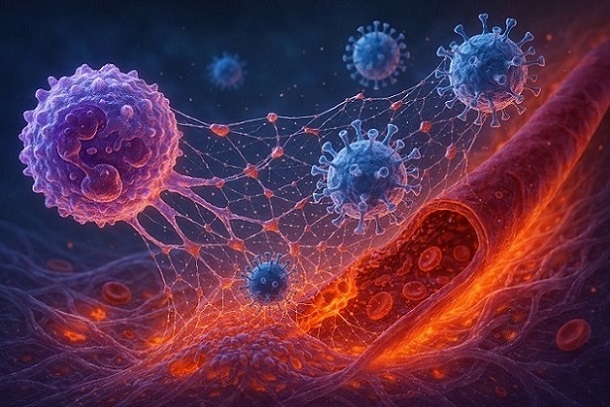 Scientists reveal how immune DNA traps can defend against viruses but also contribute to inflammation and organ injury
Understanding the Role of Immune Defense Traps
Scientists reveal how immune DNA traps can defend against viruses but also contribute to inflammation and organ injury
Understanding the Role of Immune Defense Traps
Neutrophils are among the first immune cells to respond when viruses invade the body. These cells can release NETs, networks made of DNA, proteins, and enzymes designed to trap viruses and limit their spread. According to the researchers, this mechanism represents an important early defense strategy that helps the immune system gain control over infection. However, the review emphasizes that NET formation is a double-edged process. While beneficial in moderation, excessive or prolonged NET release can damage surrounding tissues and intensify disease severity.
This
Medical News report highlights that the balance between protection and damage is critical. Infections such as COVID-19 and hepatitis B virus (HBV) can trigger strong neutrophil activation, leading to high NET production that may shift from protective to destructive.
How Viruses Trigger NET Formation
The review explains that viral components stimulate immune receptors on neutrophils, activating signaling pathways that lead to NET release. In respiratory infections like SARS-CoV-2, infected cells release inflammatory signals that attract neutrophils in large numbers. This heavy recruitment increases the likelihood of excessive NET formation, which has been associated with severe lung inflammation and vascular injury.
In liver infections caused by HBV, NETs may initially help suppress viral spread. However, persistent activation can contribute to chronic inflammation, fibrosis, and disease progression. Researchers also note that some viruses may exploit NET components or interfere with their regulation, allowing viral persistence while simultaneously amplifying immune-mediated damage.
When Protective Mechanisms Become Harmful
A major concern identified in the review is the failure to clear NETs effectively after they have served their purpose. Normally, immune cells remove these structures to restore tissue balance. When clearance is impaired, NET components can remain in tissues and act as danger signals that sustain inflammation. This prolo
nged immune activation has been linked to blood clot formation, endothelial injury, organ dysfunction, and even autoimmune reactions.
The authors further discuss how persistent NET activity may help explain post-viral syndromes, including long COVID, where inflammation and symptoms continue long after the initial infection has resolved.
Emerging Therapies Targeting NETs
Scientists are increasingly exploring treatment strategies aimed at regulating NET formation rather than completely suppressing it. Potential approaches include targeting enzymes involved in NET release, reducing oxidative stress, and enhancing natural NET clearance mechanisms. These therapies aim to maintain antiviral protection while preventing the tissue damage associated with excessive NET activity.
Conclusion
The findings highlight the complex and sometimes paradoxical role of immune defense traps in viral infections. NETs are essential for early antiviral defense, yet their uncontrolled accumulation can trigger inflammation, vascular damage, fibrosis, and long-term immune complications. The researchers stress that future therapies must carefully balance preserving immune protection while limiting harmful overactivation, as both insufficient and excessive NET responses may worsen outcomes. Understanding this balance could reshape how severe viral infections are treated and may help reduce long-term complications seen after recovery.
The study findings were published on a preprint server and are currently being peer reviewed.
https://www.preprints.org/manuscript/202602.0966
For the latest on viral infections and immune traps, keep on logging to Thailand
Medical News.
Read Also:
https://www.thailandmedical.news/articles/coronavirus
https://www.thailandmedical.news/articles/long-covid




 Share
Share
 Tweet
Tweet
 Share
Share

































