Nikhil Prasad Fact checked by:Thailand Medical News Team Jan 12, 2026 8 months, 3 weeks, 2 days, 2 hours, 47 minutes ago
Medical News: Quercetin gives chemo a powerful boost
A new laboratory study from Turkish researchers at Private Batman Life Hospital, Private Medical Practice Bursa, Kahramanmaras Sutcu Imam University, Dicle University, and Canakkale Onsekiz Mart University suggests that pairing a natural plant compound called quercetin with the common chemotherapy drug gemcitabine could make treatment far more effective for one of the most difficult forms of breast cancer.
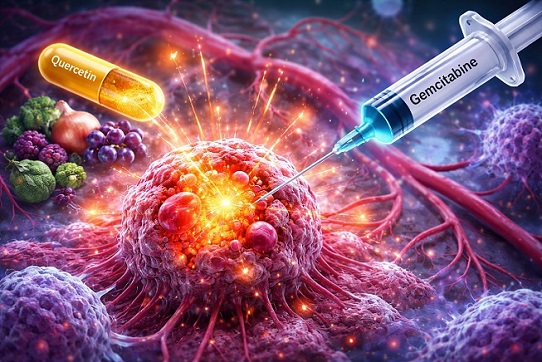
Quercetin supercharges gemcitabine to push stubborn breast cancer cells into oxidative collapse & death.
This
Medical News report focuses on triple negative breast cancer - a type that hits younger women more often and is extremely hard to treat because it does not respond to hormone medicines and quickly becomes resistant to chemotherapy.
Study reveals cleaner attack on cancer cells
Using a well-known aggressive breast cancer cell line called MDA MB 231, the team tested gemcitabine on its own, quercetin on its own and the two agents combined. Both single treatments slowed cancer growth but the mix performed dramatically better.
Cancer cell survival dropped sharply when the two were combined with the strongest dose cutting living cancer cells by roughly three quarters. That level of knockout was noticeably more than either drug could produce on its own suggesting a true synergy.
Starving cancer of oxygen and nutrients
Cancer cells thrive in low oxygen pockets where they switch on a survival program led by a molecule called HIF-1-alpha that tells tumors to build new blood vessels with help from VEGF.
The scientists found that quercetin plus gemcitabine greatly suppressed both HIF-1-alpha and VEGF which means fewer new blood vessels tumor starvation and weaker resistance to treatment.
This is important because blocking angiogenesis cuts off fuel lines cancer depends on to grow and spread.
Stressing cancer to death
Most cells can handle ordinary levels of oxidative stress substances called ROS are normally kept in check by antioxidant molecules including glutathione. But the combination treatment tipped that balance.
Cancer cells hit with both agents produced almost triple the harmful ROS seen in untreated cells and their antioxidant shields collapsed.
Levels of glutathione dropped by almost half and a marker of cell membrane damage soared. That combination of rising stress and shrinking defenses made tumor cells more prone to self-destruct.
Triggering the self-destruct switch
The research team confirmed that many cancer cells were dying through programmed cell death or apoptosis. Activity of the key execution protein caspase-3 jumped more than threefold and survival molecules dropped as death signaling rose.
Together these changes show that quercetin makes gemcitabine better at flip
ping cancers internal off switch while also weakening its defenses that normally protect against chemotherapy.
Why it matters
This study suggests that a natural dietary flavonoid can make a standard cancer drug work harder and smarter at lower doses. The findings point toward a future in which patients might gain more benefit from treatment with fewer side effects.
Although the work was done only in cell cultures and needs animal and clinical testing, it highlights a promising two-pronged strategy: squeeze tumors of oxygen and overwhelm their redox defenses at the same time. This united assault could offer new hope for aggressive breast cancers that currently lack treatment options and quickly outsmart single drug therapies. Additional studies are needed but the direction looks encouraging for real world impact.
The study findings were published in the peer reviewed journal: Antioxidants.
https://www.mdpi.com/2076-3921/15/1/91
For the latest on breast cancer, keep on logging to Thailand
Medical News.
Read Also:
https://www.thailandmedical.news/articles/cancer




 Share
Share
 Tweet
Tweet
 Share
Share

































