Nikhil Prasad Fact checked by:Thailand Medical News Team Jan 21, 2026 8 months, 2 weeks, 6 hours, 47 minutes ago
Medical News: A new international study has uncovered a hidden mechanism by which fragments of the SARS-CoV-2 virus may directly damage crucial immune cells, helping explain why some COVID-19 patients develop severe or prolonged illness even after the virus itself begins to decline.
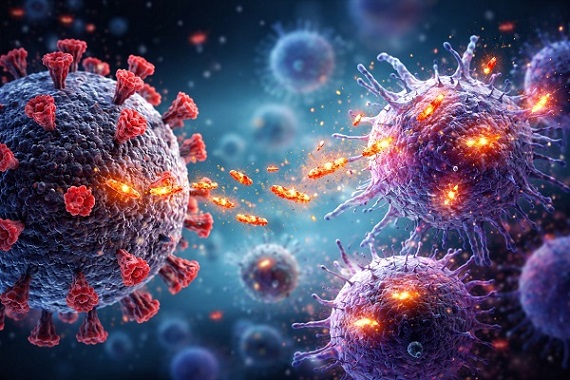 New research reveals how tiny fragments of the COVID-19 virus can selectively destroy vital immune
cells by punching holes in their membranes.
A Closer Look at What Happens After the Virus Breaks Down
When SARS-CoV-2 infects the body, its proteins do not simply disappear after being attacked by the immune system. Instead, they are chopped into smaller pieces by host enzymes. This
Medical News report highlights how researchers discovered that some of these fragments behave like antimicrobial peptides, small molecules normally used by the body to kill bacteria.
Surprisingly, these virus-derived fragments, called xenoAMPs, can form tiny holes in the membranes of certain immune cells. This process damages or kills the cells outright, interfering with the body’s ability to fight infection effectively.
Why Some Immune Cells Are Hit Harder Than Others?
The study found that not all immune cells are equally affected. Cells such as plasmacytoid dendritic cells, CD4-T cells, and CD8-T cells were especially vulnerable. These cells have complex surfaces covered in tiny projections, which create special curved regions in their membranes. The viral fragments are naturally drawn to these curved areas, where they accumulate and punch holes through the cell membrane.
In contrast, immune cells like monocytes and neutrophils have smoother, rounder surfaces and were largely spared. This selective damage mirrors real-world observations in severe COVID-19 cases, where patients often show dramatic losses of T-cells and dendritic cells while other immune cells remain relatively intact.
Advanced Tools Reveal a Hidden Physical Mechanism
Using a combination of mass spectrometry, X-ray scattering, computer simulations, and experiments on freshly isolated human immune cells, the scientists showed that these viral fragments can create pores about one to two nanometers wide. Even more striking, mixtures of different fragments worked together, increasing their destructive effect, especially when combined with the body’s own inflammatory peptides.
The research also showed that fragments from the Omicron variant were less damaging. Structural changes in Omicron-derived peptides reduced their ability to form stable pores, offering a possible explanation for why Omicron infections are often associated with less severe immune cell depletion.
Institutions Behind the Discovery
The research team included scientists from Westlake University in China, University of California Los Angeles in the United States, Max Planck Institute of Molecular Physiology in Germany, Fudan University in China, and several other collaborating institu
tions across Europe, Asia, and North America.
Why These Findings Matter
This work suggests that immune damage in COVID-19 may continue even after viral replication slows, driven by leftover viral fragments. These fragments may worsen inflammation, delay recovery, and weaken long-term immune protection.
Conclusion
The findings provide a powerful new explanation for immune cell loss seen in severe and long COVID-19. By showing how viral protein fragments selectively target immune cells based on their shape, the study opens new paths for treatments aimed at blocking this damage. Preventing these fragments from forming pores could help preserve immune function, reduce disease severity, and improve recovery outcomes in future coronavirus infections.
The study findings were published in the peer reviewed journal: Proceedings of the National Academy of Sciences
https://www.pnas.org/doi/10.1073/pnas.2521841122
For the latest COVID-19 news, keep on logging to Thailand
Medical News.
Read Also:
https://www.thailandmedical.news/articles/coronavirus
https://www.thailandmedical.news/articles/long-covid




 Share
Share
 Tweet
Tweet
 Share
Share

































