Nikhil Prasad Fact checked by:Thailand Medical News Team Jul 14, 2026 1 month, 2 weeks, 5 days, 13 hours, 50 minutes ago
Medical News: A Silent Legacy of Untreated Syphilis Can Surface Decades Later
A history of sexual promiscuity can significantly increase the lifetime risk of acquiring untreated syphilis, leaving some individuals vulnerable to one of the infection's most dangerous late-stage cardiovascular complications—syphilitic aortitis. Although widespread antibiotic use has made this condition uncommon in developed healthcare settings, experts continue to warn that delayed diagnosis of syphilis and missed screening opportunities allow the disease to silently progress in a small but important number of patients. This Medical News report examines how untreated Treponema pallidum infection can remain dormant for decades before causing irreversible injury to the body's largest artery.
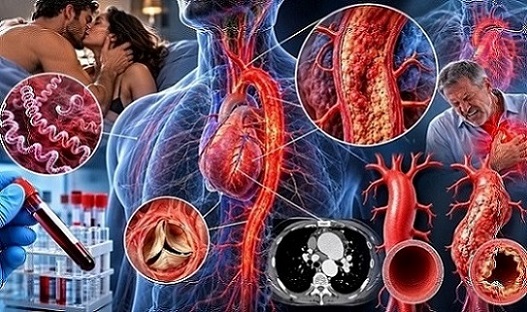 Untreated syphilis can remain silent for decades before causing irreversible damage to the aorta and
life-threatening cardiovascular complications
Syphilitic aortitis is a manifestation of tertiary syphilis that usually develops between 10 and 30 years after the initial infection. During this prolonged latent period, patients often experience no symptoms while the bacteria gradually damage the blood vessels known as the vasa vasorum, which supply oxygen and nutrients to the wall of the aorta. As these vessels become inflamed and narrowed, the aortic wall is deprived of oxygen, leading to progressive destruction of elastic fibers and smooth muscle cells.
Progressive Damage Weakens the Aorta
The chronic inflammation leaves the inner lining of the aorta scarred and wrinkled, producing the classic "tree bark" appearance recognized by pathologists. Unfortunately, by the time this damage becomes apparent, it is permanent. While antibiotic therapy can eliminate the infection, it cannot restore the destroyed elastic tissue or reverse structural deterioration that has already occurred.
The weakening of the aortic wall predisposes patients to several potentially fatal cardiovascular complications. The most common is the development of ascending thoracic aortic aneurysms, in which the weakened vessel balloons outward and becomes increasingly prone to rupture. Another frequent consequence is aortic regurgitation, where dilation of the aortic root prevents the valve leaflets from closing properly, allowing blood to leak backward into the left ventricle and eventually leading to heart failure. In addition, scarring around the coronary artery openings can produce coronary ostial stenosis, reducing blood flow to the heart muscle and triggering angina or even myocardial infarction.
Why the Disease Often Escapes Detection
One of the greatest clinical challenges is that syphilitic aortitis remains remarkably silent for decades. Most patients have no warning signs during the lengthy latent stage because Treponema pallidum remains hidden within the body after the primary and secondary stages resolve.
Latent syphilis begins after the characteristic painless sore and skin rash disappear. During this phase, the infection continues despite the absence of symptoms. The dormant period may last from one year to well over two decades. Early latent syphilis remains transmissible through sexual contact, w
hereas late latent disease generally loses sexual transmissibility, although infected pregnant women may still pass the organism to their unborn child.
Without diagnosis and treatment, the infection may eventually progress to tertiary syphilis, affecting multiple organs including the heart, brain, eyes, liver, bones and nervous system.
Symptoms Usually Reflect Advanced Structural Damage
Clinical symptoms generally appear only after significant cardiovascular injury has already occurred.
Patients with enlarging aortic aneurysms frequently develop persistent deep chest pain that may radiate into the back. Compression of nearby structures can produce hoarseness due to recurrent laryngeal nerve involvement, while pressure on the trachea or esophagus may lead to chronic cough, wheezing, difficulty breathing or swallowing.
When aortic regurgitation develops, patients gradually experience worsening shortness of breath during exertion before progressing to breathlessness at rest. Fatigue becomes increasingly severe as cardiac output declines. Palpitations, swelling of the ankles and legs, dizziness and episodes of fainting may also occur as heart failure advances.
If coronary ostial stenosis develops, blood flow to the heart muscle becomes restricted, producing severe exertional chest pain that closely resembles conventional coronary artery disease.
The most alarming warning sign is the sudden onset of tearing chest or back pain, which may indicate an impending or actual rupture of an aortic aneurysm—a life-threatening emergency requiring immediate surgical intervention.
Diagnosis Requires Specialized Cardiovascular Imaging
Because the symptoms closely resemble common heart diseases associated with aging, physicians rely on a combination of blood testing and cardiovascular imaging to identify syphilitic aortitis.
Routine syphilis serology, including rapid plasma reagin (RPR) or Venereal Disease Research Laboratory (VDRL) testing, helps establish evidence of infection. Imaging studies such as chest X-rays, echocardiography, computed tomography (CT), CT angiography and magnetic resonance imaging evaluate aneurysm formation, valve dysfunction and narrowing of the coronary artery origins.
Patients suspected of having neurological involvement often undergo lumbar puncture for cerebrospinal fluid analysis to determine whether neurosyphilis is present before treatment begins.
Penicillin Remains the Gold Standard
Despite decades of use, Treponema pallidum has never developed meaningful resistance to penicillin, making Penicillin G the definitive treatment for syphilitic aortitis.
The standard regimen consists of Benzathine Penicillin G administered intramuscularly at 2.4 million units once weekly for three consecutive weeks, for a cumulative dose of 7.2 million units.
If cerebrospinal fluid testing confirms neurosyphilis, treatment changes to intravenous aqueous Penicillin G at 18 to 24 million units daily, divided into doses every four hours for 10 to 14 days.
Patients with severe penicillin allergy are generally advised to undergo hospital-based penicillin desensitization because penicillin remains the preferred therapy. When desensitization is not feasible, prolonged doxycycline therapy under specialist supervision may be considered.
Managing Dangerous Treatment Reactions and Surgical Repair
Physicians must also anticipate the Jarisch-Herxheimer reaction, an acute inflammatory response occurring within 24 hours after antibiotic treatment begins. Rapid destruction of large numbers of bacteria releases inflammatory components into the bloodstream, producing fever, chills, muscle aches and hypotension. In patients with cardiovascular syphilis, this inflammatory surge may increase the risk of aneurysm rupture or cardiac complications. For this reason, corticosteroids such as prednisone are sometimes administered before initiating antibiotic therapy to reduce inflammatory severity.
While antibiotics eradicate the infection, they cannot repair mechanical damage already inflicted on the cardiovascular system. Patients with advanced disease frequently require major cardiac surgery, including replacement of aneurysmal segments of the aorta using synthetic Dacron grafts, aortic valve replacement for severe regurgitation and coronary artery bypass grafting when coronary ostial stenosis significantly compromises blood flow.
Following treatment, lifelong monitoring remains essential. Periodic RPR or VDRL testing helps confirm that infection remains inactive, while serial CT scans and echocardiograms monitor the stability of the repaired or remaining aorta and detect new vascular complications before they become catastrophic.
Early Screening Remains the Most Effective Protection
Although syphilitic aortitis has become relatively rare because of modern antibiotic therapy, increasing rates of sexually transmitted infections highlight the continuing importance of early diagnosis and prompt treatment. Individuals with a history of multiple sexual partners or other high-risk sexual behaviors should undergo appropriate screening, particularly because latent syphilis may remain completely asymptomatic for decades. Identifying and treating infection before tertiary complications develop not only prevents irreversible cardiovascular destruction but also eliminates further transmission, preserving both individual and public health through timely intervention and long-term medical surveillance.
References:
https://www.sciencedirect.com/topics/medicine-and-dentistry/syphilitic-aortitis
https://www.nejm.org/doi/full/10.1056/NEJMicm010343
https://www.jtcvs.org/article/S0022-5223%2817%2930873-5/fulltext
https://jamanetwork.com/journals/jamainternalmedicine/article-abstract/538234
https://www.jvascsurg.org/article/S0741-5214(10)01235-8/fulltext
https://academic.oup.com/icvts/article/14/2/223/646377
https://link.springer.com/article/10.1007/s12105-009-0127-0
https://www.nature.com/articles/nrdp201773
For the latest on Syphilitic-Aortitis, keep on logging to Thailand
Medical News.
Read Also:
https://www.thailandmedical.news/articles/stds
https://www.thailandmedical.news/articles/cardiology




 Share
Share
 Tweet
Tweet
 Share
Share