Nikhil Prasad Fact checked by:Thailand Medical News Team Mar 31, 2026 6 months, 4 days, 6 hours, 9 minutes ago
Medical News: In a striking new development, scientists have uncovered a hidden layer of gene regulation that could transform how depression is detected and monitored. Instead of focusing only on how much a gene is expressed, researchers are now looking at how genes are processed—and the findings suggest this could lead to a powerful new type of blood test for mood disorders.
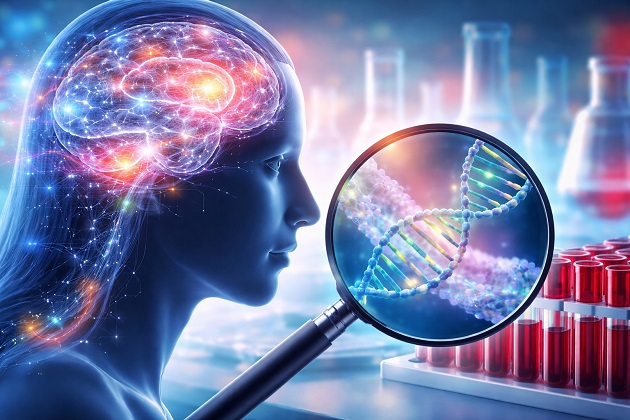 Scientists uncover a reversible gene-processing mechanism that could lead to the first reliable blood test for depression
A New Way to Understand Depression
Scientists uncover a reversible gene-processing mechanism that could lead to the first reliable blood test for depression
A New Way to Understand Depression
Depression has long puzzled scientists because it lacks reliable laboratory tests. Diagnosis still depends mainly on symptoms, which can vary widely between individuals. Now, researchers from the School of Pharmacy at Kitasato University (Japan), the Oriental Medicine Research Center at Kitasato University (Japan), and the Tsumura Advanced Technology Research Laboratories (Japan) are proposing a completely new approach.
Their work highlights a process called intron retention, a natural step in how genes are converted into usable instructions inside cells. Normally, unnecessary segments of RNA are removed before proteins are made. But sometimes, these segments are kept—and that decision appears to play a critical role in how the body responds to stress.
The “Gene Throttle” That Controls Stress Responses
The researchers describe intron retention as a kind of biological “throttle.” When the body is under stress—whether from inflammation, poor metabolism, or psychological strain—cells may deliberately hold back gene activity by retaining introns. This acts like a brake, slowing down protein production.
When conditions improve, the system can reverse itself, removing those introns and restoring normal function. This reversible mechanism suggests that the body has a built-in way to fine-tune its internal balance.
Importantly, the study shows that this process is not random. It is tightly controlled and appears across immune, metabolic, and brain-related systems.
Why Current Blood Tests Fall Short
Previous attempts to find blood biomarkers for depression focused on measuring gene activity levels. However, these methods often failed because gene expression is highly sensitive to external factors like sleep, diet, infections, and even time of day.
The new research suggests that intron retention is more stable and meaningful because it reflects deeper regulatory decisions inside cells, rather than surface-level changes. This could explain why earlier approaches struggled to produce consistent results across different patient groups.
Early Evidence from Animal and Human Studies
Experiments in animal models revealed that stress-like conditions caused widespread increases in intron retention across many genes. Remarkably, when treated with certain traditional herbal medicines, these patterns returned toward normal—indicating that the process is reversible.
Human studies also showed promis
ing results. When researchers compared different patient groups from various countries, they found that intron retention patterns were far more consistent than traditional gene expression markers. This suggests a universal biological signal linked to depression.
At this point in the research, this
Medical News report highlights that intron retention could serve not only as a diagnostic tool but also as a way to track how well treatments are working over-time.
A New Model for Mental Health
The scientists propose what they call the “IR-Homeostat” model. In simple terms, this model suggests that cells continuously monitor internal balance and adjust gene output using intron retention as a control switch.
When the body detects imbalance - such as inflammation or stress - it activates this system to restore stability. If this mechanism becomes disrupted, it may contribute to mood disorders like depression.
Potential for Future Blood Tests
One of the most exciting implications is the possibility of developing simple blood tests based on intron retention patterns. Unlike current methods, these tests could:
-Detect depression earlier
-Identify different subtypes of the condition
-Monitor treatment response in real time
-Predict relapse before symptoms return
Such tools could revolutionize mental health care, making diagnosis more objective and personalized.
Conclusion
This research introduces a compelling new way to understand depression at the molecular level. By shifting focus from gene activity to gene processing, scientists have uncovered a dynamic system that reflects how the body responds to stress. The discovery that intron retention is reversible, measurable in blood, and consistent across populations makes it a strong candidate for future diagnostics. While more studies are needed, this breakthrough opens the door to more accurate detection, better treatment monitoring, and a deeper understanding of how mental health conditions develop and evolve.
The study findings were published in the peer reviewed International Journal of Molecular Sciences.
https://www.mdpi.com/1422-0067/27/7/3119
For the latest on mental health, keep on logging to Thailand
Medical News.
Read Also:
https://www.thailandmedical.news/articles/mental-health




 Share
Share
 Tweet
Tweet
 Share
Share

































