Nikhil Prasad Fact checked by:Thailand Medical News Team Dec 01, 2025 10 months, 3 days, 5 hours, 8 minutes ago
Medical News: A Hidden Cellular System Now Tied to Lasting COVID-19 Damage and Long COVID
New scientific insights are revealing why COVID-19 can cause not only severe sickness during infection but also long-lasting complications that persist for months. Researchers from the Department of Medical Biology and Genetics at the University of Gdańsk have uncovered how SARS-CoV-2 disrupts a vital cellular control system called the TFEB (Transcription factor EB) pathway. This system governs the autophagy-lysosome pathway, a process the body uses to clear toxins, recycle damaged components and regulate immune balance. According to this
Medical News report, once this pathway is shut down or misdirected by the SARS-CoV-2 virus, inflammation rises sharply and viral debris lingers inside cells, setting the stage for prolonged illness often called as Long COVID.
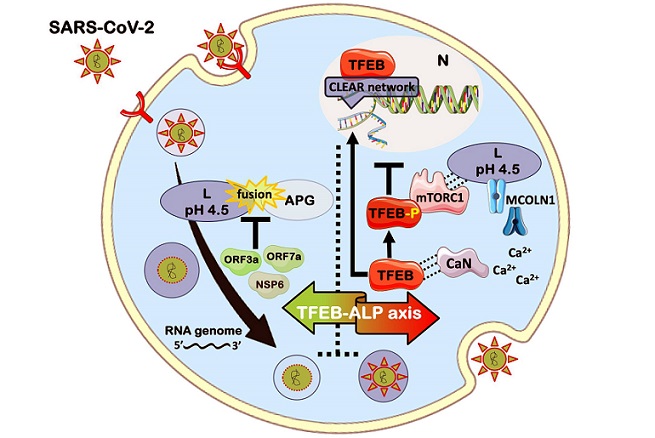 Study reveals how TFEB pathway disruption drives both acute and long COVID illness
How the Virus Blocks the Cells Cleanup Machinery
Study reveals how TFEB pathway disruption drives both acute and long COVID illness
How the Virus Blocks the Cells Cleanup Machinery
The study explains that SARS-CoV-2 uses several of its proteins—including ORF3a, ORF7a and NSP6—to block the normal fusion between autophagosomes and lysosomes. This fusion is essential for breaking down harmful materials. When the virus prevents this step, cells become overloaded with waste and viral fragments. This process, known as incomplete autophagy, leads to a buildup of inflammatory signals and allows viral components to survive longer inside tissues. The failure of this cleanup system also contributes to dangerous immune responses such as cytokine storms, which are linked to severe lung injury and multi-organ complications.
TFEB The Master Switch Knocked Off Balance
At the heart of this process lies TFEB, a master regulatory protein that controls lysosomal activity, immune signaling and metabolic stability. Under healthy conditions TFEB moves into the cell nucleus during stress to activate genes that enhance cleanup and restore balance. The study shows that SARS-CoV-2 causes abnormal lysosomal stress that forces TFEB into harmful activity patterns. This disrupts antigen presentation, weakens normal immune defenses and contributes to persistent inflammation seen in both acute and long COVID cases. The researchers also report that TFEB influences interferon signaling, cytokine production and even mitochondrial health, all of which become impaired during infection.
Why Long COVID Emerges After the Acute Phase
Even months after the initial infection, many individuals continue to show signs of disrupted autophagy, immune imbalance and mitochondrial exhaustion. Persistent complement activation, elevated oxidative stress and poor mitophagy contribute to symptoms such as fatigue, cognitive issues and chronic inflammation. The study suggests that normalizing TFEB activity could help restore immune stability and reduce lingering symptoms by reactivating proper cellular cleanup mechanisms.
Final Insights
This research shows that COVID-19 does far more than infect the respiratory tract it hijacks one of the body&am
p;rsquo;s most important maintenance systems. By disrupting the TFEB pathway and shutting down the autophagy-lysosome process, the virus creates an internal environment that encourages inflammation, immune dysfunction and long-term health complications. Restoring TFEB function may offer a powerful new therapeutic strategy that not only helps reduce viral replication in the early stages but also supports recovery and reduces the risk of Long COVID. This deeper understanding of the TFEB pathway may open new doors for treatments that repair the body’s own defenses and help millions suffering the ongoing effects of COVID-19.
The study findings were published in the peer reviewed journal: Frontiers in Immunology.
https://www.frontiersin.org/journals/immunology/articles/10.3389/fimmu.2025.1708364/full
For the latest COVID-19 News, keep on logging to Thailand
Medical News.
Read Also:
https://www.thailandmedical.news/articles/coronavirus
https://www.thailandmedical.news/articles/long-covid




 Share
Share
 Tweet
Tweet
 Share
Share

































