Nikhil Prasad Fact checked by:Thailand Medical News Team Jun 27, 2026 1 month, 3 weeks, 1 day, 19 hours, 3 minutes ago
Medical News: Scientists Discover Magnetic Pulses Can Rapidly Activate Key Memory Cells
Researchers from the College of Health Sciences & Biomedical Engineering, Hebei University of Technology, the Key Laboratory of Bioelectromagnetics and Neural Engineering of Hebei Province at Hebei University of Technology, and the Key Laboratory of Digital Medical Engineering of Hebei Province, College of Electronic & Information Engineering, Hebei University, China, have uncovered new evidence showing that high-frequency magnetic stimulation can immediately increase the activity of important brain cells involved in learning and memory. Their findings may help scientists better understand how magnetic brain stimulation works and could eventually contribute to improved treatments for neurological and cognitive disorders.
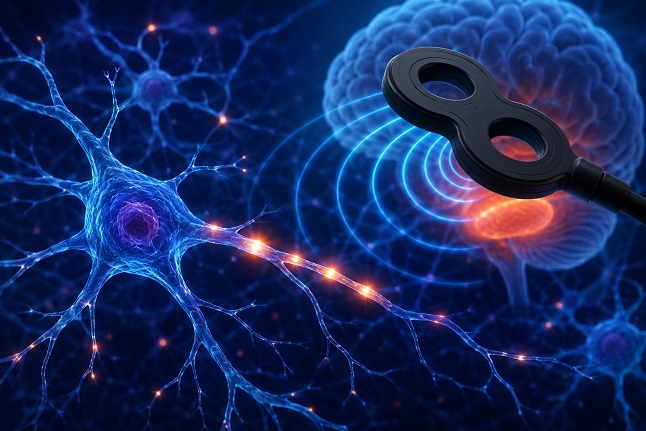 High-frequency magnetic stimulation rapidly increased the activity of key memory-related brain cells by altering their
electrical signaling properties
Focusing on the Brain's Memory Center
The research centered on the dentate gyrus, a part of the hippocampus that plays a critical role in forming memories and processing new information. The team investigated two major types of nerve cells found in this region. Glutamatergic neurons act as the brain's primary excitatory cells, helping transmit signals, while GABAergic neurons serve as inhibitory cells that keep excessive brain activity under control. Maintaining the right balance between these two cell types is essential for healthy brain function.
To examine how magnetic stimulation influences these neurons, the researchers applied magnetic pulses at frequencies of 1, 10 and 20 Hertz with magnetic field strengths of 50 and 75 millitesla. They combined sophisticated electrical recordings from mouse brain tissue with advanced computer modeling based on the Hodgkin-Huxley model to better understand the biological mechanisms involved.
High-Frequency Pulses Produced Stronger Responses
The study found that high-frequency magnetic stimulation, particularly at 10 and 20 Hertz, rapidly made both types of neurons much more excitable. The stimulated cells generated significantly more electrical impulses than untreated cells, while low-frequency stimulation at 1 Hertz produced only minimal changes.
The researchers also observed that the resting membrane potential of both neuron types became more positive after high-frequency stimulation. This meant the neurons required less additional stimulation before firing, allowing them to communicate more efficiently. Glutamatergic neurons displayed a clear frequency-dependent response, whereas GABAergic neurons appeared even more sensitive to changes in both stimulation frequency and magnetic field strength.
Magnetic Stimulation Alters Cellular Electrical Signals
Beyond increasing overall activity, the magnetic pulses also changed several important electrical characteristics of individual nerve impulses. The threshold required to trigger an electrical signal became lower, signal peaks became higher, signal duration became shorter, and the speed at which electrical signals rose increased considerably.
<
;br />
These changes indicate that neurons were able to generate electrical signals faster and more efficiently after exposure to high-frequency magnetic stimulation. This
Medical News report highlights that these immediate changes occurred within minutes of stimulation, suggesting that the earliest effects of magnetic therapy begin directly at the level of individual brain cells.
Computer simulations closely matched the laboratory findings. The models suggested that high-frequency magnetic stimulation changes the behavior of sodium and potassium ion channels, which control the movement of electrically charged particles across nerve cell membranes. Sodium channels became easier to activate and remained functional for longer, while potassium channels required stronger signals before activating. Together, these effects allowed neurons to fire more readily.
What the Findings Could Mean
Although the experiments were conducted using mouse brain tissue in laboratory conditions rather than living humans, the findings provide valuable insight into how magnetic stimulation may influence brain function at the cellular level. Understanding these immediate biological effects could help scientists optimize non-invasive brain stimulation techniques used to treat disorders such as depression, memory impairment and other neurological conditions linked to abnormal communication between excitatory and inhibitory neurons.
Conclusion
The study demonstrates that high-frequency magnetic stimulation rapidly enhances the electrical activity of both glutamatergic and GABAergic neurons within the hippocampal dentate gyrus. Rather than simply increasing overall brain activity, the stimulation appears to fine-tune the electrical properties of individual nerve cells by modifying ion channel behavior. While additional animal and human studies are needed before these findings can be translated into clinical practice, the work provides an important step toward understanding how magnetic stimulation influences the brain at its most fundamental level and may help guide the development of safer and more effective neuromodulation therapies.
The study findings were published in the peer reviewed journal: Brain Sciences.
https://www.mdpi.com/2076-3425/16/7/673
For the latest research on high-frequency magnetic stimulation for health purposes, keep on logging to Thailand
Medical News.
Read Also:
https://www.thailandmedical.news/news/magnetic-therapy-shows-promise-for-long-covid-brain-fog
https://www.thailandmedical.news/news/healing-and-regenerating-nerves-naturally-with-electromagnetic-and-sound-waves
https://www.thailandmedical.news/news/singapore-study-finds-that-brief-exposures-to-magnetic-fields-can-enhance-uptake-of-breast-cancer-chemotherapeutic-drugs




 Share
Share
 Tweet
Tweet
 Share
Share