Nikhil Prasad Fact checked by:Thailand Medical News Team Aug 17, 2026 1 month, 2 weeks, 5 days, 16 hours, 53 minutes ago
Researchers Find Measurable Changes in Long COVID Brains
Scientists have identified two unusual brainwave patterns that may help explain fatigue and “brain fog” in Long COVID. The findings raise the possibility that electroencephalography, or EEG, could help assess difficult-to-measure neurological symptoms.
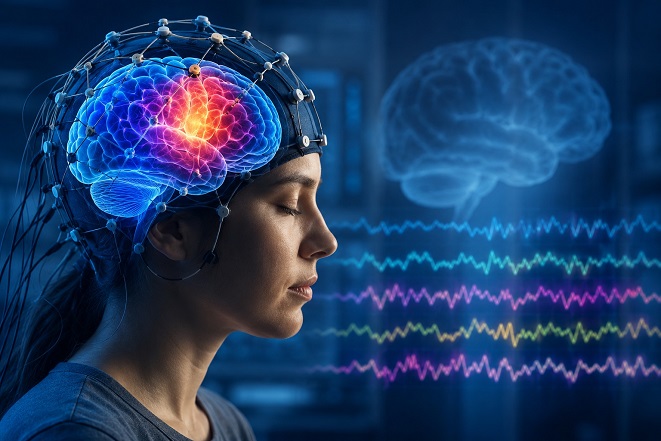 Altered beta and alpha brainwaves were linked to brain fog and fatigue in people with Long COVID
Researchers came from McGill University’s Integrated Program in Neuroscience and School of Physical and Occupational Therapy; Center for Interdisciplinary Research in Rehabilitation of Greater Montreal; BRAIN Lab, Jewish Rehabilitation Hospital, CISSS-Laval; Research Institute of the McGill University Health Centre; Université de Montréal’s Department of Anesthesiology and Pain Medicine and Department of Neuroscience; and Centre for Advanced Research in Sleep Medicine, Hôpital du Sacré-Coeur de Montréal, Canada.
How Brain Activity Was Tested
The study involved 20 people with Long COVID reporting fatigue, brain fog and post-exertional malaise, plus 20 healthy participants matched for age and sex. Long COVID participants had been infected an average of about 24 months earlier.
EEG recordings measured electrical brain activity during rest and repeated handgrips. Scientists focused on the left sensorimotor cortex, involved in movement, sensation and regulation of brain activity.
During movement, beta brainwave activity normally falls and then rebounds after movement ends. This is called the post-movement beta rebound, or PMBR.
A Much Smaller Beta Rebound
The Long COVID group showed a significantly smaller PMBR at electrode C3. Healthy controls had an average rebound of 17.47 percent, compared with just 2.95 percent in the Long COVID group. Smaller rebounds were also associated with greater cognitive difficulties.
PMBR is believed to reflect inhibitory control after movement. A weaker rebound may therefore indicate difficulty resetting and regulating brain activity.
Researchers suggest altered GABA-related signaling and disrupted thalamic and basal-ganglia circuits could contribute, although these mechanisms were not directly measured.
In this Thailand
Medical News report, another important finding appeared while participants were resting.
Slower Alpha Rhythm Linked to Fatigue
At electrode C5, controls had an average alpha central frequency of about 10.6 hertz, compared with 9.6 hertz in the Long COVID group. The difference remained significant after correction for multiple comparisons.
Slower alpha frequency was associated with greater fatigue. Alpha rhythms help organize information processing and regulate the balance between brain excitation and inhibition. Slowing could therefore reflect less efficient neural communication.
Researchers foun
d no significant differences in alpha peak power, bandwidth or background non-rhythmic EEG components. This suggests the abnormalities may involve specific synchronized rhythms rather than a broad change in overall brain activity.
Long COVID participants also showed slower reaction times and poorer combined hand-and-finger coordination, despite having similar grip strength to controls. However, associations between EEG measures and symptoms were less convincing when the Long COVID group was examined alone, meaning some relationships may partly reflect differences between patients and controls.
Conclusions
These findings provide preliminary evidence that Long COVID fatigue and brain fog are accompanied by measurable changes in sensorimotor brain rhythms. However, this small cross-sectional study cannot establish cause and effect, and larger longitudinal studies are needed before PMBR or alpha-frequency slowing can be considered reliable clinical biomarkers.
The study findings were published in the peer reviewed Journal of Clinical Neuroscience.
https://www.sciencedirect.com/science/article/pii/S0967586826003814
Read Also:
https://www.thailandmedical.news/articles/coronavirus
https://www.thailandmedical.news/articles/long-covid




 Share
Share
 Tweet
Tweet
 Share
Share