Natural Tea and Plant Compounds Show Promise Against Dangerous Alpha-1 Antitrypsin Protein Clumping
Nikhil Prasad Fact checked by:Thailand Medical News Team Jun 10, 2026 3 months, 3 weeks, 3 days, 4 hours, 54 minutes ago
Medical News: Researchers Discover Two Natural Polyphenols That May Help Prevent Harmful Protein Aggregation Linked to Liver and Lung Disease
Protein misfolding and abnormal protein clumping are increasingly recognized as major drivers of many serious diseases, including Alzheimer's disease, Parkinson's disease, and several inherited disorders. Now, scientists have identified two naturally occurring plant compounds that may help stop a key protein from forming harmful aggregates that can damage the liver and lungs.
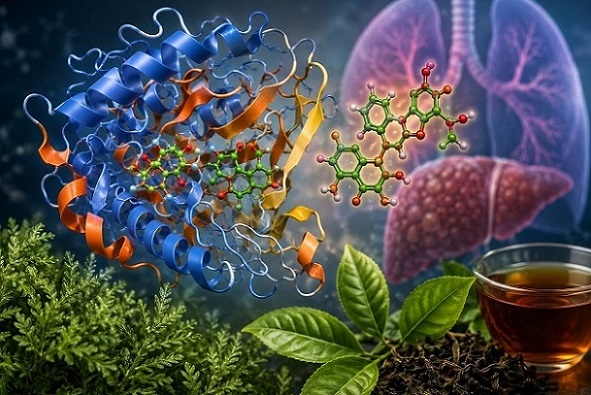 Natural polyphenols from plants and black tea may help prevent harmful alpha-1 antitrypsin protein aggregation
linked to liver and lung disease.
A new study by researchers from the Department of Medical Laboratories, College of Applied Medical Sciences, Qassim University in Saudi Arabia, and the Department of Biochemistry, Faculty of Life Sciences, Aligarh Muslim University in India, has revealed that the natural polyphenols amentoflavone and theaflavin can significantly reduce the aggregation of alpha-1 antitrypsin (A1AT), a protein whose malfunction is linked to a serious genetic disorder known as alpha-1 antitrypsin deficiency.
Why Alpha-1 Antitrypsin Matters
Alpha-1 antitrypsin is a protective protein produced mainly by the liver and released into the bloodstream. Its primary role is to protect lung tissue from damage caused by inflammatory enzymes. When functioning normally, it helps maintain healthy lungs and regulates inflammation throughout the body.
However, certain genetic mutations can cause the protein to fold incorrectly. Instead of maintaining its normal structure, the protein begins to stick together, forming large aggregates and fibers inside liver cells. Over time, this buildup can trigger liver inflammation, cirrhosis, liver cancer, and severe lung diseases such as emphysema and chronic obstructive pulmonary disease (COPD).
Scientists have long searched for safe ways to prevent this destructive protein clumping.
How the Study Was Conducted
The research team used a chemical called trifluoroethanol to trigger misfolding and aggregation of alpha-1 antitrypsin under controlled laboratory conditions. They then screened a variety of plant-derived compounds using advanced computer modeling and molecular docking techniques to identify molecules capable of binding strongly to the protein.
Two compounds emerged as the strongest candidates.
Amentoflavone is a natural plant biflavonoid found in species of Selaginella and is already known for antioxidant, anti-inflammatory, antiviral, and neuroprotective properties. Theaflavin is a major bioactive compound formed during the production of black tea and has been associated with a wide range of health benefits.
The researchers then subjected the protein to a battery of laboratory tests, including fluorescence measurements, turbidity studies, Rayleigh scattering analysis, and molecular dynamics simulations lasting 100 nanoseconds.
Remarkable Reduction in Protein Clumping
The
results were striking. As alpha-1 antitrypsin began to misfold, it passed through an unstable intermediate state before forming amyloid-like fibrils and larger aggregates. The greatest level of aggregation occurred when the protein was exposed to specific concentrations of trifluoroethanol.
When amentoflavone or theaflavin was added before the aggregation process began, both compounds significantly reduced protein clumping in a dose-dependent manner. The higher the concentration used, the greater the protective effect.
One of the most important findings came from thioflavin-T fluorescence testing, which measures amyloid-like fibril formation. The researchers found that aggregate formation decreased by approximately 60 to 65 percent when the natural compounds were present.
Amentoflavone consistently outperformed theaflavin in nearly every experiment. It showed stronger binding to the protein, better preservation of normal protein activity, greater stabilization of protein structure, and more powerful inhibition of aggregate formation.
Computer Simulations Confirm Protective Effects
To better understand how the compounds worked, the scientists performed sophisticated molecular dynamics simulations.
These simulations revealed that both natural compounds formed stable interactions with alpha-1 antitrypsin and helped prevent the structural distortions that normally lead to aggregation. Amentoflavone demonstrated the strongest and most stable binding characteristics.
The simulations suggested that these compounds effectively act as molecular stabilizers, helping the protein maintain its normal shape even under conditions that would otherwise promote harmful misfolding.
This
Medical News report highlights how naturally occurring compounds may eventually contribute to the development of safer treatments for protein misfolding disorders that currently have limited therapeutic options.
Potential Implications for Future Treatments
Although the findings are still limited to laboratory and computational studies, they provide encouraging evidence that naturally derived polyphenols could become valuable starting points for future drug development.
The ability to interfere with protein aggregation is considered one of the most promising strategies for combating diseases driven by abnormal protein deposits. Since alpha-1 antitrypsin deficiency affects both the liver and lungs, therapies that stabilize the protein before aggregation occurs could potentially reduce disease progression and improve patient outcomes.
Conclusion
The study provides compelling evidence that amentoflavone and theaflavin can significantly inhibit the harmful aggregation of alpha-1 antitrypsin, a protein whose misfolding plays a central role in alpha-1 antitrypsin deficiency. Through a combination of laboratory experiments and advanced computational modeling, the researchers demonstrated that both compounds stabilize the protein and reduce the formation of amyloid-like structures. Among the two, amentoflavone emerged as the more potent inhibitor. While further animal and human studies are needed, these findings open the door to the development of novel natural compound-based therapies aimed at preventing liver and lung damage associated with protein aggregation disorders.
The study findings were published in the peer reviewed journal: Biomedicines.
https://www.mdpi.com/2227-9059/14/6/1310
For the latest on Herbs and Phytochemicals, keep on logging to Thailand
Medical News.
Read Also:
https://www.thailandmedical.news/articles/herbs-and-phytochemicals




 Share
Share
 Tweet
Tweet
 Share
Share

































