Nikhil Prasad Fact checked by:Thailand Medical News Team Jan 24, 2026 8 months, 1 week, 4 days, 6 hours, 8 minutes ago
Medical News: Cancer remains one of the most challenging diseases of modern times, with millions of new cases diagnosed globally each year. Despite major advances in treatments, many therapies still face problems such as drug resistance, serious side effects, and limited effectiveness. Scientists are now increasingly turning their attention to natural compounds found in plants, and one such phytochemical, carnosic acid, is drawing growing interest for its powerful anticancer potential.
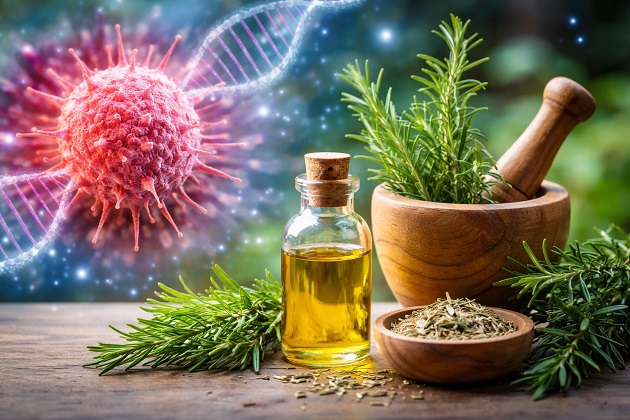 Natural compounds from rosemary are showing powerful potential in fighting multiple forms of cancer
Researchers And Institutions Behind the Study
Natural compounds from rosemary are showing powerful potential in fighting multiple forms of cancer
Researchers And Institutions Behind the Study
The research was conducted by scientists from the Laboratory of Pharmaceutical Chemistry, Faculty of Pharmacy, University of Coimbra, the Center for Neuroscience and Cell Biology, University of Coimbra, the Centre for Innovative Biomedicine and Biotechnology, University of Coimbra, Portugal, and the Drug Research Program at the Faculty of Pharmacy, University of Helsinki, Finland.
What Is Carnosic Acid and Where It Comes From
Carnosic acid is a phytochemical found mainly in rosemary and sage, herbs that have been used in traditional medicine for centuries. Modern scientific research has shown that this compound has strong antioxidant and anti-inflammatory properties. Over the last two decades, researchers have discovered that it can also interfere with many processes that cancer cells rely on to survive and multiply.
How Carnosic Acid Affects Cancer Cells
Laboratory and animal studies revealed that carnosic acid can slow down or stop the growth of cancer cells in many types of cancer, including breast, lung, colorectal, prostate, liver, skin, and leukemia. It works by forcing cancer cells to stop dividing, triggering programmed cell death, increasing harmful oxidative stress inside cancer cells, and blocking key signaling pathways that tumors use to grow and spread. This
Medical News report highlights that carnosic acid often affects cancer cells more than normal healthy cells, an important feature for safer treatments.
Why Scientists Modified the Compound
While natural carnosic acid shows promise, its strength is sometimes not high enough for medical use. To solve this, scientists chemically modified the compound to create semisynthetic derivatives. These modified versions were designed to be stronger, longer-lasting, and more effective at lower doses. Many of these new derivatives showed dramatically improved cancer-fighting activity in laboratory tests, in some cases performing far better than the original compound.
Key Findings from The Modified Versions
Several semisynthetic forms of carnosic acid were able to kill cancer cells at much lower concentrations. Some derivatives interfered with enzymes that cancer cells need to grow, while others blocked pathways linked to inflammation, metastasis, and drug resistance. Importantly, a number of these modified compounds showed better selectivity, meaning they targeted c
ancer cells while causing less harm to normal cells.
Why These Findings Matter
These discoveries suggest that carnosic acid and its improved derivatives could serve as the foundation for future anticancer drugs. Their ability to attack cancer through multiple biological pathways makes them especially valuable in overcoming treatment resistance.
Conclusion
Overall, the study provides strong evidence that carnosic acid, especially in its modified forms, holds significant promise as a future anticancer therapy. By targeting cancer growth, survival, spread, and resistance mechanisms simultaneously, these compounds may help pave the way for safer and more effective treatments. Further clinical research will be essential to determine how these findings can be translated into real-world cancer care.
The study findings were published in the peer reviewed International Journal of Molecular Sciences.
https://www.mdpi.com/1422-0067/27/3/1149
For the latest on Herbs and Phytochemicals, keep on logging to Thailand
Medical News.
Read Also:
https://www.thailandmedical.news/articles/herbs-and-phytochemicals
https://www.thailandmedical.news/articles/cancer




 Share
Share
 Tweet
Tweet
 Share
Share

































