Nikhil Prasad Fact checked by:Thailand Medical News Team Aug 05, 2026 1 month, 4 weeks, 1 day, 18 hours, 48 minutes ago
Researchers have uncovered compelling new evidence showing that small fragments of the SARS-CoV-2 spike protein can directly trigger spinal nociception, the nervous system process responsible for detecting and transmitting potentially harmful stimuli. The discovery provides a new explanation for why many people infected with COVID-19 experience severe body aches and persistent pain, and why some continue to suffer long after the infection has cleared. Rather than simply causing widespread inflammation, the study found that specific spike protein peptides can directly activate immune signaling pathways within the spinal cord that amplify nociceptive responses.
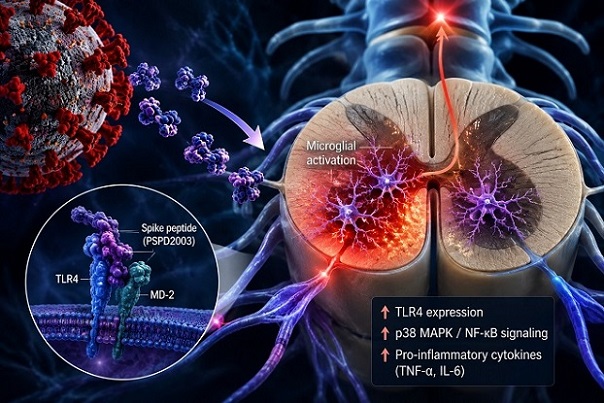 Scientists discovered that SARS-CoV-2 spike protein peptides directly activate spinal TLR4 signaling and microglia,
triggering spinal nociception through inflammatory pathways.
Researchers Investigate How Spike Protein Fragments Affect the Spinal Cord
The study was conducted by scientists from the Laboratory of Neuroimmunobiology of Pain and the Department of Cellular and Developmental Biology at the Federal University of Alfenas, the Institute of Chemistry at Unesp–Araraquara Campus, the Federal University of Northern Tocantins, Brasil University, the Federal University of Ouro Preto, and the Federal University of Minas Gerais, Brazil.
Although pain is among the most common neurological symptoms of COVID-19, the biological mechanisms responsible for it have remained poorly understood. The researchers wanted to determine whether fragments of the SARS-CoV-2 spike protein could directly activate spinal pathways involved in nociception.
Nociception is the body's process of sensing harmful or potentially damaging stimuli and sending those signals to the brain. While nociception often results in pain, it is a distinct biological process that begins within specialized nerves and the spinal cord.
To investigate this, the research team synthesized three small peptides derived from different regions of the SARS-CoV-2 spike protein, designated PSPD2001, PSPD2002, and PSPD2003, and examined their effects using mice, genetically modified animals, cultured human microglial cells, molecular biology techniques, and computer-based molecular simulations.
Spike-Derived Peptides Directly Triggered Spinal Nociception
All three spike-derived peptides produced significant mechanical nociception, meaning the animals became much more sensitive to normally harmless mechanical stimulation. Among them, PSPD2003 produced the strongest spinal nociceptive response, with the effects lasting from one to seven hours before gradually resolving by 24 hours.
The researchers then discovered that PSPD2003 significantly increased the expression of Toll-like receptor 4 (TLR4) within the spinal cord. TLR4 is an important receptor of the innate immune system that detects danger signals and initiates inflammatory responses.
The study showed that activation of spinal TLR4 served as the critical trigger for the entire nociceptive process.
Spinal Microglia Amplified the Nociceptive Response
Further investigation revealed that activation of TLR4 stimulated microglia, the resident immune cells of the c
entral nervous system. Once activated, these cells became hypertrophic, increased in number within the spinal dorsal horn, and released inflammatory mediators that amplified spinal nociception.
The investigators observed marked increases in the microglial markers TMEM119 and CX3CR1, confirming robust spinal microglial activation following exposure to PSPD2003.
The peptide also significantly elevated spinal levels of the inflammatory cytokines interleukin-6 (IL-6) and tumor necrosis factor-alpha (TNF-α). These cytokines are well known to sensitize nerve cells and strengthen nociceptive signaling within the spinal cord.
This
Medical News report highlights that the findings demonstrate a direct neuroimmune mechanism whereby spike protein peptides themselves can initiate spinal nociception without requiring the presence of the complete virus.
Blocking TLR4 Completely Prevented Spinal Nociception
One of the strongest findings came from experiments designed to interrupt the signaling pathway.
Pretreatment with a TLR4 antagonist almost completely abolished the nociceptive responses induced by all three spike peptides. Even more striking, genetically engineered mice lacking TLR4 failed to develop spinal nociception after exposure to the peptides, demonstrating that TLR4 is indispensable for this process.
The researchers also found that blocking microglial activation with minocycline dramatically reduced spinal nociception, confirming that activated microglia are essential downstream mediators of the response.
Intracellular Signaling Pathways Were Also Critical
The team next investigated how TLR4 activation produced spinal nociception.
Their experiments demonstrated that PSPD2003 activated the intracellular signaling proteins p38 MAPK and NF-κB, both of which regulate inflammatory gene expression. When either pathway was pharmacologically inhibited, PSPD2003-induced spinal nociception was significantly reversed.
Human C20 microglial cells exposed to PSPD2003 also developed an activated hypertrophic appearance while producing inflammatory responses consistent with the animal findings.
Finally, molecular dynamics simulations showed that PSPD2003 forms a stable interaction with the TLR4/MD-2 receptor complex, providing structural evidence that the spike peptide can directly engage this receptor and initiate the downstream inflammatory cascade responsible for spinal nociception.
Conclusion
The findings identify a previously unrecognized neuroimmune mechanism through which SARS-CoV-2 spike-derived peptides directly induce spinal nociception. The study demonstrates that activation of the TLR4–microglia axis, together with increased production of TNF-α and IL-6 and activation of the p38 MAPK/NF-κB signaling pathway, drives nociceptive responses within the spinal cord. These discoveries not only improve understanding of COVID-19-associated and post-viral nociceptive disorders but also identify spinal TLR4 and its downstream signaling network as promising therapeutic targets for managing persistent nociceptive symptoms following viral infections.
The study findings were published in the peer reviewed European Journal of Pain.
https://onlinelibrary.wiley.com/doi/10.1002/ejp.70343
Read Also:
https://www.thailandmedical.news/articles/coronavirus
https://www.thailandmedical.news/articles/long-covid




 Share
Share
 Tweet
Tweet
 Share
Share

































