Newly Identified Phytochemical from Agarwood Shows Promise in Fighting Alzheimer Tau Clumps
Nikhil Prasad Fact checked by:Thailand Medical News Team Dec 12, 2025 8 months, 3 weeks, 13 hours, 17 minutes ago
Medical News: A Traditional Plant Yields a Modern Hope
Researchers from Sungkyunkwan University, Korea University, and the Korea Institute of Science and Technology have made an exciting discovery involving Aquilaria agallocha, the tree responsible for the famous agarwood resin used in traditional Asian medicine. This
Medical News report reveals that a natural compound found in this plant may help reduce tau protein clumping—an important factor behind Alzheimer’s disease and similar brain disorders.
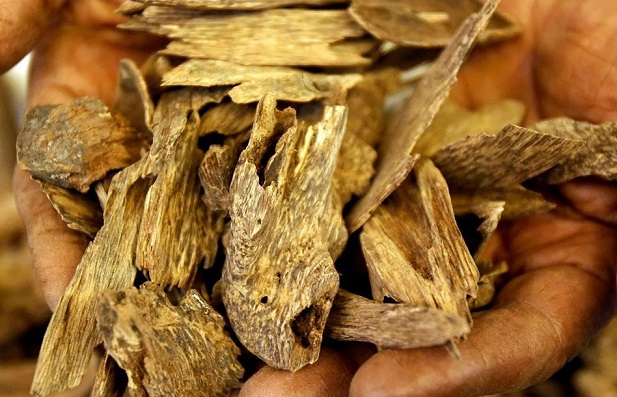 Scientists uncover a compound in Aquilaria agallocha that reduces tau protein clumps linked to Alzheimer’s disease
without harming brain cells
Aquilaria agallocha, also called chim-hyuang in Korea and chen-xiang in China, has long been used to treat various ailments like asthma, pain, and stomach issues. But this latest study has taken things a step further, identifying a specific phytochemical compound in the plant that appears to prevent harmful proteins in the brain from sticking together—a major problem in Alzheimer’s.
The Hidden Treasure in Agarwood
The team focused on the ethyl acetate (EtOAc) extract of Aquilaria agallocha resin. Using advanced lab techniques, they isolated four chemical compounds. The standout among them was (3R,5R)-octahydrocurcumin, a diarylheptanoid compound related to curcumin, the active ingredient in turmeric.
This compound, when tested in laboratory-grown human cells engineered to mimic early Alzheimer’s protein behavior, reduced tau protein aggregation by 43.7% at a concentration of 20 micromoles. Even more encouraging, it showed no signs of toxicity at that dosage, which means it is less likely to harm healthy cells.
How the Experiments Were Done
To find these results, scientists used a high-tech screening system that tracks how tau proteins clump together in cells. They triggered the clumping process using a chemical called thapsigargin, which stresses cells in a way similar to brain diseases. After treating the cells with the isolated natural compounds, they found that only compound 2—(3R,5R)-octahydrocurcumin—significantly reduced the harmful buildup of tau proteins.
They also ensured that the decrease in tau clumps was not due to cells dying from the treatment. The treated cells remained healthy, proving that the compound worked without causing cell damage.
Why This Discovery Matters
Tau proteins are central to diseases like Alzheimer’s. When they clump together inside brain cells, they disrupt normal function and eventually kill the cells. Current drugs aiming to stop this process often come with severe side effects or poor absorption in the body. Natural compounds like the one found in Aquilaria agallocha offer an alternative that may be safer and more effective.
The researchers emphasized that while the compound may not be as powerful as synthetic drugs like methylene b
lue, its lack of toxicity makes it a safer starting point for future drug development.
Conclusion
This study suggests that the rarely explored compounds in Aquilaria agallocha, especially (3R,5R)-octahydrocurcumin, could serve as a promising base for new Alzheimer’s treatments. The compound's ability to reduce tau buildup without harming cells provides a hopeful step forward in the search for safer neuroprotective agents. Further research will be needed to see how it performs in animals and eventually humans, but this is a promising beginning rooted in centuries-old traditional medicine.
The study findings were published in the peer reviewed journal: Biomedicines
https://www.mdpi.com/2227-9059/13/12/2855
For the latest on Herbs and Phytochemicals and Alzheimer research, keep on logging to Thailand
Medical News.
Read Also:
https://www.thailandmedical.news/articles/alzheimer,-dementia-
https://www.thailandmedical.news/articles/herbs-and-phytochemicals




 Share
Share
 Tweet
Tweet
 Share
Share