Nikhil Prasad Fact checked by:Thailand Medical News Team Apr 11, 2026 5 months, 3 weeks, 1 day, 23 hours, 24 minutes ago
Medical News: A surprising new line of research is drawing attention to a possible hidden consequence of malaria: a link to prostate cancer. Scientists are now investigating how a substance produced during malaria infection could quietly influence cancer development over time.
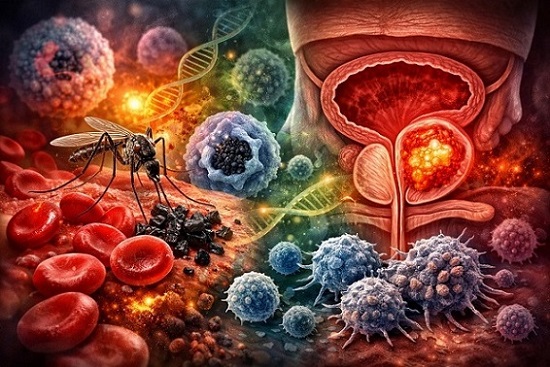 Scientists uncover a possible hidden link between malaria infections and prostate cancer risk
What Is Hemozoin and Why It Matters
Scientists uncover a possible hidden link between malaria infections and prostate cancer risk
What Is Hemozoin and Why It Matters
When malaria parasites infect the body, they break down hemoglobin in red blood cells. This process produces a dark crystalline by-product known as hemozoin. For years, scientists believed hemozoin mainly played a role in triggering immune responses during infection. However, new findings suggest its effects may go far beyond that.
Researchers from Covenant University, Ota, Nigeria, and the University of Ghana, Accra, Ghana, have explored how long-term exposure to hemozoin might alter the immune system in ways that could promote cancer, particularly in the prostate.
How Malaria Could Influence Cancer Development
The study highlights that hemozoin accumulates inside immune cells such as macrophages and dendritic cells. Once inside, it can disrupt normal immune signaling pathways, including NF-kB, MAPK, and STAT3. These pathways are crucial in controlling inflammation and cell survival.
Over time, this disruption may lead to persistent low-grade inflammation - a known risk factor for cancer. This
Medical News report notes that such chronic inflammation can encourage abnormal cell growth, reduce the body’s ability to remove damaged cells, and even cause genetic instability.
Immune System Changes That Favor Tumors
One of the most concerning findings is how hemozoin appears to “reprogram” immune cells. It pushes macrophages toward a tumor-friendly state known as M2, while weakening cancer-fighting T-cells. At the same time, it increases regulatory T-cells, which can suppress the body’s natural anti-tumor responses.
Additionally, hemozoin seems to amplify immune reactions when combined with other infections or signals, further fueling inflammation. The study also points to interactions with oxidative stress and key cellular pathways like PI3K/Akt/mTOR, which are often linked to tumor growth.
A Complex but Concerning Pattern
Epidemiological observations show that regions heavily affected by malaria also report rising cases of prostate cancer. While this overlap does not prove direct causation, it raises important questions. Factors such as aging populations, improved malaria survival rates, and other infections may also play a role, making the connection complex.
Conclusion
The findings suggest a potentially serious long-term consequence of repeated malaria exposure that has largely been overlooked. While more research is needed to confirm a direct causal link, the evidence indicates that hemozoin-driven immune ch
anges could create an environment that favors cancer development. Understanding this relationship could open new doors for early detection, prevention strategies, and targeted therapies, especially in malaria-endemic regions where both diseases pose significant health burdens.
The study findings were published as an abstract in the peer reviewed journal: Frontiers in Immunology.
https://www.frontiersin.org/journals/oncology/articles/10.3389/fonc.2026.1786079/abstract
This is an emerging news story and more details and the full study along with comments from other experts in this field will be covered in coming days.
For the latest on Prostate Cancer, keep on logging to Thailand
Medical News.
Read Also:
https://www.thailandmedical.news/articles/cancer




 Share
Share
 Tweet
Tweet
 Share
Share

































