Nikhil Prasad Fact checked by:Thailand Medical News Team Aug 13, 2026 1 month, 3 weeks, 2 days, 14 hours, 51 minutes ago
A new study has uncovered distinctive changes in blood metabolism among people suffering from neuropsychiatric Long COVID, offering fresh clues as to why patients can experience persistent fatigue, low mood and cognitive difficulties months after their initial SARS-CoV-2 infection.
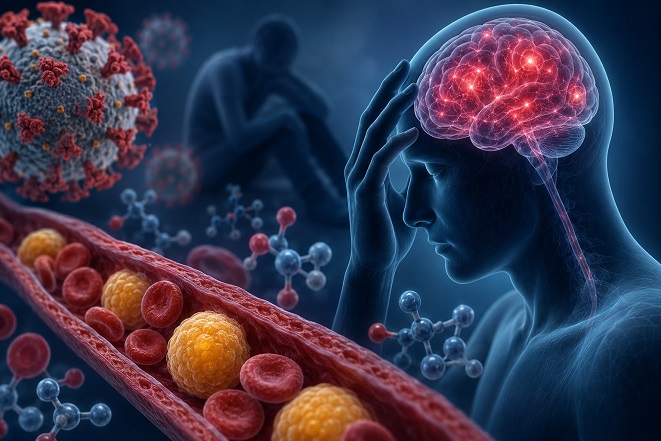 Researchers have identified distinctive metabolic changes linked to fatigue, depressive symptoms and brain structure in
people with neuropsychiatric Long COVID
Researchers Examine Hundreds of Blood Metabolites
Researchers studied 54 Long COVID patients, 18 people who recovered from confirmed COVID-19 without developing Long COVID, and 30 healthy individuals with no known previous infection. The groups were similar in age and sex. On average, Long COVID patients were assessed about 10.5 months after infection.
Using targeted mass spectrometry, the team measured up to 630 metabolites representing 26 biochemical classes. The researchers also assessed depression, cognition, general health and fatigue, while brain MRI scans allowed them to examine cortical thickness.
The research involved scientists from Jena University Hospital and Friedrich Schiller University Jena, the German Center for Mental Health sites Halle-Jena-Magdeburg and Berlin-Potsdam, Leibniz Institute on Aging–Fritz Lipmann Institute, Charité–Universitätsmedizin Berlin, Uppsala University in Sweden, and the Latvian Institute of Organic Synthesis in Riga.
Long COVID Shows a Disturbed Lipid Pattern
The researchers identified 56 metabolites that differed in at least one comparison between the study groups. Many belonged to lipid-related pathways.
Triacylglycerides, commonly called triglycerides, were consistently increased in Long COVID patients compared with people who recovered normally from COVID-19. Meanwhile, acetylcarnitine was among the metabolites showing a particularly strong decrease.
Acylcarnitines help transport fatty-acid components into mitochondria, the tiny structures inside cells responsible for producing much of the body's usable energy. Lower acetylcarnitine could therefore potentially reflect impaired fatty-acid burning and reduced mitochondrial energy production.
Interestingly, other acylcarnitines, including hexenoylcarnitine and butenylcarnitine, were increased. Researchers also detected alterations involving homocysteine, dehydroepiandrosterone sulfate and several bile acids.
Metabolic Changes Track Symptoms and Brain Structure
Importantly, this
Thailand Medical News report highlights that these biochemical differences were not simply isolated laboratory abnormalities.
Seven metabolites were associated with changes in clinician-rated depressive symptoms, while four were associated with differences in vitality, a measure closely related to fatigue. Several triglycerides were among those connected with depressive symptom scores. The researchers found no significant metabolite associations after correction with the BDI-II depressi
on scale, cognitive MoCA score or SF-36 general-health score.
Several altered metabolites were also associated with cortical thickness across brain regions involved in cognitive and emotional functions. These included temporal regions, the insula, parietal areas, frontal regions and the cingulate cortex.
Bile acids including taurocholic acid, taurochenodeoxycholic acid, glycochenodeoxycholic acid and glycocholic acid were elevated compared with healthy COVID survivors. Similar increases were observed in an independent previously published Long COVID dataset, strengthening interest in these metabolic signals.
What Could These Findings Mean?
The combined pattern suggests that Long COVID may involve disrupted fatty-acid metabolism and mitochondrial energy production. Such disturbances could potentially help explain severe fatigue while also interacting with inflammatory processes and changes involving the brain.
However, the researchers stressed that the study was relatively small and used a targeted metabolomics panel heavily weighted toward lipids. Most importantly, the findings demonstrate associations and cannot establish whether metabolic abnormalities cause Long COVID symptoms, result from the illness, or represent the body's attempt to compensate.
Conclusions
The findings provide intriguing evidence that neuropsychiatric Long COVID is accompanied by measurable biochemical changes involving triglycerides, acylcarnitines, bile acids and energy-related metabolism. Their relationships with fatigue, depressive symptoms and cortical thickness suggest that persistent neurological complaints may have detectable biological counterparts. Larger, untargeted and longitudinal studies are now needed to determine whether these metabolic signatures can eventually become useful biomarkers or treatment targets.
The study findings are currently available as a medRxiv preprint and have not yet been certified by peer review.
https://www.medrxiv.org/content/10.64898/2026.08.07.26359942v1
Read Also:
https://www.thailandmedical.news/articles/coronavirus
https://www.thailandmedical.news/articles/long-covid




 Share
Share
 Tweet
Tweet
 Share
Share