The Experimental Drug Ampligen Shows Remarkable Survival Potential for Those Infected with Ebola
Nikhil Prasad Fact checked by:Thailand Medical News Team Jun 17, 2026 3 months, 2 weeks, 3 days, 9 hours, 34 minutes ago
Medical News: As global concern about Ebola continues to grow following renewed outbreaks and heightened international surveillance efforts, a new development involving the experimental drug Ampligen is drawing attention from scientists, public health officials, and investors alike. AIM ImmunoTech recently highlighted what it describes as an emerging opportunity for Ampligen amid escalating Ebola-related concerns and ongoing efforts to strengthen preparedness against future outbreaks.
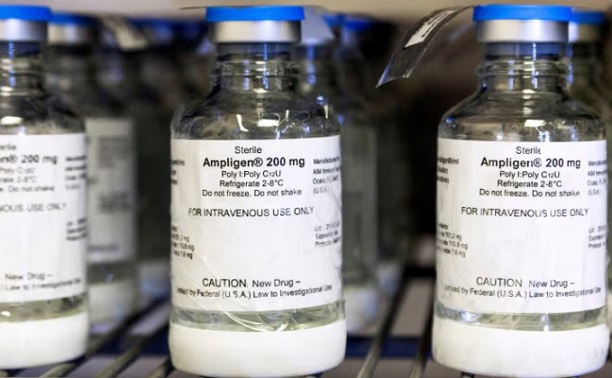 Experimental drug Ampligen delivered complete survival in a lethal Ebola animal model by helping the immune
system fight back against the virus
The renewed interest comes as researchers continue to search for therapies that can provide broad protection against Ebola virus disease, one of the world's deadliest infectious diseases. While existing antibody-based treatments have improved outcomes, scientists remain concerned that additional therapeutic options are needed, especially those capable of enhancing the body's natural immune defenses against infection.
Ebola Remains a Persistent Global Threat
Ebola virus disease is caused by a highly infectious virus belonging to the Filoviridae family. Although outbreaks have historically been concentrated in parts of Central and West Africa, the virus has repeatedly demonstrated its ability to trigger major public health emergencies.
The devastating West African epidemic between 2014 and 2016 resulted in more than 11,000 deaths and exposed major weaknesses in global outbreak preparedness. Since then, several new outbreaks have occurred, including those in the Democratic Republic of the Congo, Guinea, and Uganda. Concerns have also emerged that the virus may persist in survivors for prolonged periods, potentially contributing to future flare-ups.
These ongoing risks have led scientists to investigate novel approaches that can stop Ebola before it gains a foothold in the body.
Ampligen Produces Stunning Survival Results
A key study that is fueling renewed interest in Ampligen examined its effectiveness against a lethal Ebola infection in laboratory animals. Researchers from the Department of Life and Environmental Sciences at the University of Cagliari in Italy, AIM ImmunoTech in Florida, and Vanderbilt University School of Medicine in Tennessee evaluated the drug in a well-established Ebola mouse model.
The results were striking.
Mice infected with a normally 100 percent lethal strain of Ebola virus received Ampligen treatment beginning just four hours after infection. Animals were then treated every other day.
Researchers found that the lowest tested dose of Ampligen, equivalent to a clinically relevant human dose of approximately 6 mg/kg, achieved complete survival. Every treated animal survived the otherwise fatal infection. By comparison, untreated animals died within days. The treated mice also maintained their body weight and showed far fewer signs of severe disease.
Overall survival across all tested dosing groups averaged approximately 93 percent, an extraordinary
outcome in a model designed to produce universal mortality.
How Ebola Disarms the Immune System
One of the reasons Ebola is so deadly is its ability to shut down the body's early immune defenses.
A viral protein known as VP35 plays a central role in this process. Often referred to as a major virulence factor, VP35 helps Ebola hide from immune detection by binding to viral double-stranded RNA. This prevents the activation of critical antiviral pathways and suppresses the production of type I interferons, which are among the body's first lines of defense against viral infections.
Without a rapid interferon response, the virus gains valuable time to multiply and spread throughout the body.
Ampligen Attacks Ebola in Two Different Ways
What makes Ampligen particularly interesting is that it appears to work through two complementary mechanisms.
First, laboratory experiments showed that Ampligen can act as a decoy target for Ebola's VP35 protein. By binding to VP35, Ampligen interferes with the protein's ability to sequester viral genetic material. This allows the immune system to recognize the infection more effectively. Researchers found that Ampligen was highly effective at competing with viral RNA for VP35 binding.
Second, Ampligen activates Toll-like receptor 3 (TLR3), a key component of the innate immune system. Activation of TLR3 triggers antiviral signaling pathways and stimulates production of interferons and other protective immune molecules. Laboratory studies confirmed that Ampligen activated TLR3-dependent immune responses while helping restore antiviral signaling that Ebola normally suppresses. According to the investigators, this dual-action mechanism may explain the remarkable protection observed in infected animals.
Why Researchers Are Excited
Unlike monoclonal antibody therapies that target specific viral proteins, Ampligen works primarily by enhancing host immune defenses and interfering with a critical Ebola immune-evasion strategy.
This
Medical News report notes that such an approach could potentially provide broader protection and may be less vulnerable to viral mutations. Researchers also observed that many of the VP35 binding regions targeted by Ampligen are highly conserved across Ebola virus strains, raising hopes that resistance may be more difficult for the virus to develop.
Another important advantage is that Ampligen already has an extensive human safety history. More than 100,000 doses have reportedly been administered in human clinical studies for other conditions, providing valuable information about its tolerability and pharmacology.
Growing Interest Amid New Ebola Concerns
AIM ImmunoTech's recent announcement comes at a time when global health authorities remain vigilant about Ebola's continuing threat and the current 17th Ebola outbreak in DRC.
The company believes the encouraging animal data, combined with Ampligen's established clinical experience, may create opportunities for further development as a preparedness countermeasure against future Ebola outbreaks.
Healthcare workers, emergency responders, and populations in outbreak-prone regions could potentially benefit from additional preventive or early-intervention options if future studies confirm these findings in humans.
Conclusion
The latest findings suggest that Ampligen may represent one of the more intriguing experimental approaches currently being explored against Ebola virus disease. By simultaneously blocking a key viral immune-evasion mechanism and stimulating the body's natural antiviral defenses, the drug achieved complete protection in a highly lethal animal model. While much more research is still required before any Ebola-related use could be approved, the study provides compelling evidence that Ampligen deserves further investigation. As concerns about future Ebola outbreaks continue to grow, therapies capable of strengthening innate immunity may become an increasingly important part of global pandemic preparedness strategies. The combination of strong survival data, a unique mechanism of action, and an existing human safety record positions Ampligen as a candidate that many researchers will be watching closely in the years ahead.
References:
https://aimimmuno.com/aim-immunotech-announces-emerging-ebola-opportunity-for-ampligen-amid-escalating-global-health-concerns-and-who-emergency-declaration/
https://www.sciencedirect.com/science/article/pii/S0166354223000323
For the latest Ebola news, keep on logging to Thailand
Medical News.
Read Also:
https://www.thailandmedical.news/articles/ebola




 Share
Share
 Tweet
Tweet
 Share
Share

































