Blocking Riboflavin Metabolism via Roseoflavin Could Become a New Approach to Cancer Therapy
Nikhil Prasad Fact checked by:Thailand Medical News Team Mar 14, 2026 6 months, 3 weeks, 40 minutes ago
Medical News: Scientists have uncovered an intriguing biological mechanism showing how vitamin B2 metabolism helps cancer cells survive—and how disrupting this pathway could lead to a new strategy for cancer treatment. The discovery reveals that interfering with the way cells process riboflavin, a common dietary vitamin, may weaken cancer cells and trigger their destruction.
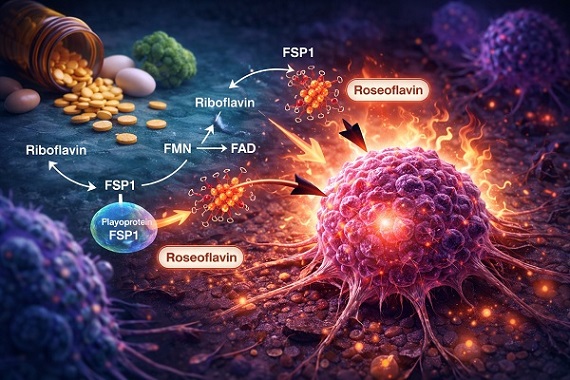 Scientists discover that disrupting vitamin B2 metabolism with roseoflavin may force cancer cells into ferroptosis,
opening a potential new pathway for targeted cancer treatment
The research was conducted by scientists from the Rudolf Virchow Center for Integrative and Translational Bioimaging at Julius-Maximilians-Universität Würzburg, Würzburg, Germany, led by Professor José Pedro Friedmann Angeli with contributions from researcher Vera Skafar. Their findings highlight how targeting vitamin metabolism may open the door to a new class of therapies that force cancer cells to self-destruct.
A Vital Nutrient with an Unexpected Role
Vitamin B2, also known as riboflavin, is an essential nutrient that the human body cannot produce on its own. Instead, it must be obtained through diet, typically from foods such as dairy products, eggs, meat, and green vegetables.
Inside the body, riboflavin is converted into two critical molecules—flavin adenine dinucleotide (FAD) and flavin mononucleotide (FMN). These molecules help power many biological reactions, including energy production and the defense against oxidative damage caused by unstable molecules known as free radicals.
Normally, this protective role is beneficial. However, the new research shows that the same biochemical system can also help cancer cells survive by shielding them from a powerful cell-death mechanism.
Understanding Ferroptosis
Cells have several built-in mechanisms that allow them to die in a controlled and orderly way when they become damaged or dangerous. One of these mechanisms is called ferroptosis, a form of regulated cell death driven by iron-dependent chemical reactions.
During ferroptosis, iron triggers the oxidation of fats within the cell membrane in a process known as lipid peroxidation. When this damage becomes severe enough, the membrane loses its structural integrity and the cell dies.
This pathway has attracted strong scientific interest because it plays important roles in diseases such as cancer, neurodegenerative disorders, and tissue damage caused by restricted blood supply followed by restoration of circulation.
Cancer cells often evade ferroptosis by strengthening their antioxidant defense systems. By neutralizing oxidative damage before it becomes overwhelming, tumors can avoid this natural self-destruct mechanism.
The Protective Role of FSP1
A key component of this protective network is a protein called ferroptosis suppressor protein 1 (FSP1). This protein prevents ferroptosis by continuously restoring antioxidants located in cell membranes.
These antioxidants—incl
uding ubiquinone (coenzyme Q10), vitamin E, and vitamin K—act as molecular shields that stop damaging chain reactions in membrane lipids. FSP1 regenerates these antioxidants using cellular energy molecules, allowing them to repeatedly neutralize oxidative threats.
The researchers discovered that riboflavin metabolism is closely linked to the stability and activity of FSP1.
How Riboflavin Supports Cancer Cell Survival
Using advanced CRISPR–Cas9 gene-editing techniques and cancer cell models, the scientists screened for biological factors that regulate the FSP1 protein. Their results revealed that riboflavin plays a crucial role in maintaining the structure and functionality of FSP1.
The reason lies in riboflavin’s conversion into FAD, which acts as a cofactor required for the proper folding and stability of the FSP1 protein. Without sufficient FAD, the protein becomes unstable, misfolds, and is eventually destroyed by the cell’s internal protein-degradation machinery.
When riboflavin levels were reduced in laboratory experiments, the amount of functional FSP1 decreased significantly. As a result, cancer cells lost part of their antioxidant protection and became far more vulnerable to ferroptosis.
This
Medical News report highlights how riboflavin metabolism acts as a previously underrecognized regulator of ferroptosis resistance in cancer cells.
Roseoflavin Shows Powerful Effects
The research team then explored whether interfering with riboflavin metabolism could actively trigger ferroptosis. To do this, they tested roseoflavin, a naturally occurring compound produced by certain bacteria that closely resembles riboflavin in chemical structure.
Because of this similarity, roseoflavin enters the same metabolic pathways as vitamin B2. However, instead of supporting the production of protective molecules, it disrupts the process.
Experiments showed that roseoflavin strongly impaired the function of FSP1 even at very low concentrations. Once the protein’s activity was weakened, the recycling of membrane antioxidants slowed down dramatically. This allowed lipid peroxidation to intensify, ultimately pushing cancer cells into ferroptosis.
Remarkably, roseoflavin worked at concentrations in the nanomolar range, suggesting it could be a highly potent modulator of ferroptosis.
A Strategy with Reduced Risk of Drug Resistance
Another promising aspect of roseoflavin is its reliance on the same metabolic enzymes used to process riboflavin. These enzymes include cellular transporters and metabolic proteins that are essential for producing FAD and FMN.
If cancer cells attempted to develop resistance by altering these pathways, they would also disrupt their ability to process riboflavin itself—an essential function needed for many other biochemical reactions. This makes it much harder for cells to develop resistance without severely damaging their own metabolism.
Because of this dual effect, roseoflavin-like compounds may have an advantage over drugs that target only a single protein.
Broader Medical Implications
The findings may also have implications beyond cancer. Ferroptosis is increasingly recognized as a factor in neurodegenerative diseases such as Parkinson’s and Alzheimer’s disease, as well as tissue damage following strokes or organ transplantation.
Understanding how riboflavin metabolism regulates ferroptosis could therefore help researchers explore treatments for a range of disorders linked to oxidative damage.
Conclusion
The discovery that riboflavin metabolism helps regulate ferroptosis provides a new perspective on how nutrients influence disease processes. By stabilizing the FSP1 protein and supporting antioxidant recycling, vitamin B2 can protect cells from oxidative damage—but this protection can also allow cancer cells to evade death. Blocking riboflavin metabolism, particularly through compounds such as roseoflavin, may therefore provide a promising new therapeutic strategy. Future research will focus on developing inhibitors that can safely target this pathway and testing their effectiveness in preclinical cancer models.
The study findings were published in the peer reviewed journal: Nature Cell Biology.
https://www.nature.com/articles/s41556-025-01856-x
For the latest news, keep on logging to Thailand
Medical News.
Read Also:
https://www.thailandmedical.news/articles/cancer
https://www.thailandmedical.news/articles/supplements




 Share
Share
 Tweet
Tweet
 Share
Share

































