Nikhil Prasad Fact checked by:Thailand Medical News Team Apr 14, 2026 5 months, 2 weeks, 5 days, 23 hours, 40 minutes ago
Medical News: A new medical report is raising fresh concerns about a little-known but potentially dangerous neurological condition emerging after COVID-19 infections, one that can easily be mistaken for a simple stomach problem but may actually signal serious brain inflammation.
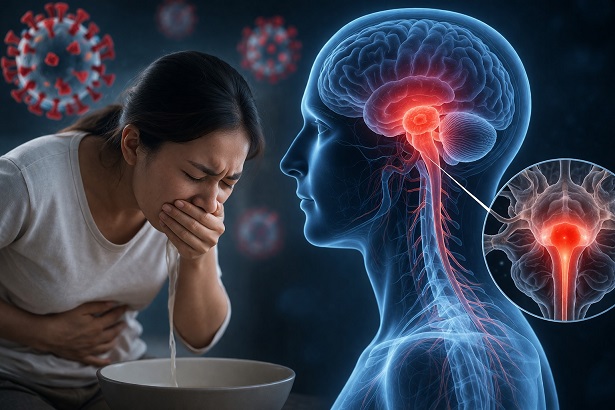 Persistent vomiting after COVID may signal dangerous brain inflammation, not a stomach problem
Unusual Symptoms After COVID Raise Alarm
Persistent vomiting after COVID may signal dangerous brain inflammation, not a stomach problem
Unusual Symptoms After COVID Raise Alarm
Doctors have identified a condition called area postrema syndrome, where patients experience persistent nausea, uncontrollable vomiting, and hiccups with no clear digestive cause. While these symptoms may appear harmless at first glance, new findings suggest they can be early warning signs of inflammation in a specific part of the brain.
The study examined two female patients who developed these symptoms shortly after recovering from COVID-19. Both cases initially looked similar, but their outcomes were drastically different, highlighting the unpredictable nature of post-COVID complications.
What Researchers Discovered
The research team included experts from multiple institutions: the Department of Radiology and Department of Neurology at the Affiliated Hospital of People’s Hospital of Wenshan Prefecture, Kunming University of Science and Technology, Wenshan, China; the Medical College of Kunming University of Science and Technology, Kunming, China; the Department of Respiratory Medicine at The First People’s Hospital of Yunnan Province, Kunming, China; and The Affiliated Hospital of Kunming University of Science and Technology, Kunming, China.
Both patients underwent brain scans that revealed lesions in the dorsal medulla, an area of the brain responsible for controlling vomiting. Interestingly, advanced testing detected traces of SARS-CoV-2 genetic material in the cerebrospinal fluid of both individuals, suggesting that the virus may directly or indirectly affect the brain.
Two Patients Two Very Different Outcomes
Despite similar early symptoms, the two patients followed very different paths.
The first patient, a younger woman, tested negative for a key autoimmune antibody known as AQP4-IgG. She responded well to treatment that included steroids and immune therapy, and after one year, she remained symptom-free with no relapse.
The second patient, however, tested positive for the same antibody. Although she initially improved, she later suffered a severe relapse involving spinal cord inflammation and ultimately died months later.
This
Medical News report highlights how a single biological marker can determine whether the condition remains mild or turns life-threatening.
Why This Matters More Than You Think
One of the most striking findings was the presence of viral genetic material in the fluid surrounding the brain. This suggests that COVID-19 may either directly invade the nervous system or trigger an immune response that
attacks it.
Doctors warn that these symptoms are often misdiagnosed as gastrointestinal issues, leading to delays in proper treatment. In reality, persistent vomiting after COVID should raise immediate suspicion of neurological involvement.
The Role of the Immune System
The study also points to the immune system as a key player. In some individuals, COVID-19 may trigger an autoimmune reaction where the body mistakenly attacks its own brain cells. This can lead to a condition known as neuromyelitis optica spectrum disorder, a serious disease affecting the brain and spinal cord.
The presence or absence of specific antibodies appears to determine how aggressive the disease becomes and what kind of treatment is needed.
Conclusions
The findings from this study offer an important warning that symptoms like persistent vomiting after COVID-19 should not be ignored or dismissed as minor issues. They may represent early signs of serious neurological involvement that requires urgent medical evaluation. The dramatic difference in outcomes between the two patients underscores the critical importance of early diagnosis, proper antibody testing, and appropriate long-term treatment strategies. Recognizing these warning signs early could mean the difference between full recovery and severe complications or even death.
The study findings were published in the peer reviewed journal: Immunity, Inflammation and Disease.
https://onlinelibrary.wiley.com/doi/10.1002/iid3.70421
For the latest on COVID-19 or Long COVID, keep on logging to Thailand
Medical News.
Read Also:
https://www.thailandmedical.news/articles/coronavirus
https://www.thailandmedical.news/articles/long-covid




 Share
Share
 Tweet
Tweet
 Share
Share

































