Study Shows That All Exposed to COVID-19 Have an Increased Risk of Developing Lung Cancer Over Time
Nikhil Prasad Fact checked by:Thailand Medical News Team Apr 11, 2026 5 months, 3 weeks, 2 days, 7 hours, 5 minutes ago
Medical News: A New Study Reveals a Hidden Biological Link Between COVID-19 and Lung Cancer Risk
Since the start of the COVID-19 pandemic, scientists have been racing to understand not just the immediate effects of the virus, but also its long-term consequences. Now, a new international study is raising concerns about a possible connection between COVID-19 and an increased risk of lung cancer over time. The findings suggest that even after recovery, the virus may leave behind subtle but important changes in the lungs that could contribute to cancer development.
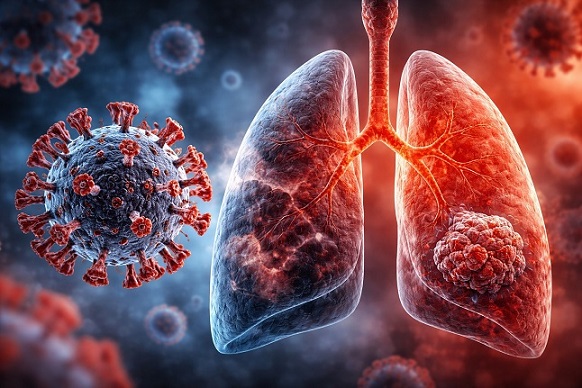 COVID-19 may silently trigger long-term lung changes that increase cancer risk, especially in vulnerable individuals
This
Medical News report highlights how researchers have uncovered a detailed biological pathway that may explain this risk, offering both concern and hope for future prevention strategies.
Researchers Identify a Potential Cancer-Triggering Mechanism
The study was conducted by a team of scientists from Marshall University in Huntington, United States, and The Hebrew University of Jerusalem and Hadassah Medical Center in Jerusalem, Israel. Key contributors included Prof. Alex Gileles-Hillel, Cayleigh Wallace, Dr. Hong Yue, Prof. David Gozal, and Dr. Wei Li.
Their research focused on the SARS-CoV-2 spike protein, the part of the virus responsible for entering human cells. While this protein is widely known for initiating infection, the study found that it may also trigger a chain of biological events that promote long-term lung damage and potentially cancer.
Large-Scale Human Data Shows Increased Risk
To understand the real-world impact, researchers analyzed data from over 166,000 patients using the TriNetX global health database. By carefully matching individuals based on age, gender, and other factors, they were able to isolate the effect of COVID-19.
The findings revealed that people who had recovered from COVID-19 showed a 22 percent higher relative risk of developing lung cancer compared to those who had never been infected. The risk was especially higher among current smokers, suggesting that pre-existing lung damage may worsen the effects of the virus.
Interestingly, the increased risk was specific to lung cancer. Other cancers, such as oral or bladder cancer, did not show the same pattern, indicating that the virus may uniquely affect lung tissue.
The Role of an Enzyme Called TYMP
At the center of this discovery is an enzyme known as thymidine phosphorylase (TYMP). The study found that this enzyme becomes highly active after exposure to the spike protein and plays a key role in damaging lung tissue.
TYMP appears to drive several harmful processes, including inflammation, scarring (fibrosis), and changes in the immune system. These changes create an environment in the lungs that is more favorable for tumor development. The researchers also found that TYMP activates a well-known cancer-
related pathway called STAT3. This pathway is involved in cell growth and survival and is often linked to tumor progression.
A Step-by-Step Chain Reaction in the Lungs
The study outlines a clear sequence of events that may occur after COVID-19 infection. First, the spike protein causes injury to lung cells. This injury then activates TYMP, which increases inflammation and scarring. At the same time, STAT3 signaling is triggered, and the immune system shifts into a state that supports tumor growth rather than fighting it.
Over time, this combination of damage and altered immune response may increase the likelihood of cancer developing, particularly in individuals who already have risk factors such as smoking.
Animal Studies Confirm the Findings
To strengthen their conclusions, the researchers conducted experiments in specially designed mice. These experiments showed that exposure to the spike protein significantly increased lung tumor formation. However, when TYMP was removed or blocked, the number and size of tumors were greatly reduced. This provides strong evidence that TYMP is not just associated with cancer risk but may actively drive the process.
Implications for Future Treatment and Prevention
One of the most important aspects of this study is that it identifies potential targets for treatment. By focusing on TYMP and the pathways it controls, scientists may be able to develop therapies that reduce long-term lung damage and lower cancer risk after COVID-19.
Existing drugs that inhibit TYMP are already being used for other conditions, raising the possibility that they could be repurposed for patients recovering from COVID-19.
Conclusion
The findings of this study provide an important new perspective on the long-term effects of COVID-19. While the increased risk of lung cancer for any individual remains relatively small, the sheer number of people infected worldwide means that even a modest rise in risk could have significant public health implications. The research clearly shows that COVID-19 is not just a short-term respiratory illness but may leave lasting biological changes in the lungs that evolve over time. Importantly, the identification of TYMP as a central player offers a promising pathway for intervention, allowing scientists to explore targeted treatments that could prevent or reduce these long-term risks. Moving forward, regular monitoring of lung health in COVID-19 survivors, especially smokers and high-risk individuals, may become increasingly important. Continued research will be essential to fully understand the long-term cancer risks and to develop effective strategies to protect those affected.
The study findings were published in the peer reviewed journal: Frontiers in Immunology.
https://www.frontiersin.org/journals/immunology/articles/10.3389/fimmu.2026.1798566/full
For the latest COVID-19 News, keep on logging to Thailand
Medical News.
Read Also:
https://www.thailandmedical.news/articles/coronavirus
https://www.thailandmedical.news/articles/long-covid
https://www.thailandmedical.news/articles/cancer




 Share
Share
 Tweet
Tweet
 Share
Share

































