Nikhil Prasad Fact checked by:Thailand Medical News Team Feb 13, 2026 7 months, 2 weeks, 5 days, 2 hours, 7 minutes ago
Medical News: Breast cancer remains one of the most common cancers affecting women worldwide. While chemotherapy is still widely used, many conventional drugs come with serious side effects and can eventually stop working due to drug resistance. Now, scientists in China have developed a novel nanomedicine made from two natural compounds that appears to dramatically boost anti-tumor effects while remaining remarkably safe.
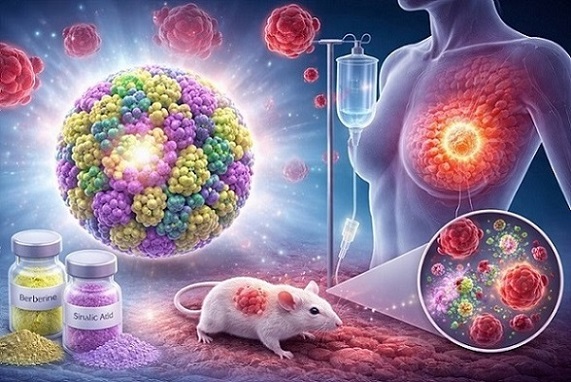 Nanoparticles made from two natural plant compounds dramatically shrink breast tumors in laboratory
and animal studies while showing minimal toxicity
Researchers from the College of Pharmacy, Henan University of Chinese Medicine, Zhengzhou, China, have successfully created a self-assembled nanomedicine using berberine and sinapic acid. Their innovative approach allows the two plant-derived compounds to combine into tiny particles that attack breast cancer cells more effectively than either compound alone.
Turning Natural Compounds into Smart Nanoparticles
Berberine is a plant alkaloid long used in traditional Chinese medicine. It has anti-inflammatory, antimicrobial, and anti-cancer properties. Sinapic acid is a natural antioxidant found in cruciferous vegetables and is known to interfere with cancer-related signaling pathways.
The researchers discovered that when mixed under specific conditions, the two molecules naturally bind together through electrostatic attraction, hydrogen bonding, and π-π stacking interactions. This self-assembly process forms stable, spherical nanoparticles measuring about 50 to 60 nanometers under microscopy.
Importantly, the new nanomedicine showed strong water dispersibility, overcoming a major limitation of many natural compounds, which often dissolve poorly in the body. Drug loading was also impressive, with 31.12 percent berberine and 21.05 percent sinapic acid incorporated into the nano-structure.
Stronger Cancer Cell Killing in The Lab
In laboratory experiments, the team tested the nanomedicine against mouse breast cancer cells known as 4T1 cells. Compared to berberine or sinapic acid used separately, the combined nanoparticle showed significantly stronger tumor-killing ability.
At a concentration of 200 micrograms per milliliter, nearly all cancer cells were eliminated within 24 hours. Fluorescence imaging confirmed that the nanoparticles were efficiently taken up by cancer cells. Further staining tests showed clear signs of apoptosis, or programmed cell death, including disruption of mitochondrial membrane potential.
At the same time, tests on normal mouse fibroblast cells showed much lower toxicity. Even at higher concentrations, many healthy cells remained viable. This
Medical News report highlights that the selective action against tumor cells is a key strength of this new formulation.
Remarkable Tumor Suppression in Mice
The researchers then moved to animal testing using a breast cancer mouse model. Once tumors reac
hed measurable size, mice received intravenous injections of either saline, berberine alone, sinapic acid alone, or the combined nanomedicine.
The results were striking. Tumors in mice treated with the nano-combination grew very slowly and remained significantly smaller than those in other groups. In contrast, tumors in mice treated with the individual compounds continued to grow, though at a somewhat reduced rate.
Importantly, body weight remained stable in treated mice, indicating low systemic toxicity. After 28 days of repeated injections, examination of major organs including the heart, liver, spleen, lungs, and kidneys showed no significant tissue damage. Blood tests also revealed no major abnormalities.
A Promising Step Forward
The findings suggest that combining berberine and sinapic acid into a self-assembled nanomedicine dramatically enhances their anti-cancer power while maintaining a strong safety profile. By improving solubility, cellular uptake, and synergistic activity, this strategy addresses many limitations that have traditionally restricted the clinical use of natural compounds.
While further studies, including human trials, are necessary before clinical application, the research provides compelling evidence that intelligently designed natural compound nanomedicines could represent a new frontier in safer chemotherapy approaches. The ability to deliver multiple plant-derived agents in a carrier-free, high-loading nano-formulation may open doors to more effective and less toxic cancer therapies in the future.
The study findings were published in the peer reviewed journal: Molecules.
https://www.mdpi.com/1420-3049/31/4/621
For the latest on breast cancer research, keep on logging to Thailand
Medical News.
Read Also:
https://www.thailandmedical.news/articles/cancer




 Share
Share
 Tweet
Tweet
 Share
Share

































