Scientists Discover How Vagus Nerve Stimulation Can Block a Key Trigger of Inflammation and Pain
Nikhil Prasad Fact checked by:Thailand Medical News Team Jun 25, 2026 3 months, 1 week, 1 day, 18 hours, 35 minutes ago
Medical News: A new scientific perspective is shedding light on how electrical stimulation of the vagus nerve may help stop inflammation and chronic pain at their source by preventing the release of a powerful inflammatory protein known as HMGB1. Rather than simply reducing inflammation after it has already begun, researchers believe this bioelectronic approach may prevent dangerous inflammatory signals from gaining access to cells in the first place, opening the door to new treatments for a wide range of diseases.
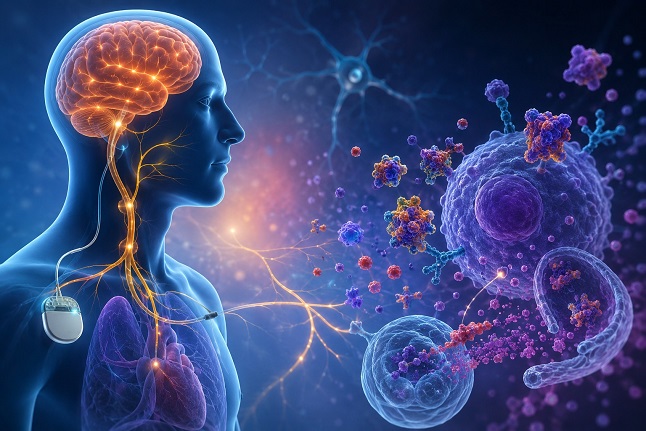 Scientists reveal how vagus nerve stimulation may prevent HMGB1 release, shutting down multiple inflammatory pathways
before they trigger chronic pain and disease
The research was conducted by scientists from the Institute for Bioelectronic Medicine at the Feinstein Institutes for Medical Research, Northwell Health, Manhasset, New York, USA, and the Department of Women's and Children's Health, Karolinska Institute and Karolinska University Hospital, Stockholm, Sweden.
A New Way of Looking at Inflammation
For many years, scientists have tried to develop drugs that neutralize HMGB1, or High Mobility Group Box 1 protein, because it is known to play a major role in inflammation, tissue damage, and chronic pain. However, despite impressive laboratory results, these therapies have not produced consistent success in patients.
The researchers now believe they know why. Instead of focusing on how much HMGB1 is present, they argue that the real issue is whether HMGB1 is actually able to interact with other inflammatory molecules and enter cells. According to their new model, HMGB1 acts like a transport vehicle, carrying dangerous inflammatory substances into cells where they can activate powerful immune responses.
Once HMGB1 is released from injured or stressed cells, it can bind to a wide variety of harmful molecules produced during infections or tissue damage. These include bacterial toxins, viral proteins, DNA, RNA, inflammatory proteins, and many other danger signals. HMGB1 then escorts these molecules into cells through a receptor called RAGE, allowing them to escape normal destruction and trigger even stronger inflammation.
This
Medical News report highlights an important shift in scientific thinking. Rather than viewing HMGB1 simply as another inflammatory protein, researchers now describe it as a molecular carrier that helps dangerous inflammatory cargo gain access to the inside of cells, where it can activate the inflammasome—a powerful cellular defense system responsible for producing inflammation and contributing to chronic pain.
How HMGB1 Fuels Disease
The study explains that HMGB1 is normally located inside the nucleus of almost every cell, where it helps organize DNA and regulate genes. During injury, infection, or severe stress, however, HMGB1 moves out of the nucleus and is released into surrounding tissues.
Outside the cell, HMGB1 becomes a potent alarm signal. It attaches itself to numero
us inflammatory molecules and delivers them into cells through RAGE-mediated endocytosis. Once inside, HMGB1 destabilizes lysosomes, allowing these dangerous molecules to escape into the cell's interior instead of being destroyed.
This escape activates inflammasomes and several inflammatory pathways that lead to tissue injury, excessive immune responses, and persistent pain. The researchers believe this process may contribute to diseases such as rheumatoid arthritis, sepsis, neuropathic pain, ischemia-reperfusion injury, autoimmune disorders, and even severe viral infections.
How Vagus Nerve Stimulation Stops HMGB1 Release
One of the most significant findings presented in the paper is how vagus nerve stimulation (VNS) can interrupt this entire process before it begins.
The vagus nerve is one of the body's major communication pathways between the brain and internal organs. When electrically stimulated, it activates what scientists call the cholinergic anti-inflammatory pathway, causing the release of the neurotransmitter acetylcholine.
Acetylcholine binds to specialized receptors known as alpha7 nicotinic acetylcholine receptors (α7nAChR) found on immune cells, nerve cells, microglia, and other inflammatory cells.
Activation of these receptors produces several protective effects. First, it activates a protein called SIRT1 that removes acetyl groups from HMGB1. This seemingly small chemical change is extremely important because HMGB1 must become hyperacetylated before it can leave the nucleus. By reversing this process, SIRT1 keeps HMGB1 trapped safely inside the cell nucleus, preventing it from being released into surrounding tissues.
Second, vagus nerve stimulation appears to reduce the ability of cells to absorb HMGB1-containing inflammatory complexes through the RAGE receptor. Scientists believe this may occur by lowering RAGE activity, reducing its transport functions, or altering the cell's internal transport machinery, although these mechanisms are still being investigated.
Together, these actions dramatically reduce the amount of HMGB1 available to transport inflammatory cargo, effectively shutting down multiple inflammatory pathways before they can become established. Instead of blocking only one inflammatory molecule, vagus nerve stimulation may prevent the activation of numerous inflammatory cascades simultaneously.
Potential Benefits Beyond Inflammation
The researchers also highlight the importance of HMGB1 in chronic pain. Pain-sensing nerve cells, known as nociceptors, actively release HMGB1 after injury. This protein then amplifies communication between the nervous and immune systems, making pain signals stronger and more persistent. By preventing HMGB1 release from both immune cells and nerve cells, vagus nerve stimulation could potentially reduce inflammation and chronic pain at the same time.
Since vagus nerve stimulation is already approved for conditions including epilepsy, depression, and rheumatoid arthritis, the technology provides an established platform for investigating whether controlling HMGB1 accessibility can benefit many other inflammatory disorders.
Conclusions
The researchers believe their new model changes the way scientists should think about HMGB1. Instead of measuring only how much of the protein is present, future therapies should focus on preventing HMGB1 from leaving cells, forming inflammatory complexes, and delivering harmful molecules into the cell interior. Vagus nerve stimulation appears uniquely positioned to accomplish this by activating the body's own anti-inflammatory reflex. If confirmed in future clinical studies, this bioelectronic strategy could represent a major advance in treating chronic inflammatory diseases and persistent pain by stopping inflammation before it fully develops rather than attempting to suppress it after irreversible damage has already begun.
The study findings were published in the peer reviewed journal: Bioelectronic Medicine.
https://link.springer.com/article/10.1186/s42234-026-00209-9
For the latest on prevention and treating inflammation, keep on logging to Thailand
Medical News.
Read Also:
https://www.thailandmedical.news/news/iris-tectorum-extract-found-to-suppress-inflammation
https://www.thailandmedical.news/news/grape-powder-may-help-calm-gut-inflammation-in-crohn-s-disease
https://www.thailandmedical.news/news/common-plant-compound-rutin-found-to-calm-brain-inflammation-and-protect-nerve-cells




 Share
Share
 Tweet
Tweet
 Share
Share

































