Silico Studies Show That Phytochemicals from Ashwagandha Show Potential Against COVID-19 Virus Protein ORF9b
Nikhil Prasad Fact checked by:Thailand Medical News Team Feb 24, 2026 7 months, 1 week, 2 days, 13 hours, 31 minutes ago
Medical News: The scientific search for new strategies to combat COVID-19 continues to evolve, with researchers increasingly turning toward natural compounds that may offer therapeutic promise. One such focus is Withania somnifera, widely known as Ashwagandha, a plant long used in traditional medicine systems for its reputed immune-supporting and anti-inflammatory benefits. In a recent computational study, researchers investigated whether phytochemicals derived from Ashwagandha could interact with a specific protein of the SARS-CoV-2 virus called ORF9b, which plays an important role in helping the virus evade the human immune system.
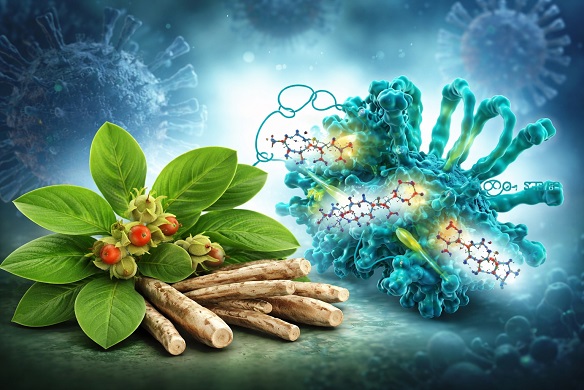 Computer-based simulations reveal that key Ashwagandha phytochemicals may strongly bind to the
SARS-CoV-2 ORF9b protein, highlighting new possibilities for antiviral research
This
Medical News report presents the study in clear and simple language so that readers without a scientific or medical background can understand what the researchers discovered, why it matters, and what the findings could mean for future antiviral research.
Researchers and Institutions Involved
The research was carried out by scientists from the Department of Life Sciences and the Department of Physics at the Parul Institute of Applied Sciences, Parul University, located in Vadodara, Gujarat, India. The interdisciplinary nature of the team allowed them to combine expertise in biology, molecular modeling, and computational analysis to explore how natural plant compounds may interact with viral proteins.
Why ORF9b Is an Important Target
While public attention has largely focused on the coronavirus spike protein, the virus actually produces several other proteins that help it survive and spread inside the human body. One of these is ORF9b, a small accessory protein that helps the virus weaken the body’s natural antiviral defenses.
ORF9b interferes with immune signaling pathways that normally trigger protective responses against viral infections. By dampening these defenses, the virus gains an advantage, allowing it to replicate more effectively. Because of this role, scientists consider ORF9b a promising target for new antiviral therapies. Blocking or interfering with this protein could potentially reduce the virus’s ability to suppress immune responses.
Why Scientists Studied Ashwagandha
Ashwagandha has been used for centuries in traditional medicine and has attracted growing scientific interest due to its bioactive compounds known as withanolides and other phytochemicals. Previous studies explored its potential activity against different viral targets, but research specifically focusing on ORF9b has been limited.
The researchers aimed to bridge this gap by analyzing whether compounds found in Ashwagandha could bind to ORF9b and potentially disrupt its function. Instead of conducting laboratory experiments at this stage, they relied on computational techniques that allow scientists to simulate m
olecular interactions in great detail.
How the Study Was Conducted
The research used molecular docking and molecular dynamics simulations, two powerful computer-based methods widely used in early drug discovery.
First, the team selected 21 phytochemicals derived from Ashwagandha. These compounds were tested virtually to see how well they could fit into the binding region of the ORF9b protein. The strength of interaction was measured using binding affinity scores. In simple terms, stronger binding suggests that a compound may be more capable of influencing the protein’s behavior.
The researchers also examined other important factors such as molecular size, hydrogen bonding, polarity, and hydrophobic interactions. These characteristics help determine whether a compound could eventually be developed into a drug.
Key Findings from the Study
Among all the compounds analyzed, three stood out as the most promising: Ashwagandhanolide, Withanolide D, and Sitoindoside IX.
Ashwagandhanolide demonstrated the strongest binding ability, suggesting a highly stable interaction with ORF9b. Withanolide D and Sitoindoside IX also showed strong and consistent binding patterns. These compounds formed multiple hydrogen bonds and hydrophobic contacts with amino acids inside the protein’s active region, which helped stabilize the interaction.
Such molecular interactions are significant because they indicate that the compounds may have the potential to interfere with ORF9b’s biological activity, at least in theory.
Stability and Molecular Behavior
To further evaluate these interactions, the researchers conducted molecular dynamics simulations. These simulations mimic real biological conditions by observing how molecules move and behave over time.
The results suggested that the top-performing compounds remained stable while bound to ORF9b. Importantly, the protein maintained its structural integrity, meaning that the compounds interacted in a way that appeared natural and energetically favorable rather than disruptive. Stable binding is considered an important indicator when identifying potential drug candidates.
Insights into How the Molecules Work
The study revealed that compounds with higher polarity and more hydrogen bond donors generally exhibited stronger interactions with ORF9b. Hydrophobic regions within the protein also played a key role by helping anchor the molecules in place.
However, some of the strongest compounds were relatively large molecules. While larger molecules may create stronger interactions due to multiple contact points, they can also face challenges related to absorption and movement within the human body. This balance between binding strength and drug-like properties is one of the major considerations in future development.
What These Findings Mean for the Future
Although the results are promising, it is important to emphasize that this study was entirely computational. The findings do not prove that Ashwagandha or its compounds can treat or prevent COVID-19. Instead, the study serves as an early screening step that helps identify which compounds deserve further investigation in laboratory settings.
The next stages would involve laboratory experiments to confirm whether these compounds truly block ORF9b activity in living cells, followed by animal studies and eventually clinical trials if results remain positive. Many compounds that look promising in computer simulations do not always succeed in real-world testing, which is why further validation is essential.
Broader Scientific Significance
This research highlights how modern science is increasingly blending traditional medicinal knowledge with advanced computational tools. By using computer simulations, researchers can rapidly narrow down large numbers of natural compounds and focus on those with the highest potential.
The study also demonstrates that viral proteins beyond the spike protein may represent valuable targets for future antiviral strategies. Exploring multiple targets could help scientists develop therapies that remain effective even as viruses evolve.
Conclusion
The study provides encouraging early evidence that phytochemicals derived from Ashwagandha may strongly interact with the SARS-CoV-2 ORF9b protein, a key component involved in immune evasion. Compounds such as Ashwagandhanolide, Withanolide D, and Sitoindoside IX showed particularly strong and stable interactions in computational models, suggesting they may be worth further scientific investigation. While these findings remain preliminary and require extensive laboratory confirmation, they offer an important step toward understanding how natural plant compounds might contribute to future antiviral research and therapeutic development against COVID-19 and similar viral infections.
The study findings were published in the peer reviewed journal: Current Research in Structural Biology.
https://www.sciencedirect.com/science/article/pii/S2665928X26000061
For the latest on Herbs and Phytochemicals, keep on logging to Thailand
Medical News.
Read Also:
https://www.thailandmedical.news/articles/coronavirus
https://www.thailandmedical.news/articles/herbs-and-phytochemicals




 Share
Share
 Tweet
Tweet
 Share
Share