Nikhil Prasad Fact checked by:Thailand Medical News Team May 11, 2026 3 months, 3 weeks, 1 day, 16 hours, 20 minutes ago
Medical News: A naturally occurring protein extracted from red algae may offer new hope in the fight against the dangerous Hantaan virus (a type of Hantavirus mostly found in South Korea and China), according to a new study by researchers from Northwest University in Xi’an, Airforce Medical University in Xi’an, Guiyang Maternal and Child Health Care Hospital, Fudan University in Shanghai, Xi’an International Medical Center Hospital, Tangdu Hospital, and Yan’an University in China.
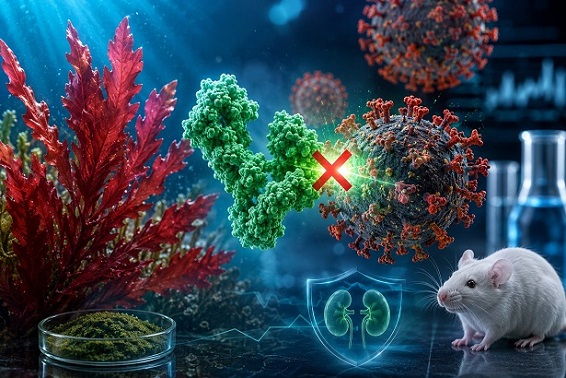 Scientists discover that a red algae protein can strongly block deadly hantavirus infections in laboratory
and animal studies
The Hantaan virus is one of the major causes of hemorrhagic fever with renal syndrome (HFRS), a severe disease that can trigger internal bleeding, high fever, kidney failure, and even death. The virus is mainly spread through exposure to infected rodent droppings and urine and remains a major public health issue across parts of Asia, especially China.
Scientists involved in the new research discovered that a compound called griffithsin, originally isolated from marine algae, was able to strongly block the virus from infecting cells in laboratory experiments and even protected infected mice from dying.
A Natural Antiviral from the Sea
Griffithsin is a lectin, a type of protein known for attaching itself to sugar molecules found on the outer surface of many viruses. Earlier studies had already shown that griffithsin could work against HIV, coronaviruses, hepatitis viruses, and Japanese encephalitis virus. In this new study, researchers tested whether it could also stop Hantaan virus infections.
The researchers found that griffithsin attached itself to sugar-coated structures on the virus surface, essentially preventing the virus from entering healthy cells. Laboratory tests using kidney and lung cells showed that the compound dramatically reduced viral infection rates without harming the cells themselves.
Importantly, the researchers confirmed that griffithsin worked against both artificial viral models and the authentic Hantaan virus. Viral protein levels and viral genetic material dropped significantly when treated with the algae-derived compound.
How the Compound Stops Infection
The Hantaan virus relies on special surface proteins covered with sugar molecules called N-linked glycans. These sugar molecules help the virus attach to and invade human cells.
Researchers discovered that griffithsin targets these sugar molecules directly. When scientists flooded the experiments with mannose, a type of sugar, the antiviral effects weakened considerably. This proved that griffithsin’s virus-blocking ability depends heavily on its interaction with these sugar-coated viral structures.
The study also revealed that certain glycan sites on the virus were especially important. When researchers genetically altered three key sugar attachment sites on the virus, griffithsin almost completely lost its ability to stop infection. This finding suggests the antiviral compound works by physically blocking critical areas the virus needs to infect cells.
r />
This Medical News report highlights that the antiviral action appears broad and difficult for the virus to escape through simple mutation, making griffithsin especially attractive as a future treatment candidate.
Strong Results in Animal Testing
One of the most striking parts of the study came from animal experiments involving newborn mice infected with lethal doses of Hantaan virus. Untreated mice all died within days. However, mice given higher doses of griffithsin showed an impressive 80 percent survival rate. Even lower doses delayed death and reduced disease severity.
Researchers said these findings demonstrate that griffithsin is not only effective in cell cultures but can also work inside living organisms.
Potential Against Multiple Hantaviruses
The study went even further by testing griffithsin against several other dangerous hantaviruses, including Seoul virus, Puumala virus, Dobrava-Belgrade virus, Andes virus, and Sin Nombre virus.
Remarkably, griffithsin inhibited all of them in a dose-dependent manner. This suggests the algae protein may eventually become a broad-spectrum anti-hantavirus treatment capable of targeting both Asian and American hantavirus strains.
Currently, there are no widely approved antiviral drugs specifically designed for Hantaan virus infections. Existing treatment mainly focuses on supportive hospital care after symptoms appear.
Conclusion
The findings from this study suggest that griffithsin could become a powerful future weapon against hantavirus infections. Its ability to block multiple hantaviruses, combined with its low toxicity and natural origin, makes it a particularly exciting antiviral candidate. Researchers also noted that griffithsin can be produced relatively easily in large quantities, an important factor for future medical use. While more testing in larger animal models and eventually humans is still needed, the results provide strong early evidence that this algae-derived protein may someday help reduce deaths from severe hantavirus diseases worldwide.
The study findings were published in the peer reviewed journal: Frontiers in Cellular and Infection Microbiology.
https://www.frontiersin.org/journals/cellular-and-infection-microbiology/articles/10.3389/fcimb.2022.881083/full
For the latest on hantavirus, keep on logging to Thailand Medical News.
Read Also:
https://www.thailandmedical.news/articles/hantavirus-news




 Share
Share
 Tweet
Tweet
 Share
Share

































