Nikhil Prasad Fact checked by:Thailand Medical News Team Jun 23, 2026 3 months, 1 week, 3 days, 21 hours, 24 minutes ago
Medical News: A new study from Taiwan has uncovered troubling evidence that long COVID may be causing subtle but measurable damage to blood vessels in the brain, potentially helping explain why many people continue to suffer from brain fog and chronic headaches months after recovering from COVID-19. Researchers found that patients with persistent neurological symptoms showed signs of cerebral arteriopathy, a condition involving abnormalities and narrowing of brain arteries that may reduce blood flow to critical brain regions.
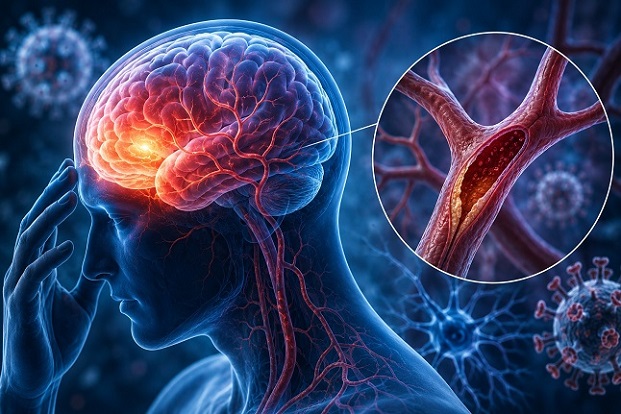 Researchers find that long COVID brain fog and headaches may be linked to hidden abnormalities in brain blood
vessels and reduced cerebral blood flow
The research was conducted by scientists from the Department of Neurology and the Department of Radiology at Taipei Veterans General Hospital, the College of Medicine and Institute of Biophotonics at National Yang Ming Chiao Tung University, the Department of Post-Baccalaureate Medicine at National Chung Hsing University, and the Department of Psychiatry at Taichung Veterans General Hospital, all in Taiwan.
Investigating the Lasting Effects of COVID-19
Although most people recover from COVID-19, many continue to experience symptoms long after the infection has cleared. Among the most common complaints are persistent headaches and “brain fog,” a term used to describe problems with memory, concentration, thinking, and communication.
To better understand what might be causing these symptoms, researchers recruited 108 adults who had previously been infected with COVID-19. Participants were divided into four groups: those with persistent headaches, those with brain fog, those with both conditions, and a control group that recovered without neurological symptoms.
Using advanced magnetic resonance angiography (MRA) scans, the researchers examined blood vessels throughout the brain and calculated the severity of arterial abnormalities using a specialized scoring system.
More Symptoms Meant More Blood Vessel Abnormalities
The results revealed a clear pattern. People suffering from both headaches and brain fog had the highest levels of arterial abnormalities. Those with either brain fog alone or headaches alone also showed significantly more vessel damage than symptom-free controls.
Patients with combined symptoms recorded the highest scores for abnormalities in both the front and back circulation of the brain. In contrast, control participants had very low scores, suggesting that the vascular changes were strongly linked to long COVID symptoms.
Researchers also discovered that nearly three-quarters of all participants with persistent neurological symptoms showed dominant involvement of arteries supplying the front regions of the brain.
Brain Fog Appears Closely Connected to Reduced Brain Blood Flow
One of the most important findings was the relationship between brain fog and cerebral blood vessel changes.
Individuals with brain fog were far more likely to show abnormalities in arteries supplying the brain's fr
ontal regions. These areas are responsible for attention, planning, decision-making, memory, and higher cognitive functions.
Interestingly, the severity of brain fog increased as abnormalities in the brain's posterior circulation became more pronounced. Patients reporting more severe cognitive difficulties also tended to have higher scores indicating vascular damage in these regions.
This
Medical News report highlights growing evidence that long COVID brain fog may not simply be a psychological complaint but could be linked to measurable biological changes affecting blood flow to multiple brain networks.
Researchers believe that reduced blood supply, known as hypoperfusion, may impair normal brain function and contribute to the cognitive problems experienced by many long COVID sufferers.
Headaches May Involve Different Mechanisms
The findings for headaches were more complex. While patients with persistent headaches also showed evidence of cerebral arteriopathy, headache frequency was not directly related to the severity of blood vessel abnormalities. This suggests that changes in brain arteries alone cannot fully explain post-COVID headaches.
The researchers noted that inflammation and activation of pain pathways involving the trigeminal nerve system may play a much larger role. Previous studies have also linked post-COVID headaches to elevated levels of calcitonin gene-related peptide (CGRP), a molecule known to drive migraine attacks.
As a result, some long COVID headaches may resemble migraines even though their underlying causes differ from traditional vascular disorders.
Important Implications for Long COVID Care
The study suggests that people experiencing persistent brain fog or headaches for more than three months after COVID-19 may benefit from brain imaging to identify potential cerebrovascular complications. Researchers observed signs of possible vessel spasms and arterial narrowing in a substantial number of affected patients.
These findings add to growing concerns that COVID-19 can leave behind long-lasting effects on the vascular system, even after the acute infection has resolved.
Conclusion
The study provides compelling evidence that long COVID can be associated with significant abnormalities in the brain's blood vessels. Brain fog appears particularly linked to disrupted circulation in areas responsible for cognition and memory, while headaches may arise through a combination of vascular and inflammatory mechanisms. The findings strengthen the argument that long COVID is a genuine biological condition with measurable effects on the brain and highlight the need for further research into diagnostic imaging, treatment strategies, and long-term neurological monitoring for affected patients.
The study findings were published in the peer reviewed journal: European Archives of Psychiatry and Clinical Neuroscience.
https://link.springer.com/article/10.1007/s00406-026-02276-0
For the latest on Long COVID, keep on logging to Thailand
Medical News.
Read Also:
https://www.thailandmedical.news/articles/long-covid
https://www.thailandmedical.news/articles/coronavirus




 Share
Share
 Tweet
Tweet
 Share
Share

































