Nikhil Prasad Fact checked by:Thailand Medical News Team Aug 11, 2026 1 month, 3 weeks, 3 days, 1 hour, 10 minutes ago
A major multinational study has raised new concerns about the possible long-term effects of COVID-19, finding that people with existing thyroid disorders who had COVID-19 were more likely to later be diagnosed with thyroid cancer than comparable patients without a recorded SARS-CoV-2 infection.
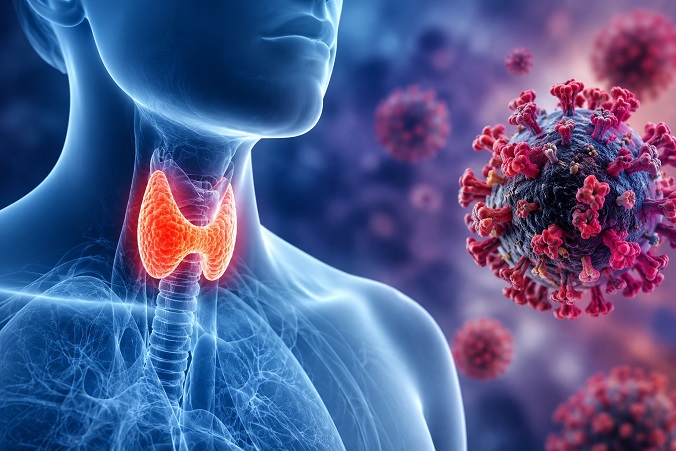 A large multinational study found a higher long-term rate of thyroid cancer diagnosis following COVID-19 among people with existing thyroid disorders.
Researchers Examined More Than 1.2 Million Matched Patients
A large multinational study found a higher long-term rate of thyroid cancer diagnosis following COVID-19 among people with existing thyroid disorders.
Researchers Examined More Than 1.2 Million Matched Patients
The research was conducted by Ming Yew from the Department of Anesthesiology, Chi Mei Medical Center, Tainan, Taiwan; Wei-Ting Wang from the Department of Anesthesiology, E-Da Hospital, I-Shou University, Kaohsiung, Taiwan; and Ping-Hsun Feng from the Department of Anesthesiology, Chi Mei Hospital, Liouying, Tainan, Taiwan.
Using the TriNetX Global Collaborative Network, which contains de-identified electronic medical records from 179 healthcare organizations across multiple countries, the researchers studied adults with pre-existing thyroid disorders.
After extensive statistical matching, the final analysis included 603,364 people with documented COVID-19 and 603,364 matched controls without recorded SARS-CoV-2 infection.
Thyroid Cancer Risk Was 61 Percent Higher
The most striking finding was that thyroid cancer was diagnosed in 1,371 people in the COVID-19 group compared with 1,055 controls. This represented 0.23 percent versus 0.18 percent.
When researchers considered both the occurrence and timing of cancer diagnoses, COVID-19 was associated with a 61 percent higher hazard of developing thyroid cancer.
The researchers deliberately excluded cancers diagnosed during the first two years after the starting point. This was important because people recovering from COVID-19 might undergo more medical examinations, potentially leading doctors to accidentally discover small thyroid cancers that were already present.
As explained in this
Thailand Medical News report, the increased risk remained when the investigators repeatedly changed their analytical approach. Sensitivity analyses produced hazard ratios ranging from 1.70 to 1.95, strengthening evidence that the main finding was not simply an isolated statistical result.
Signal Seen Across Different Patient Groups
The association appeared in both sexes and different age groups. It was also found among patients who already had hypothyroidism, hyperthyroidism or goiter.
Patients with hypothyroidism had a hazard ratio of 1.66, those with hyperthyroidism had a ratio of 1.97, while those with goiter had a ratio of 1.63.
Researchers also examined a separate group of adults with type 2 diabetes who had no previous thyroid disease. COVID-19 was again associated with increased thyroid cancer risk, with a hazard ratio of 1.78.
Could COVI
D-19 Affect Existing Abnormal Cells?
The researchers discussed several possible biological explanations. Thyroid cells contain ACE2, a protein involved in SARS-CoV-2 infection, and viral RNA has previously been detected in thyroid tissue. Inflammation, oxidative stress, disturbed immune responses and disruption of tumor-suppressing pathways could theoretically create conditions favorable to cancer progression.
However, the investigators consider it unlikely that COVID-19 could cause an entirely new differentiated thyroid cancer to develop and become detectable within the study's relatively short follow-up period. One possibility is that infection could accelerate the growth or recognition of previously undetected thyroid abnormalities. This remains speculative.
Findings Do Not Mean Everyone Needs Screening
The researchers specifically warn against people requesting thyroid ultrasounds, biopsies or cancer screening simply because they previously had COVID-19. Excessive screening can detect tiny thyroid cancers that might never have caused illness during a person's lifetime.
The study also lacked information about tumor size, cancer subtype, stage and how each cancer was discovered. Undocumented COVID-19 infections and differences in medical surveillance could also have affected the results.
Conclusions
The findings provide a substantial epidemiological signal that COVID-19 may be associated with a delayed increase in thyroid cancer diagnoses, particularly among people already living with thyroid disorders. However, they do not establish that SARS-CoV-2 directly causes thyroid cancer. Further long-term studies are needed to determine whether infection contributes biologically to tumor progression or whether some of the increased diagnoses result from healthcare and surveillance differences. For now, patients should continue established thyroid follow-up rather than undergo additional cancer screening solely because they had COVID-19.
The study findings were published in the peer reviewed journal: Frontiers in Endocrinology.
https://www.frontiersin.org/journals/endocrinology/articles/10.3389/fendo.2026.1926365/full
Read Also:
https://www.thailandmedical.news/articles/long-covid
https://www.thailandmedical.news/articles/coronavirus 



 Share
Share
 Tweet
Tweet
 Share
Share

































