Nikhil Prasad Fact checked by:Thailand Medical News Team Feb 27, 2026 6 months, 3 days, 15 hours, 14 minutes ago
Medical News: A groundbreaking new study has uncovered how COVID-19 may activate biological processes in the brain that resemble accelerated aging, potentially explaining why many patients struggle with memory loss, poor concentration, and lingering “brain fog” long after recovery.
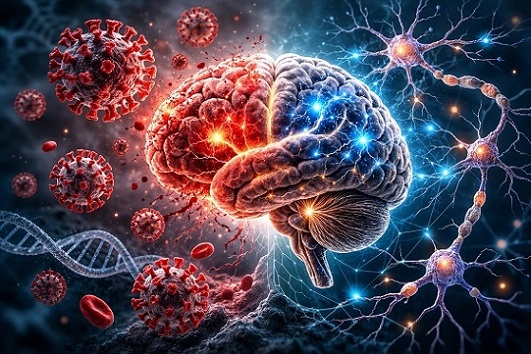 New research reveals that COVID-19 activates aging-related gene pathways in the brain, potentially
explaining persistent memory loss and brain fog
Researchers from the Department of Emergency Medicine at Renji Hospital, Shanghai Jiao Tong University School of Medicine; the Department of Respiratory and Critical Care Medicine at Shanghai Punan Hospital; the Department of Obstetrics and Gynecology at Daping Hospital, Army Medical University; and the Department of Respiratory and Critical Care Medicine at Shanghai Jiaotong University School of Medicine Renji Hospital have identified specific gene networks that link SARS-CoV-2 infection to age-related cognitive impairment.
Brain Changes That Mirror Aging
Since early in the pandemic, many recovering patients have reported persistent neurological symptoms. To investigate the cause, scientists analyzed gene activity in the frontal lobe, the brain region responsible for reasoning, memory, attention, and decision-making.
Using publicly available brain tissue datasets, the team compared 22 COVID-19 samples with 23 healthy controls. They discovered 527 genes that behaved differently in infected individuals. Among them, 441 genes were unusually overactive, while 86 were suppressed.
The overactive genes were largely involved in immune and inflammatory pathways, including interferon signaling and cytokine responses. Meanwhile, the suppressed genes were associated with neurons, synapses, and communication between brain cells. Because synapses are essential for learning and memory, their disruption may directly contribute to cognitive decline.
Five Aging-Related Genes Stand Out
To pinpoint the most critical drivers, researchers applied advanced machine learning tools and cross-referenced aging-related gene databases. This process narrowed the field to five key genes: SST, S100A9, SOCS3, FKBP5, and HBB.
SST normally helps regulate brain signaling and reduce inflammation. Lower levels may impair synaptic balance.
S100A9 was elevated and is known to promote inflammation, potentially worsening immune-driven damage in brain tissue.
SOCS3 and FKBP5 regulate immune and stress signaling pathways, suggesting that COVID-19 may overstimulate inflammatory stress responses in the brain.
HBB, typically associated with oxygen transport in blood, may reflect oxygen stress or microvascular injury within brain tissue.
These five genes demonstrated strong diagnostic power, distinguishing COVID-19 brain samples from healthy ones with accuracy rates of 96 percent in one dataset and 87 percent in another.
Immune Overactivation in the Brain
The researchers also examined immune cell patterns in brain samples. They found that 16 types of immune cells showed
significant changes in COVID-19 cases. This indicates an intense immune presence within the brain, which can disrupt neural circuits and accelerate processes similar to natural aging.
Chronic inflammation is already known to contribute to age-related cognitive decline. The findings suggest that COVID-19 may trigger a comparable inflammatory cascade, potentially speeding up brain aging in vulnerable individuals.
Importantly, this
Medical News report underscores that the molecular signatures seen in COVID-19 brains overlap with established aging-related pathways, strengthening the theory that post-COVID brain fog may be rooted in accelerated biological aging mechanisms.
Potential Treatment Leads
The team also explored therapeutic possibilities and identified seven compounds that interact with the key genes: Fulvestrant, Bucladesine, S-Adenosylmethionine, Valproic Acid, Folic Acid, Kaempferol, and Quercetin. Some of these compounds have known anti-inflammatory or neuroprotective properties, although clinical trials are still needed.
Conclusion
The study provides compelling molecular evidence that COVID-19 may activate immune and stress pathways that closely resemble those seen in brain aging. Reduced synaptic function combined with heightened inflammation creates conditions that can impair memory, attention, and cognitive flexibility.
Although the research was based on genetic datasets and involved a limited sample size, it offers one of the clearest biological explanations to date for post-COVID cognitive symptoms. The identification of five aging-related genes as potential biomarkers opens new avenues for early detection and targeted therapies. Larger studies and laboratory validation will be essential to confirm these findings and translate them into clinical treatments.
The study findings were published in the peer reviewed journal: Virus Research.
https://www.sciencedirect.com/science/article/pii/S0168170226000249
For the latest COVID-19 News, keep on logging to Thailand
Medical News.
Read Also:
https://www.thailandmedical.news/articles/coronavirus
https://www.thailandmedical.news/articles/long-covid




 Share
Share
 Tweet
Tweet
 Share
Share

































