Nikhil Prasad Fact checked by:Thailand Medical News Team Feb 14, 2026 7 months, 2 weeks, 3 days, 19 hours, 1 minute ago
Medical News: A team of Japanese scientists has discovered that a little-known rare sugar compound may significantly extend lifespan—at least in fruit flies—raising hopes that it could one day support healthier aging in humans. The compound, called 4-galactosylkojibiose (4-GK), was found to prolong life without disrupting normal sleep or daily activity, according to new research from Nagoya City University and Meiji Co., Ltd., Japan.
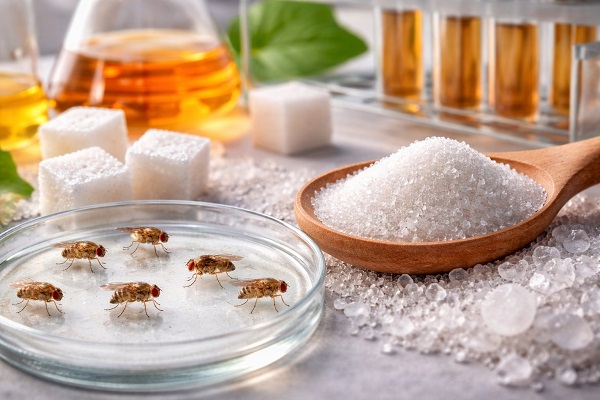 Rare sugar compound 4-GK extends lifespan in fruit fly aging experiments
A New Kind of Prebiotic Sugar
Rare sugar compound 4-GK extends lifespan in fruit fly aging experiments
A New Kind of Prebiotic Sugar
Oligosaccharides such as fructooligosaccharides (FOS) are widely used as prebiotics because they support beneficial gut bacteria and reduce inflammation. However, advances in food science have enabled the development of newer, more specialized sugars derived from rare carbohydrates. One of these is 4-GK, a trisaccharide composed of galactose linked to kojibiose, itself considered a rare sugar.
The research team from the Department of Neuropharmacology at the Graduate School of Pharmaceutical Sciences, Nagoya City University, together with scientists from the R&D Division of Meiji Co., Ltd., and Wellness Science Labs, Meiji Holdings Co., Ltd., set out to determine whether 4-GK could influence lifespan and sleep in Drosophila melanogaster, commonly known as the fruit fly. Fruit flies are frequently used in aging studies because their short lifespan allows scientists to observe biological changes quickly.
Clear Lifespan Extension Observed
Male flies fed diets supplemented with 4-GK showed significantly longer median lifespans compared to those fed sucrose alone. In some experiments, lifespan increased from about 19 days in control flies to as much as 25 days in flies receiving 4-GK.
Even at a lower concentration of 1 percent, 4-GK extended lifespan. By comparison, FOS required higher concentrations to achieve statistically significant benefits. When total sugar content was carefully controlled, flies receiving 4-GK still lived longer than those given equivalent amounts of sucrose.
This
Medical News report highlights that the lifespan extension was consistently confirmed across multiple experimental setups, including individually housed flies and larger group studies.
What Is Happening Inside the Cells
To understand why the flies lived longer, researchers performed RNA sequencing on fly head tissues after three weeks of feeding. They found increased activity in genes associated with longevity, particularly those encoding heat shock proteins.
Heat shock proteins act as protective molecules inside cells. They help repair damaged proteins and improve stress resistance. In the 4-GK group, several heat shock protein genes were upregulated more than two-fold compared to controls. Interestingly, genes linked to insulin signaling and sirtuins—well-known longevity pathways—were not significantly activated.
This suggests that 4-GK may extend lifespan primarily by enhancing stres
s response systems rather than altering metabolic hormone pathways.
No Major Impact on Sleep or Activity
Because sleep and lifespan are often biologically linked, researchers also examined whether 4-GK changed sleep patterns. Under normal dietary conditions, neither 4-GK nor FOS altered overall sleep duration or activity levels in young or aging flies.
However, when 4-GK replaced sucrose entirely as the sole carbohydrate source, nighttime sleep decreased. Scientists believe this may be related to reduced sweetness or altered energy availability, though further studies are needed.
What This Means for Future Research
The findings suggest that 4-GK may offer health-promoting properties comparable to, or possibly stronger than, conventional prebiotics like FOS. Its effectiveness at lower doses could potentially reduce gastrointestinal side effects often associated with higher oligosaccharide intake.
Importantly, the study was conducted only in male fruit flies, and the gut microbiome was not directly analyzed. Researchers caution that further investigations in mammals are required before any conclusions can be drawn for human health.
Conclusion
In summary, 4-GK significantly extended lifespan in fruit flies without disrupting normal sleep or activity. The effect appears linked to activation of cellular stress-protection genes, particularly heat shock proteins. While promising, these findings remain preliminary and require confirmation in more complex biological systems. Nevertheless, this rare sugar compound opens an intriguing new avenue in the search for dietary interventions that may support healthy aging.
The study findings were published in the peer reviewed journal: Nutrients.
https://www.mdpi.com/2072-6643/18/4/604
For the latest on anti-aging protocols or discoveries, keep on logging to Thailand
Medical News.
Read Also:
https://www.thailandmedical.news/articles/anti-aging




 Share
Share
 Tweet
Tweet
 Share
Share

































