Spike Protein Fragments Not Intact Spike May Be the Real Driver of Dangerous COVID-19 Blood Clots
Nikhil Prasad Fact checked by:Thailand Medical News Team Jun 17, 2026 3 months, 2 weeks, 3 days, 5 hours, 36 minutes ago
Medical News: As scientists continue to investigate why some COVID-19 patients develop dangerous blood clots, a new scientific letter is offering an important explanation that could help resolve years of conflicting research. The new findings suggest that the intact SARS-CoV-2 spike protein may not be responsible for abnormal clotting behavior. Instead, it may be smaller spike protein fragments that form harmful amyloid structures after being broken down inside the body.
Researchers Per Hammarström and Sofie Nyström from Linköping University and the Science for Life Laboratory in Sweden have proposed a new hypothesis that could unify several seemingly contradictory studies on COVID-19-related blood clotting disorders.
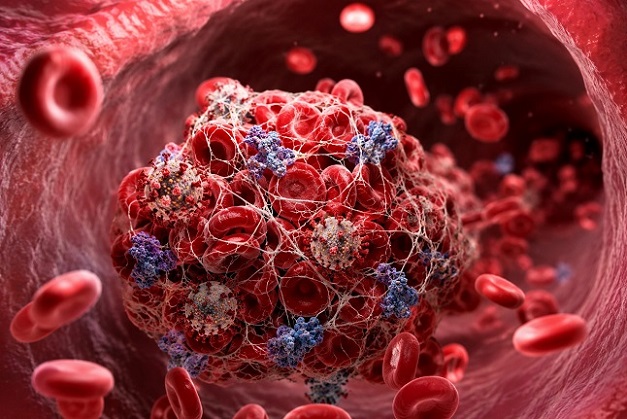 Swedish researchers suggest that misfolded spike protein fragments, rather than intact spike proteins, may be
responsible for dangerous COVID-related blood clot abnormalities
Conflicting Studies Spark New Investigation
Blood clotting abnormalities have been one of the most concerning complications associated with COVID-19 since the beginning of the pandemic. Scientists have long debated whether the SARS-CoV-2 spike protein directly alters fibrinogen, a blood protein that plays a crucial role in clot formation.
Recently, researchers Kangro and colleagues reported that the full-length native trimeric spike protein can bind to fibrinogen but does not significantly affect clot formation, clot structure, or the body's ability to break down clots. Their findings challenged earlier studies that suggested spike protein could trigger abnormal clotting behavior.
Seeking to explain these differences, the Swedish researchers carefully examined previous evidence and proposed that the answer may lie in the form of the spike protein being studied.
Why Intact Spike Protein May Be Harmless
According to the researchers, the naturally folded and intact spike protein appears to be relatively inactive when it comes to influencing fibrinogen and blood clot formation.
However, the situation changes dramatically after the spike protein undergoes proteolytic processing inside the body. During this process, enzymes cut the spike protein into smaller fragments.
The researchers point out that histological studies have found spike protein and spike fragments inside blood clots from COVID-19 patients. Earlier investigations also showed that the S1 portion of the spike protein could alter fibrin structure and promote the formation of abnormal amyloid-like clots.
Amyloid Fragments May Be the Real Culprit
One of the most important findings highlighted by the Swedish team involves the formation of amyloid fibrils. Amyloids are misfolded protein structures that can accumulate and disrupt normal biological processes.
Previous work by the same researchers demonstrated that when spike protein is broken down by neutrophil elastase, an enzyme released during inflammation, the resulting spike fragments can form amyloid fibrils. In contrast, the intact folded spike protein does not readil
y form these structures.
Further studies revealed that these spike-derived amyloid fibrils can interfere with both fibrin formation and fibrinolysis, the natural process that dissolves blood clots. This suggests that abnormal clotting may arise not from the native spike protein itself but from misfolded fragments generated after enzymatic cleavage.
This
Medical News report highlights how the new hypothesis may help explain why some studies observed harmful clotting effects while others found little or no impact from spike protein exposure.
A New Unified Explanation
The researchers propose that pathological changes in fibrinogen are not an intrinsic property of the native spike protein. Instead, harmful effects emerge only after spike fragments are generated and subsequently assemble into amyloid fibrils.
In this abnormal state, the spike-derived structures may alter clot architecture, reduce clot breakdown, and contribute to the thrombotic complications observed in some COVID-19 patients.
Conclusion
The new hypothesis offers a compelling framework for understanding the relationship between SARS-CoV-2 and abnormal blood clotting. Rather than viewing all spike proteins as equally harmful, the research suggests that the biological context is crucial. Intact spike protein appears largely inert with respect to fibrinogen, while proteolytically generated spike fragments that form amyloid fibrils may possess the ability to disrupt normal clotting processes. Future studies investigating COVID-19-associated thrombosis may need to focus more closely on these fragmented and misfolded forms of spike protein, which could ultimately become important therapeutic targets for preventing severe clotting complications.
The hypothesis was published as a letter in the peer reviewed journal: Blood Advances.
https://www.sciencedirect.com/science/article/pii/S2473952926004386
For the latest COVID-19 news, keep on logging to Thailand
Medical News.
Read Also:
https://www.thailandmedical.news/articles/coronavirus
https://www.thailandmedical.news/articles/long-covid




 Share
Share
 Tweet
Tweet
 Share
Share

































