Nikhil Prasad Fact checked by:Thailand Medical News Team Jun 05, 2026 3 months, 4 weeks, 1 day, 6 hours, 58 minutes ago
Medical News: For years, scientists believed that chronic abdominal pain in conditions such as irritable bowel syndrome (IBS) and inflammatory bowel diseases was driven mainly by irritated nerves, inflammation, or changes in the brain–gut connection. Now, a new scientific review suggests that an overlooked group of cells lining the intestine may play a much larger role than previously thought. These specialized gut cells appear capable of sensing what is happening inside the digestive tract and deciding whether signals are amplified into pain or suppressed before they even reach the nervous system.
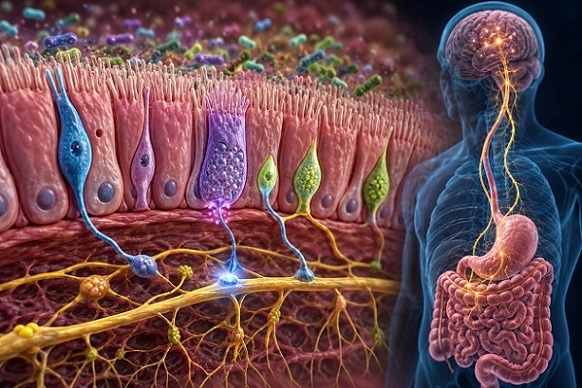 Scientists discover that specialized gut lining cells can either amplify or suppress pain signals before they
reach the nervous system
The Gut Is More Than a Digestive Organ
Researchers from the Department of Neurosurgery, Collegium Medicum in Bydgoszcz, Nicolaus Copernicus University in Toruń, Poland, and the Department of Animal Biotechnology and Genetics, Faculty of Animal Breeding and Biology, Bydgoszcz University of Science and Technology, Poland, examined growing evidence showing that the intestinal lining acts like a sophisticated sensory network.
Traditionally, the gut lining was viewed as a simple barrier that absorbed nutrients and kept harmful substances out of the body. However, recent discoveries reveal that some intestinal cells behave almost like miniature sensory organs, constantly monitoring food, microbes, chemicals, stress signals, and physical stretching inside the digestive tract.
Special “Neuropod” Cells Communicate Like Nerve Cells
One of the most surprising discoveries involves so-called neuropod cells. These rare intestinal cells possess long extensions resembling nerve fibers and can communicate directly with neurons.
Studies reviewed by the researchers showed that neuropod cells can rapidly send information to nerves connected to the brain. They do this using neurotransmitters such as glutamate, the same chemical messenger widely used by neurons throughout the nervous system.
Remarkably, these cells can even distinguish between different types of sugars. They are able to tell the difference between real nutritive sugar and artificial sweeteners and relay this information to the brain using different signaling pathways. This demonstrates that the gut possesses a highly sophisticated sensory coding system previously thought to exist only in specialized nervous tissues.
Enterochromaffin Cells Act as Pain Amplifiers
Another key player identified in the review is the enterochromaffin cell. These cells produce most of the body's serotonin, a chemical commonly associated with mood but also heavily involved in gut function.
Scientists now know that enterochromaffin cells are highly sensitive detectors capable of responding to irritating chemicals, bacterial byproducts, stress hormones, and even physical pressure within the intestines. When activated, they release serotonin that stimulates nearby sensory nerves. Research highlighted in the review demonstrated that activation of these cells can increase nerve sensitivity and
contribute to visceral hypersensitivity, a condition in which normal digestive processes become painful.
In experimental models, activation of enterochromaffin cells triggered stronger pain-related responses and heightened sensitivity to intestinal stretching. Even more concerning, repeated activation produced long-lasting effects that persisted after the original stimulation had stopped.
The Gut's Built-In Pain Suppression System
While some intestinal cells appear capable of increasing pain signals, the review also uncovered evidence for a natural pain-control system within the gut.
Researchers identified a rare population of specialized cells rich in a receptor known as GUCY2C. These cells resemble neuropod cells and appear to function as natural brakes on pain signaling.
Activation of GUCY2C pathways reduced the excitability of sensory neurons that normally carry pain messages to the spinal cord. Importantly, these effects were observed even before pain signals reached the central nervous system. Experiments showed that when these protective cells were disrupted, animals became more sensitive to intestinal stimulation and developed stronger pain-related responses. The findings suggest that certain gut cells actively work to prevent harmless digestive sensations from being interpreted as pain.
A New Understanding of Chronic Abdominal Pain
This
Medical News report highlights a major shift in how scientists view gastrointestinal pain. Rather than acting merely as a passive barrier, the intestinal lining appears to function as an active sensory control center.
The review proposes that the gut epithelium serves as a biological filter that can either amplify, reshape, or suppress information before it enters pain-processing pathways. This means that chronic abdominal pain may sometimes originate much earlier in the signaling chain than previously believed.
Conclusions
The findings presented in this review suggest that chronic abdominal pain is not solely a problem of overactive nerves or abnormal brain processing. Instead, specialized sensory cells within the gut lining may play a crucial role in determining which signals become painful and which are ignored. Neuropod cells and enterochromaffin cells appear capable of rapidly communicating with nerve pathways, while GUCY2C-enriched cells may act as natural pain suppressors.
Understanding how these neuroepithelial circuits function could open entirely new avenues for treating IBS, inflammatory bowel disorders, and other conditions characterized by persistent abdominal pain. Future research will need to determine how these discoveries translate to humans and whether targeting these unique gut sensory cells can provide safer and more effective pain therapies.
The study findings were published in the peer reviewed International Journal of Molecular Sciences.
https://www.mdpi.com/1422-0067/27/11/5109
For the latest on the discovery of the neuropod cells in the gut, keep on logging to Thailand
Medical News.
Read Also:
https://www.thailandmedical.news/articles/gastroenterology




 Share
Share
 Tweet
Tweet
 Share
Share

































