Nikhil Prasad Fact checked by:Thailand Medical News Team Mar 29, 2026 5 months, 4 days, 14 hours, 22 minutes ago
Medical News: A new scientific investigation has uncovered how the human pineal gland—an often overlooked but vital part of the brain—gradually loses its structure and efficiency with age. The findings shed light on why sleep patterns, hormone balance, and even brain health can subtly decline over time.
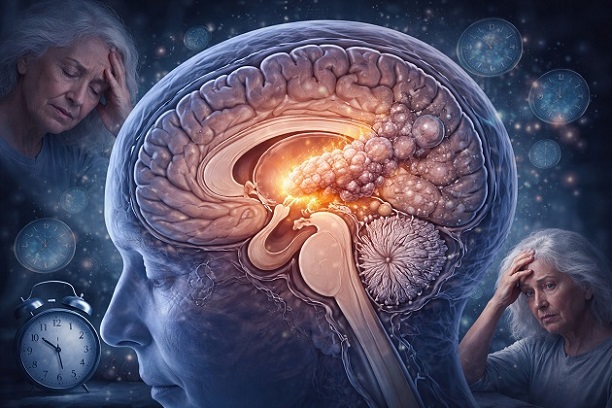 Aging weakens the pineal gland’s structure, reducing melatonin and potentially impacting sleep and brain health
What the Pineal Gland Really Does
The pineal gland is a tiny organ deep in the brain responsible for producing melatonin, the hormone that regulates sleep-wake cycles. Beyond sleep, melatonin also acts as a powerful antioxidant, supports immune function, and may even help slow certain diseases. Because of this, any damage or decline in the pineal gland can have wide-reaching effects on overall health.
Study Details and Who Conducted It
Researchers from the Institute of Nanotechnology-CNR in Rome, Italy, and the Avtsyn Research Institute of Human Morphology at the Petrovsky National Research Centre of Surgery in Moscow, Russia conducted a detailed morphological study of 69 human pineal glands. These samples included individuals aged 27 to 91, both healthy and those with conditions such as Alzheimer’s disease, vascular dementia, schizophrenia, and alcoholism.
Two Distinct Aging Pathways Identified
The researchers discovered that the pineal gland does not simply “wear out” in one uniform way. Instead, it follows two main aging patterns.
The first pathway shows an increase in supportive brain cells known as astrocytes. These cells appear to step in as the gland weakens, possibly trying to maintain function. This may represent a compensatory response, where the brain attempts to preserve melatonin production despite aging damage.
The second pathway is more concerning. In this pattern, the internal structure of the gland—called its lobular organization—begins to break down. When this happens, the gland loses its ability to function efficiently, leading to reduced hormone output and impaired biological rhythms.
Structural Breakdown Is More Common with Age
The study revealed that while all structural types can appear at any age, disrupted gland architecture becomes significantly more common in older individuals. In fact, half of the healthy control group already showed disrupted structures, and this pattern increased in frequency with advancing age.
Interestingly, the density of astrocyte networks also changed. A “light” network—indicating weaker support—was most commonly seen in damaged glands, while dense networks were only found in structurally intact glands and mostly in elderly individuals. This suggests that once structural damage progresses too far, even supportive cells cannot compensate.
Disease Accelerates the Damage
Although aging was identified as the primary driver, certain diseases appeared to worsen the degeneration. In patients with Alzheimer’s d
isease and vascular dementia, the pineal gland structure was almost always disrupted. In vascular dementia cases, intact structures were not observed at all.
Similarly, individuals with alcoholism and schizophrenia showed altered patterns, though not as severe. Across all disease groups, the combination of a damaged structure and weak astrocyte support was the most frequent finding.
Hidden Changes Like Cysts
Another striking discovery was the presence of glial cysts—small fluid-filled spaces within the gland. These cysts were found in multiple groups and were most commonly associated with disrupted structures and weak astrocyte networks. While often harmless, larger cysts can reduce the number of functional cells, further lowering melatonin production.
Why This Matters
The gradual breakdown of the pineal gland helps explain why many people experience sleep disturbances, hormonal imbalance, and cognitive decline as they age. Reduced melatonin levels are already linked to poor sleep, increased oxidative stress, and higher risks of neurodegenerative diseases.
This
Medical News report highlights that while diseases can worsen the situation, the underlying process is largely a natural part of aging itself.
Conclusion
The study provides strong evidence that aging is the main force behind pineal gland degeneration, with disease acting as an accelerator rather than the root cause. The discovery of two distinct aging pathways offers valuable insight into how the brain attempts to cope with decline and when those efforts fail. Understanding these mechanisms could open the door to new therapies aimed at preserving melatonin production, improving sleep, and protecting brain health. While more research is needed, these findings emphasize that maintaining pineal gland function may be a key factor in healthy aging and long-term neurological well-being.
The study findings were published in the peer reviewed International Journal of Molecular Sciences.
https://www.mdpi.com/1422-0067/27/7/3093
For the latest on the health effects of aging, keep on logging to Thailand
Medical News.
Read Also:
https://www.thailandmedical.news/articles/anti-aging
https://www.thailandmedical.news/articles/health-news




 Share
Share
 Tweet
Tweet
 Share
Share

































