Long COVID Breathlessness Mystery Deepens as Obesity Emerges as Major Risk Factor
Nikhil Prasad Fact checked by:Thailand Medical News Team Jun 11, 2026 3 months, 3 weeks, 2 days, 7 hours, 21 minutes ago
Medical News: For millions of people living with Long COVID, one of the most frustrating symptoms is persistent shortness of breath. Many continue to struggle with breathing months or even years after recovering from the initial infection, yet doctors often find that traditional lung tests do not fully explain the severity of their symptoms. A new study from Spain is shedding light on this puzzling condition and suggests that factors beyond visible lung damage may be playing a major role.
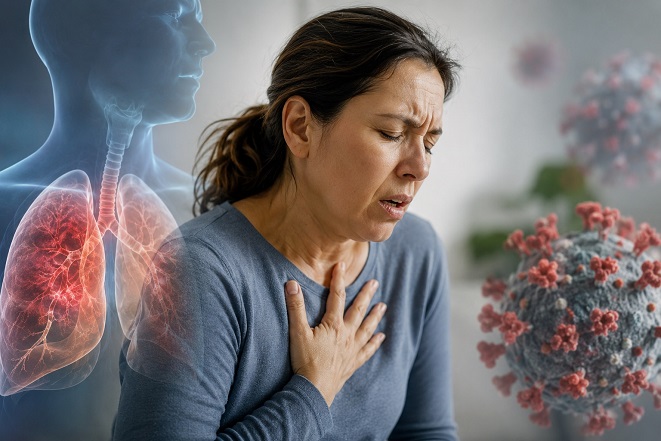 New research reveals that obesity and subtle lung function changes may play a bigger role in Long COVID
breathlessness than visible lung damage alone
Researchers found that while many Long COVID patients showed abnormalities on scans and exercise tests, only reduced lung gas-exchange capacity and obesity were consistently linked to more severe breathlessness. The findings challenge the assumption that lingering lung damage alone is responsible for ongoing respiratory symptoms.
Investigating Persistent Breathlessness After COVID-19
The study was conducted by researchers from the Hospital Universitario 12 de Octubre, Universidad Complutense de Madrid, Instituto de Investigación Hospital 12 de Octubre (i+12), and the Centro de Investigaciones Biomédicas en Red de Enfermedades Infecciosas (CIBERINFEC) in Madrid, Spain.
The research team followed 80 adults diagnosed with Long COVID between 2020 and 2023. The average age of participants was 60 years, and nearly 55 percent were women. Most of the patients had experienced severe COVID-19 during the acute phase, with almost all requiring hospitalization and nearly one-third suffering respiratory failure.
The researchers examined patients using chest imaging, pulmonary function testing, and six-minute walking tests at multiple time points over a year.
Abnormal Findings Were Common
The study revealed that lingering physical abnormalities were extremely common among participants.
Nearly 68 percent of patients showed persistent abnormalities on chest X-rays during follow-up. More than 61 percent demonstrated abnormal results during six-minute walking tests, indicating reduced exercise tolerance or oxygen desaturation during activity.
Many patients continued to experience symptoms long after infection. The most common accompanying symptoms were weakness, affecting nearly half of participants, and anxiety, reported by almost one-quarter.
Interestingly, even patients without a history of heart or lung disease frequently displayed abnormal imaging findings and exercise limitations.
Lung Function Tests Tell Only Part of the Story
One of the most important measurements in the study was DLCO, a test that evaluates how effectively oxygen moves from the lungs into the bloodstream.
Researchers found that about 20 percent of patients had reduced DLCO values. Those with lower DLCO scores were more likely to experience severe breathlessness.
However, the majority of patients with significant br
eathing complaints actually had normal DLCO results.
Furthermore, reduced DLCO did not strongly correlate with how far patients could walk or how much oxygen they lost during exercise. This surprising finding suggests that objective lung abnormalities do not fully explain why many Long COVID patients feel breathless.
This
Medical News report highlights an increasingly recognized feature of Long COVID: patients often report debilitating symptoms despite having relatively normal findings on standard medical tests.
Obesity Emerges as a Powerful Predictor
Perhaps the most striking discovery was the strong role of obesity. Half of the study participants were classified as obese. After adjusting for other factors, obesity emerged as the strongest independent predictor of severe breathlessness.
Patients with obesity were nearly eight times more likely to experience severe dyspnea compared to non-obese individuals.
Researchers believe obesity may worsen breathing by increasing the workload placed on the respiratory system, reducing lung expansion, altering diaphragm movement, and creating what scientists call "neuromechanical constraints" that make breathing feel more difficult even when oxygen levels remain adequate.
The findings suggest that body weight may significantly influence how Long COVID symptoms are experienced.
Why Are Patients Still Breathless?
The researchers propose that Long COVID breathlessness likely results from a combination of factors rather than a single cause.
Possible contributors include physical deconditioning after prolonged illness, dysfunction of the autonomic nervous system, persistent inflammation, altered breathing patterns, muscle weakness, anxiety, and psychological stress.
The study also found that subjective feelings of breathlessness often did not match objective test results. Some patients reported severe symptoms despite relatively normal lung function and exercise performance.
This mismatch supports the growing belief that Long COVID affects multiple body systems simultaneously.
Important Implications for Patient Care
The findings suggest that doctors should not rely solely on lung scans or pulmonary function tests when evaluating Long COVID patients.
A broader approach that includes physical rehabilitation, weight management, psychological support, cardiovascular assessment, and autonomic nervous system evaluation may be necessary to fully address persistent symptoms.
The researchers stress that Long COVID breathlessness is a complex condition requiring multidisciplinary care. Standard respiratory testing alone may overlook important contributors to symptom severity.
Conclusion
This study provides important new insights into one of the most common and disabling symptoms of Long COVID. While many patients continue to show lingering abnormalities on chest imaging and exercise testing, these findings alone do not adequately explain the severity of breathlessness experienced by sufferers. Reduced DLCO was associated with worse symptoms, but obesity emerged as an even stronger independent predictor. The results reinforce the idea that Long COVID is a multifaceted disorder involving far more than residual lung injury. Factors such as obesity, deconditioning, autonomic dysfunction, muscle weakness, and psychological influences likely interact to produce persistent symptoms. These findings underscore the urgent need for comprehensive and individualized treatment strategies for Long COVID patients struggling with ongoing breathlessness.
The study findings were published in the peer reviewed journal: COVID.
https://www.mdpi.com/2673-8112/6/6/102
For the latest on Long COVID, keep on logging to Thailand
Medical News.
Read Also:
https://www.thailandmedical.news/articles/long-covid




 Share
Share
 Tweet
Tweet
 Share
Share

































